 HISTORY
Who Is JJ? The History of JJOS
The early betas, the anonymous name, the Akai theories and twenty years of MPC history. Old threads and release notes, with the sources.
Comparisons and buying guides with every spec checked against the sources. If we could not verify a number, we say so.
Looking for instructions? Browse tutorials by topic, find manuals and downloads, or search all guides.
HISTORYThe early betas, the anonymous name, the Akai theories and twenty years of MPC history. Old threads and release notes, with the sources.
 REVIEW
8-core chip, 16GB of RAM, no battery. Checked against Akai's own manual, page by page, against a Live 3 and a used MPC X SE.
 VS
VS
Bigger screen, new pads, same battery question. What actually changed, what didn't, and who should keep the Live 2.
 GEAR
GEAR
Every pack here loads as .XPM programs, not loose WAV folders. Ranked by how fast you get to an actual beat.
 GUIDE
GUIDE
One anonymous developer, four current versions, and the third-party OS that made a $470 sampler run features Akai never shipped.
 TUTORIAL
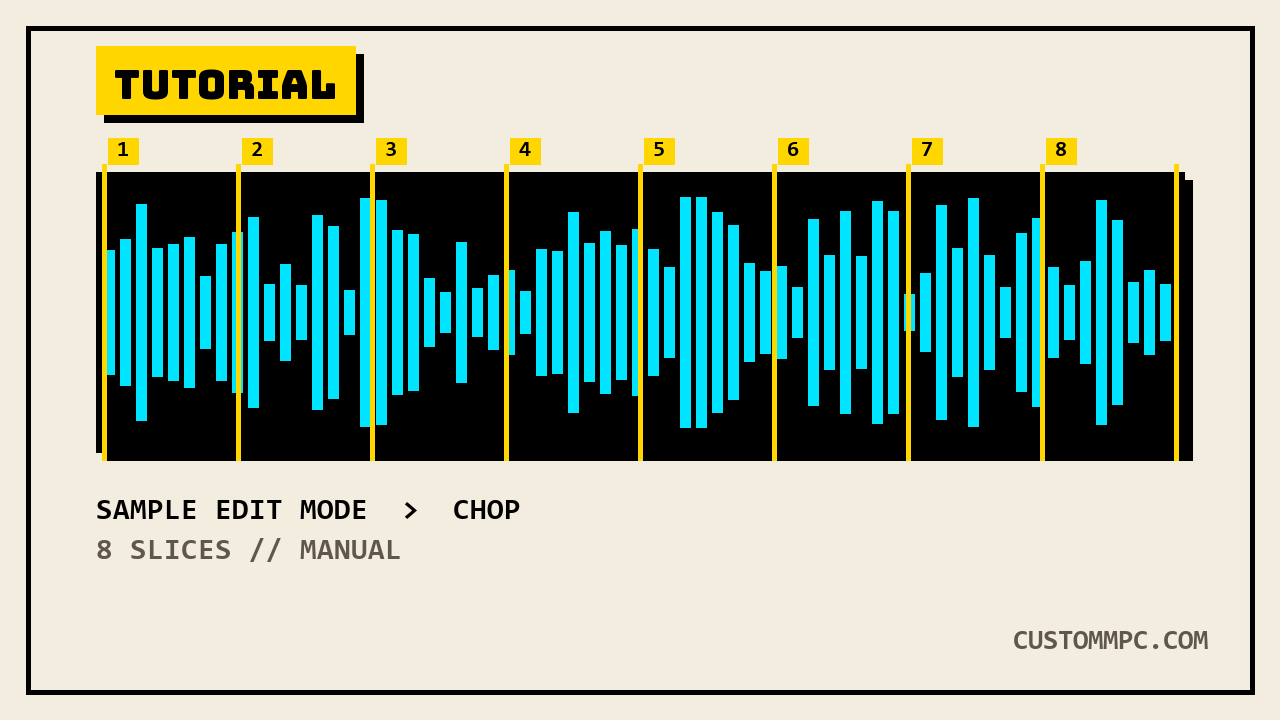
Manual, Threshold, Regions, BPM: every Chop Mode method, straight from the manual, plus how to convert slices to a real drum track.
 TUTORIAL
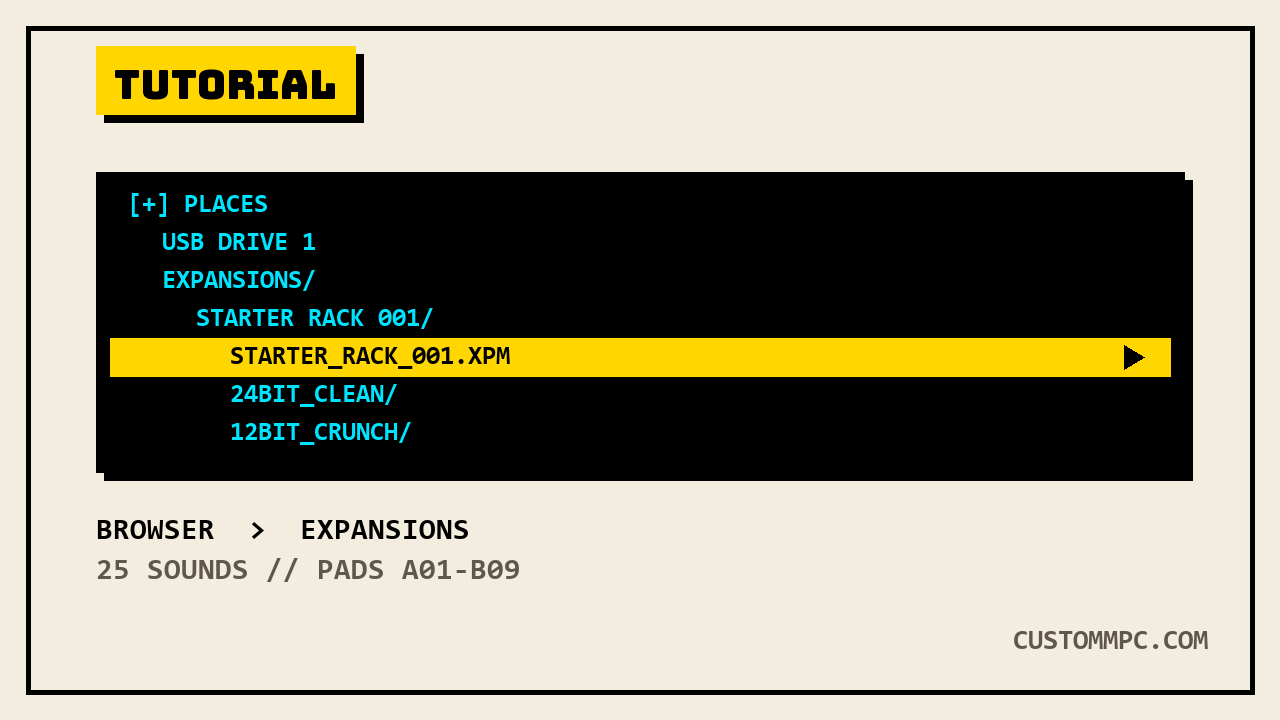
Zip file to loaded pads, step by step. Modern Live/One/X standalone plus the MPC1000/2500 workflow, walked through with our own free kit.
 TUTORIAL
Tempo and transport, not audio, not MIDI Time Code. Master, slave, the Ableton Live side, and the failure modes Akai's own manual admits to.
 TUTORIAL
Two features that only look related. Setup, the live-performance workflow, and where Akai's own manual disagrees with itself about what 16 Levels can do.
 TUTORIAL
Plug a synth into the inputs and get a mapped keygroup patch back. Every field in Akai's Auto Sampler window, the real hookup, and a typo the manual fixed between releases.
 GUIDE
GUIDE
A documented percentage since 1988, not a mystery. The MPC60's own manual against the current Timing Correct window, checked page by page.
 TUTORIAL
Up to 32 songs, 999 steps each, built from the screen or straight off the pads. Every field, both build methods, and how it connects to Next Sequence Mode.
 GUIDE
GUIDE
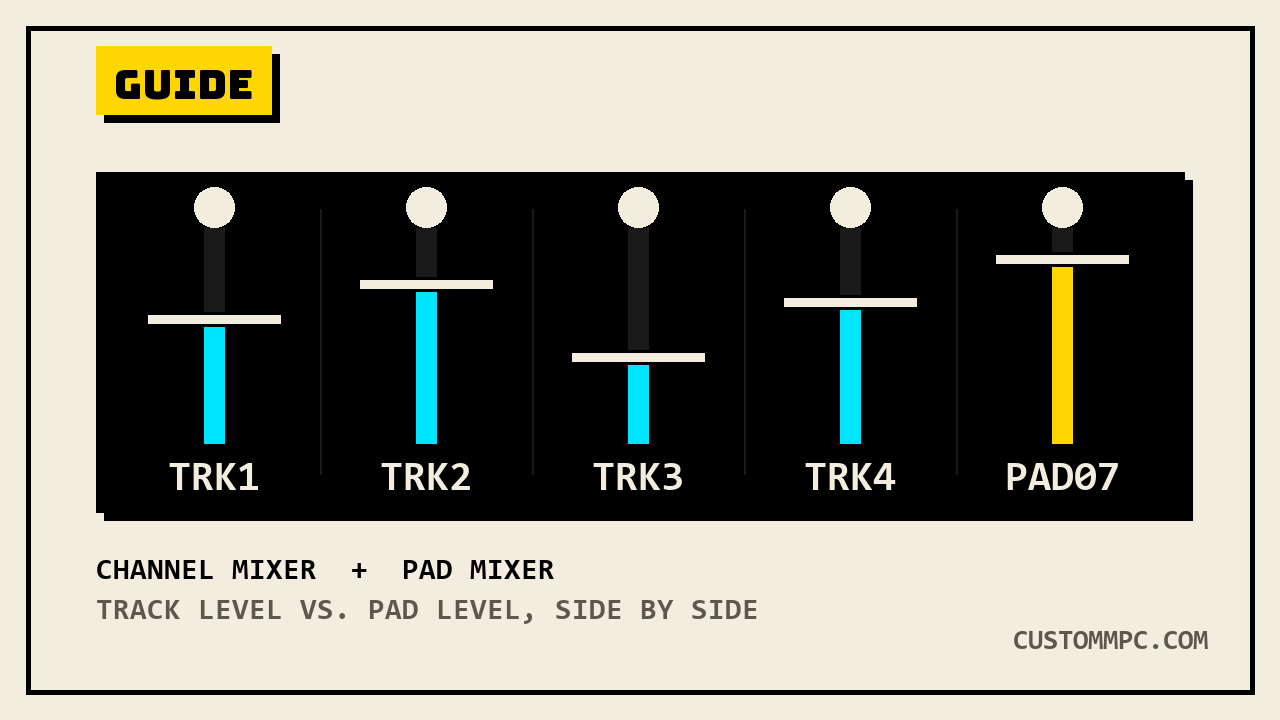
Track level vs. pad level, every tab, checked page by page. Plus the Sends knob that does nothing until you load a return effect first.
 GUIDE
GUIDE
One sample, every key. Creating one, every track setting, Legacy vs Advanced, up to 128 keygroups, and the new MPC Oscillators feature.
 BUYING GUIDE
Not the XL. Real specs from Akai's own manual, five concrete differences from the 2000XL, and what to check before you buy the original.
 BUYING GUIDE
Real specs straight from Akai's own manual, plus what to physically check on a used unit, screen, floppy, SCSI, battery, and pads, before you pay.
 GUIDE
GUIDE
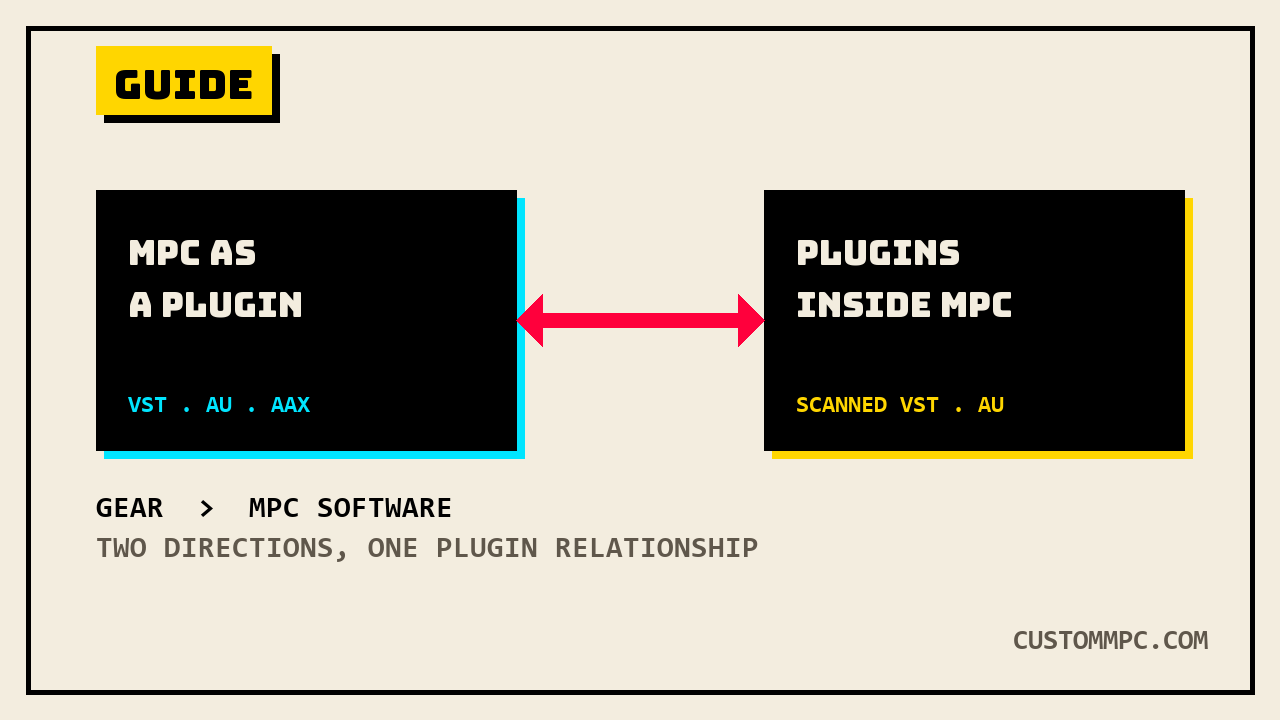
MPC as a VST/AU/AAX instrument in your host DAW, and third-party VST/AU plugins scanned inside MPC itself. Both directions, plus what standalone hardware genuinely cannot do.
 GUIDE
GUIDE
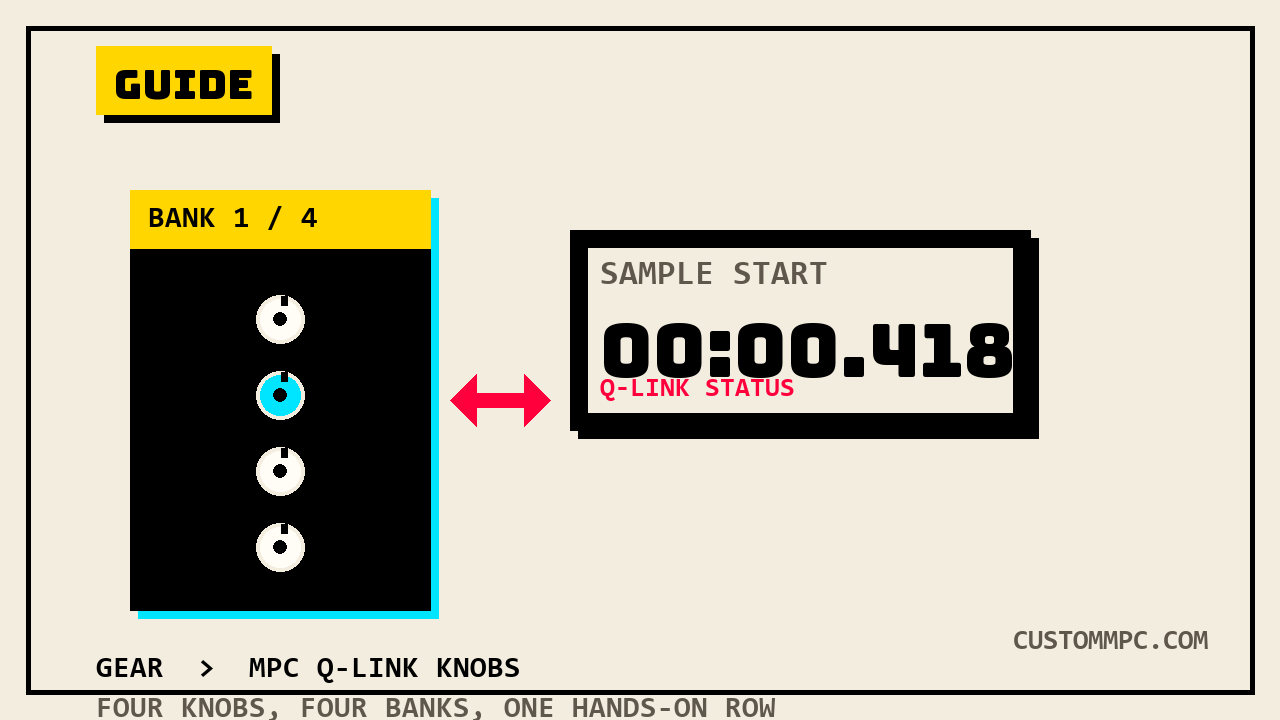
Four knobs, four banks (or columns, Akai's manual uses both), the Status pop-up, Q-Link Edit macros, and every practical use, checked page by page.
 GUIDE
GUIDE
Recording CC automation, the per-track CC filter, and mapping a Q-Link knob, Touch Strip, or pedal to a CC number that reaches a plugin. Checked page by page.
 BUYING GUIDE
Real specs straight from Akai's own manual, plus what to physically check on a used unit, CompactFlash slot, screen, pads, and RAM, before you pay.
 GUIDE
GUIDE
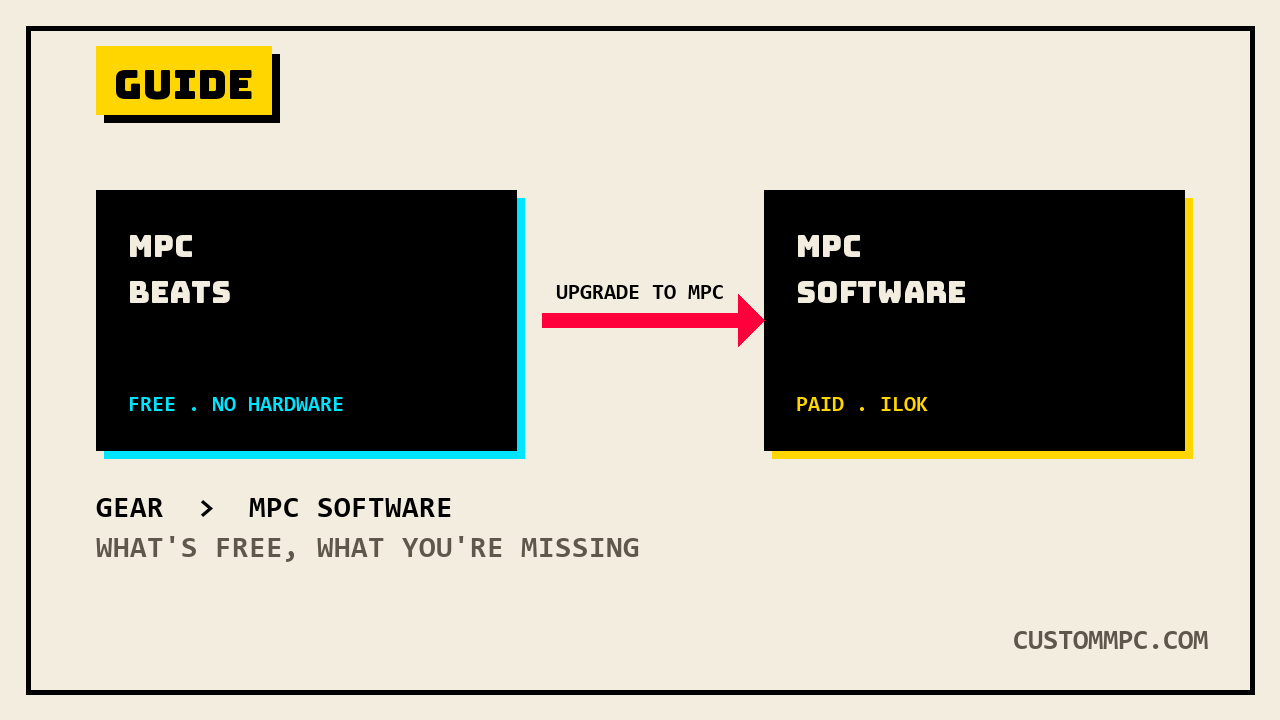
Free, and needs zero MPC hardware: exact track counts, the bundled AIR plugins, the two different setup flows, and the Help menu upgrade path, checked page by page.
 TUTORIAL
Off, In, Loop Start, and the Punch In/Out field that feeds them, plus how it ties into loop-and-replace recording. Checked page by page, with a real documentation gap flagged instead of guessed past.
 BUYING GUIDE
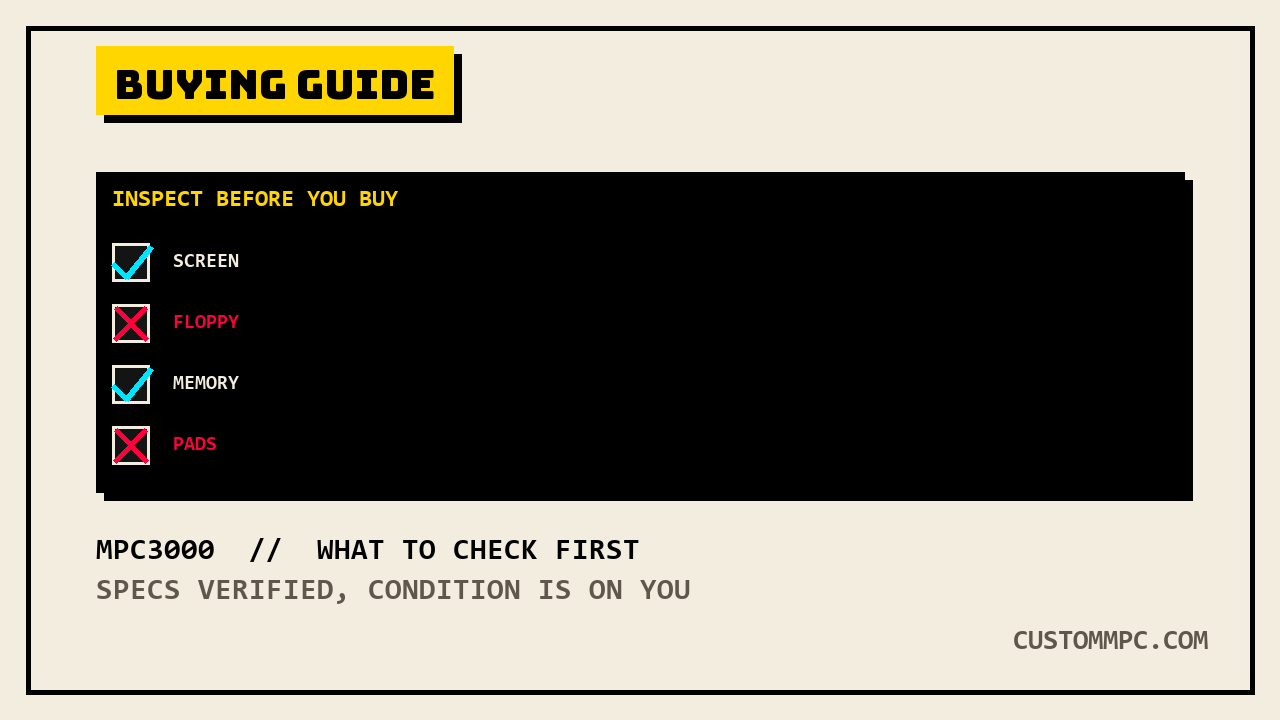
Real specs straight from Akai's own service manual, plus what to physically check on a used unit, screen, floppy, SCSI, memory configuration, and pads, before you pay collector-grade money.
 BUYING GUIDE
Real specs from Akai's own 1988 manual and service manual, the OS 2 vs 3.1 gap, why it has no factory SCSI, and what to physically check before you buy one used.
 GUIDE
GUIDE
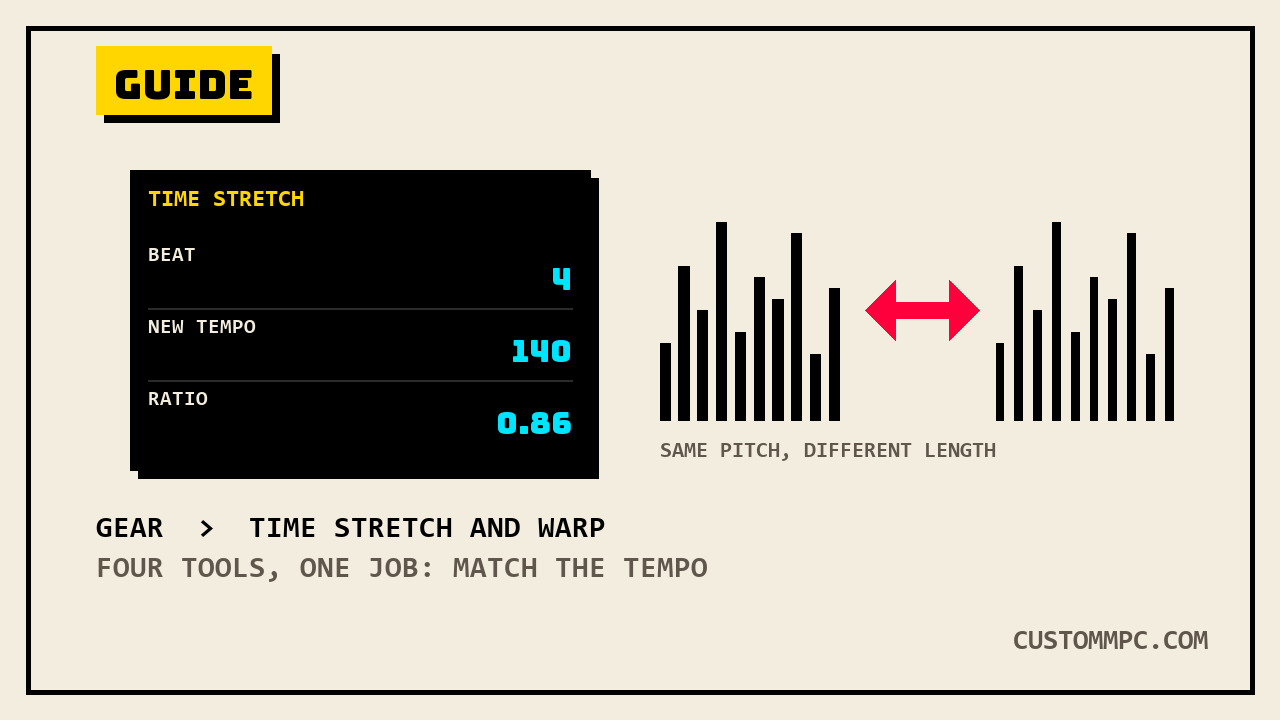
Destructive Time Stretch, real-time Warp on Audio/Drum/Keygroup tracks, Flatten Elastique, and the Pro Pack's Super Warp algorithm. Every field, checked page by page.
 GUIDE
GUIDE
Entering Step Sequencer mode, the config window fields, editing and paging through steps, velocity, nudge and flip, and how it changed since v3.7. Checked page by page.
 GUIDE
GUIDE
The Mute Group field on Drum and Keygroup tracks, the separate Mute Targets tool, and Pad Polyphony's Mono mode, compared field by field, plus why Pad Mute Mode's Pad Group is not the same feature.
 GUIDE
GUIDE
Preferences > Audio Device, the 44.1kHz/128-sample requirement, and the 32 Inputs/Outputs checkbox, kept clearly separate from MPC One G2/Key 37 G2's own 8/24 USB Audio Channel Out toggle. Checked page by page.
 GUIDE
GUIDE
Resample L, Resample R, Resample L+R: the Sampler and Looper's internal input source, the four Sampler recording methods, and the effect with a confusingly similar name. Checked page by page.
 BUYING GUIDE
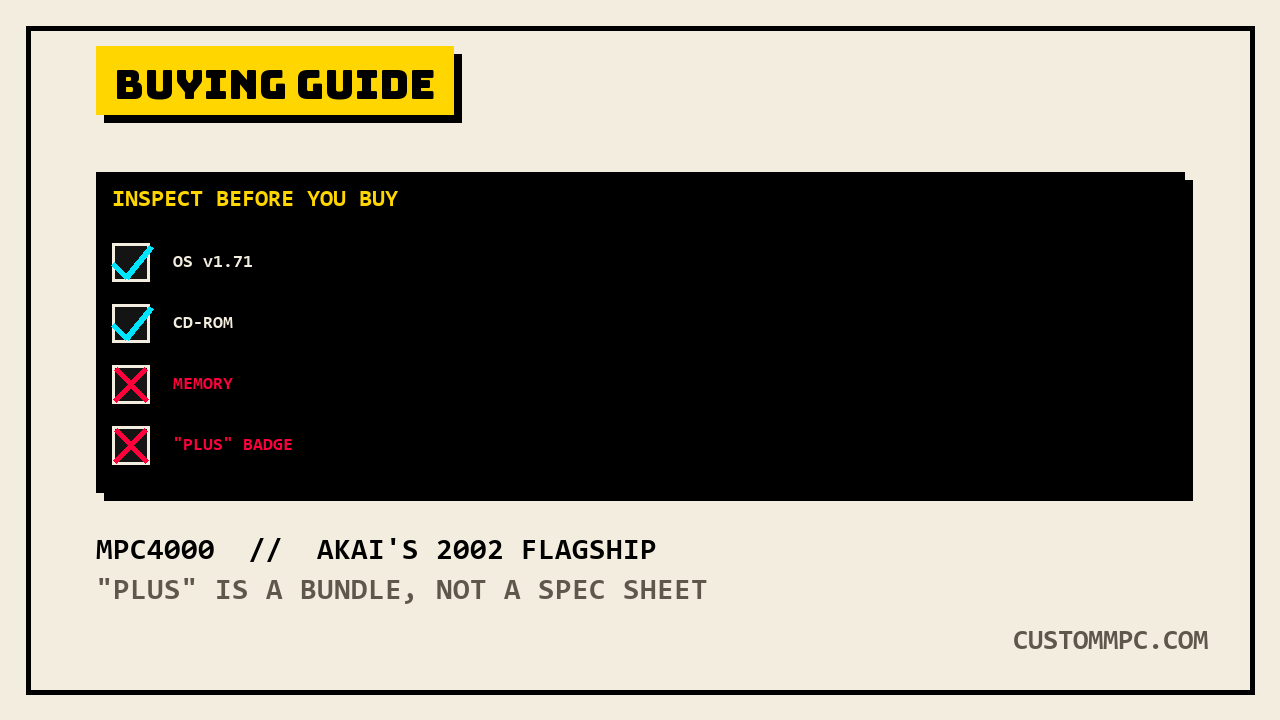
Real specs from Akai's own service manual, the "Plus" bundle confusion sorted out, the factory test mode most sellers don't know about, and what to check before you buy one used.
 GUIDE
GUIDE
Arp, Rhythm, and Pattern modes, the track-type restriction, Probability, and the MIDI modifiers that let a mod wheel bend the pattern live, checked page by page.
 GUIDE
GUIDE
The Pro Pack's Ableton-Force-style Clip Matrix, Navigate Mode, the Clip Editor, scenes, and the one workflow genuinely new since v3.7, checked page by page.
 GUIDE
GUIDE
Six Type options, twenty-one scales, per-Type chord lists, and the Custom note-map presets, checked page by page against Akai's own manual.
 BUYING GUIDE
Real specs from Akai's own manual, the internal hard disk and CD drive that are options the printed spec sheet never lists at all, and what to check before you buy one used.
 BUYING GUIDE
Real specs from Akai's own reference manual, the CD drive and RAM card that are options not standard equipment, the firmware version that gates Keygroup Programs entirely, and what to check before you buy one used.
 GUIDE
GUIDE
What Bassline, Electric, Hype, TubeSynth, DrumSynth, Mellotron, Solina, and the WayOutWare Odyssey actually do, straight from Akai's own manual, including a naming collision and a one-per-project limit worth knowing.
 BUYING GUIDE
One, One+, and One G2 are three different machines, not three storage tiers. Real specs from Akai's own manuals, the two power supplies that don't interchange, and what to check before you buy.
 GUIDE
GUIDE
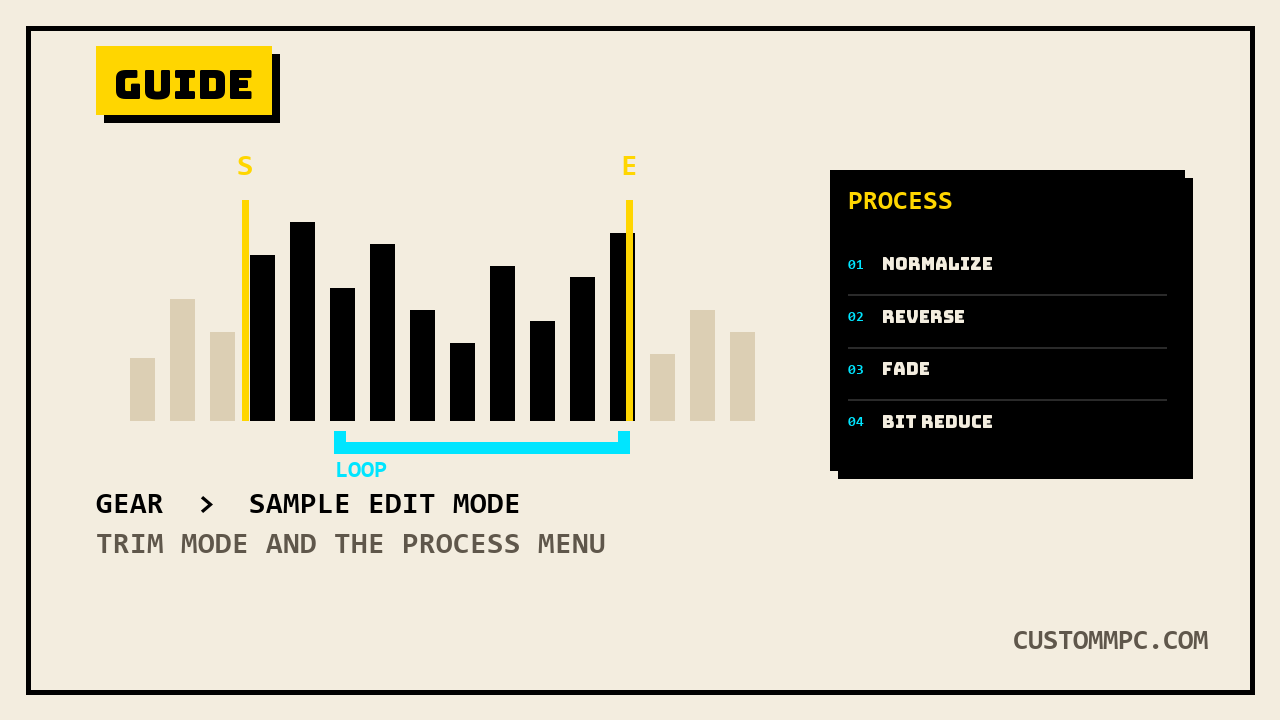
Trim Mode's Start/End/Loop fields, plus every Process menu function from Discard through the paid Stems separator, Normalize, Reverse, Fade, Pitch Shift, Bit Reduce, checked page by page.
 BUYING GUIDE
Real specs from Akai's own manual: 12 pads not 16, one Q-Link slider, no individual outs, and six AA batteries for real portable power. What to check before you buy Akai's smallest classic MPC.
 BUYING GUIDE
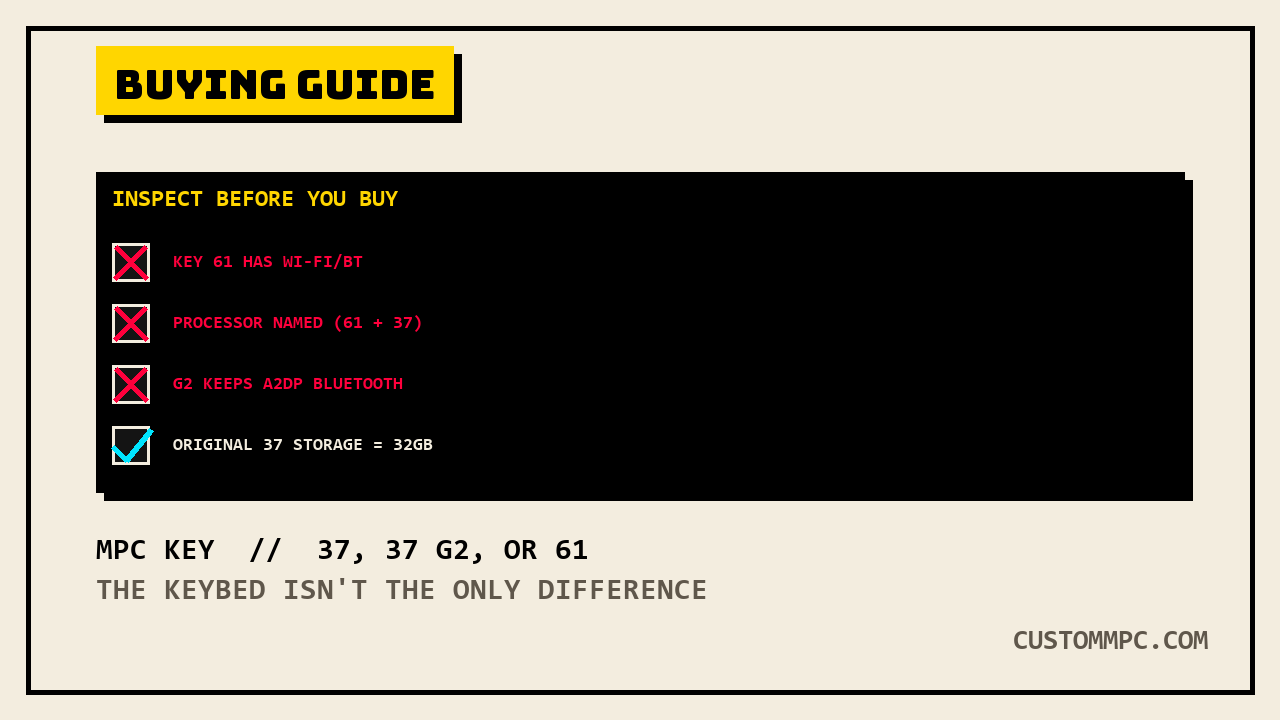
Key 37, Key 37 G2, and Key 61 are three different spec tables. Real specs from Akai's own manual: the flagship with no Wi-Fi, and the Bluetooth profile the G2 quietly drops.
 GUIDE
GUIDE
Touch the screen and bend two effect parameters with one finger, but it's really an insert effect eating one of your four slots. Location, Latch, and the Attack/Release/Wet-Dry knobs, checked against Akai's own manual.
 GUIDE
GUIDE
The CV track type, which MPC hardware actually has the physical jack (the original Live doesn't), the TS-vs-TRS split, and the Pro Pack's paid advanced editor. Checked against Akai's own manual.
 VS
VS
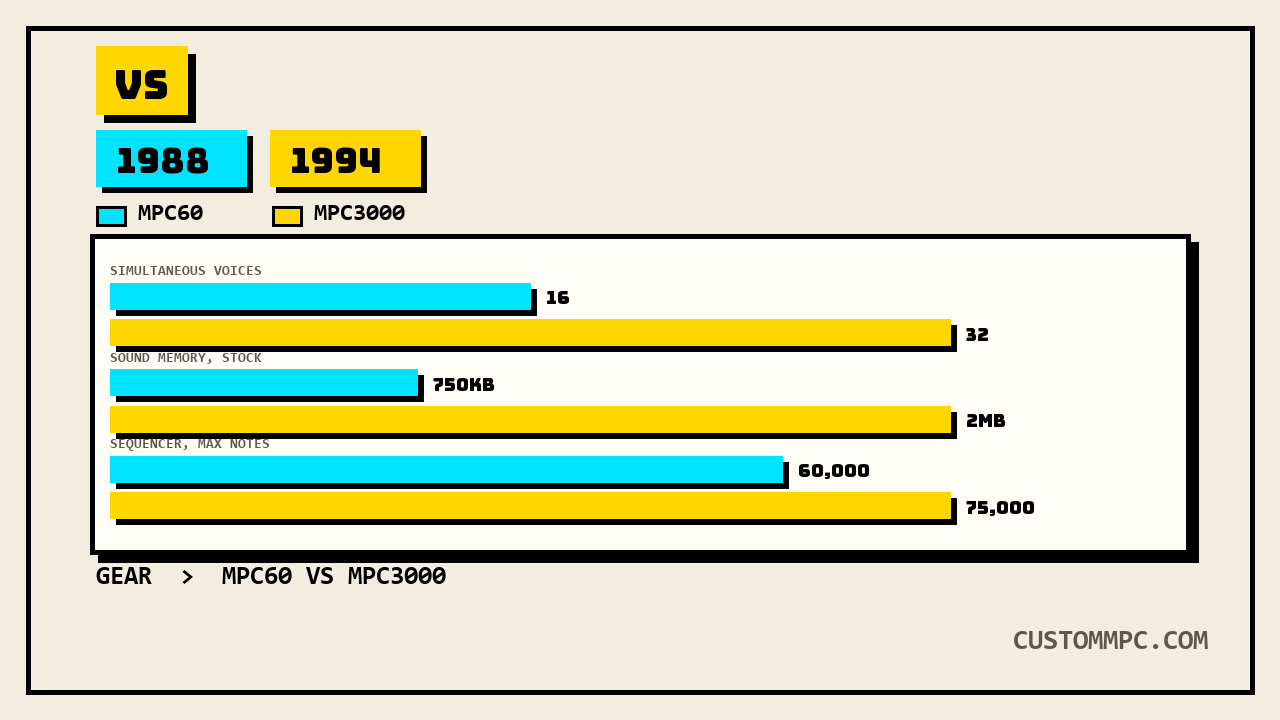
Voices doubled, sound memory nearly tripled, and one firmware update that closes half the gap. Every figure checked against Akai's own manuals.
 GUIDE
GUIDE
Two modulation layers hide behind one word: fixed Velocity and LFO sliders, and a flexible 32-point matrix. The real velocity-to-slice trick from Akai's own changelog.
 VS
VS
Same pad surface, completely different I/O panel. One's a full audio interface with a hardware Vintage Mode circuit, the other is MIDI only. Neither is standalone hardware.
 BUYING GUIDE
MPC X and MPC X Special Edition share one spec table in Akai's own manual, not two. Real specs on the richest I/O in the current lineup and the 6GB storage gotcha.
 GUIDE
GUIDE
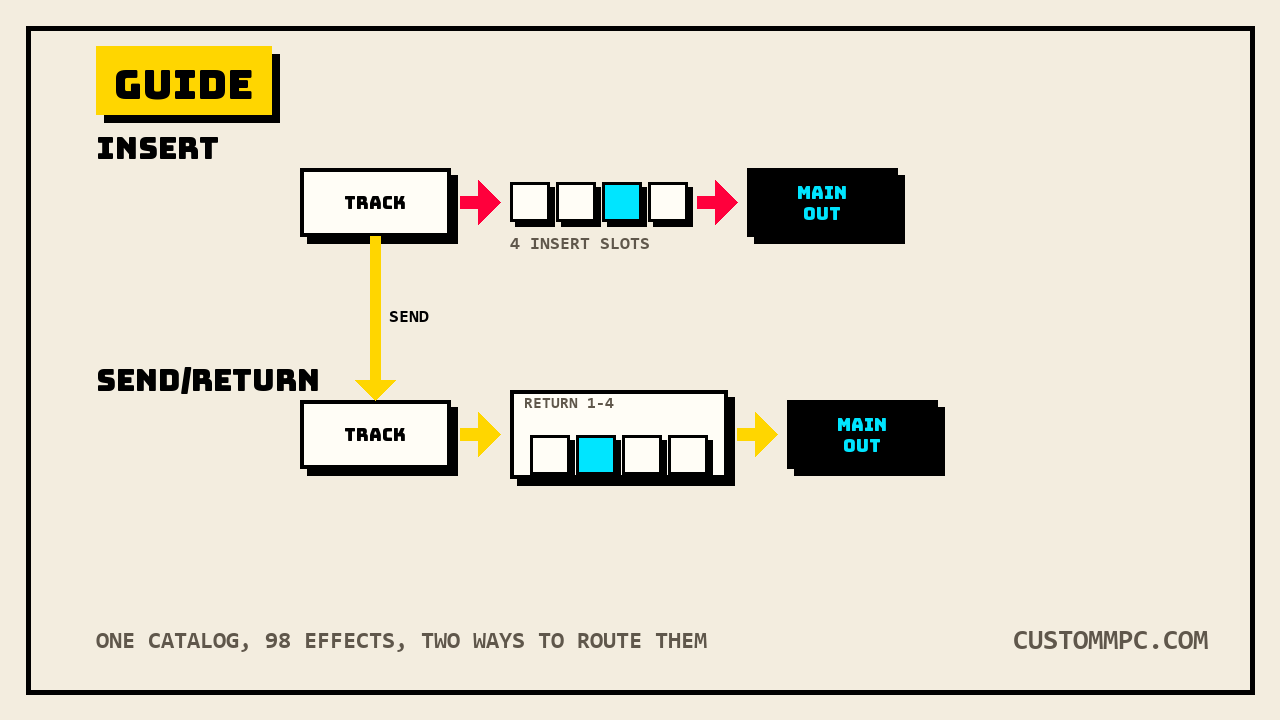
Two routing systems, one shared 98-effect catalog. Insert changes one point in the signal path; Send/Return shares one processed bus across multiple sources.
 VS
VS
Real specs from Akai's own manual: the button count that runs backward from price, the battery and phono jack the One skips, and a contradiction inside Akai's own Connections table.
 GUIDE
GUIDE
Six current units can drive Ableton Live from the hardware, four can't, and the MPC One line lost the feature somewhere between two manual versions with no changelog entry saying so.
 GUIDE
GUIDE
One slider on the Key 61 does twelve jobs, and the famous one, TouchFX, isn't a mode like the other eleven, it's a real insert effect with its own nine-preset catalog and a default value that sits outside its own stated range.
 GUIDE
GUIDE
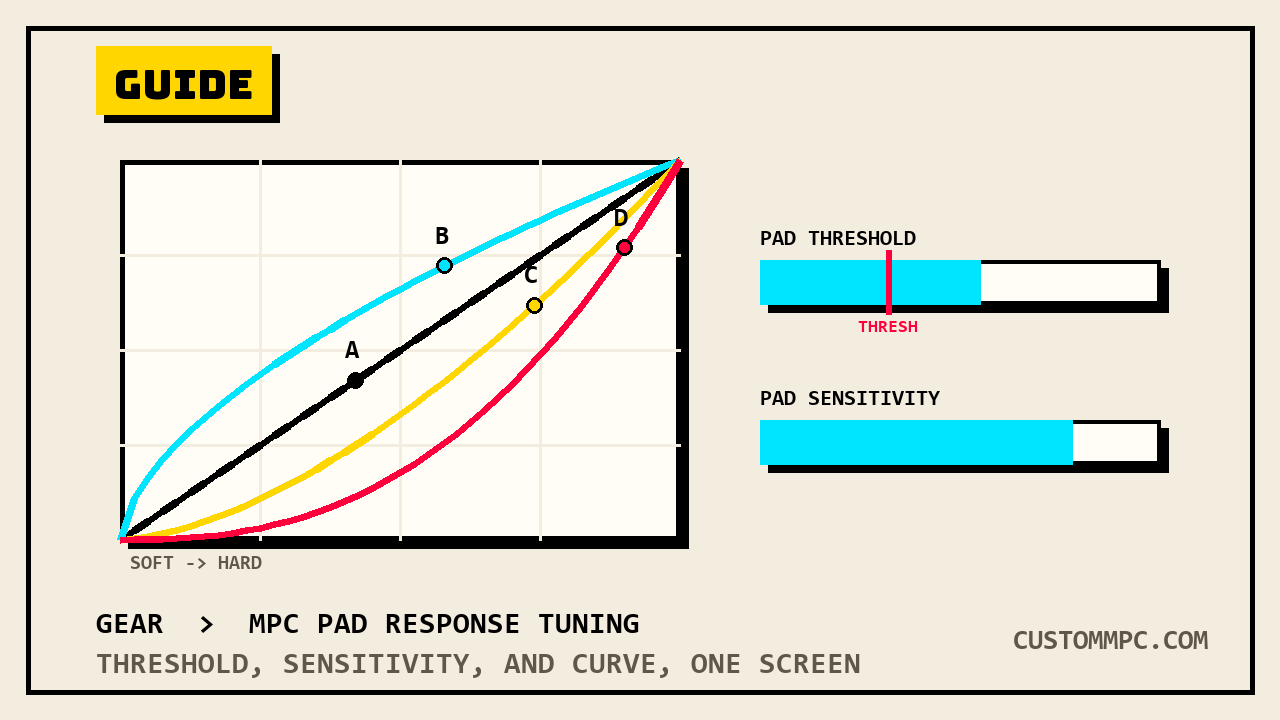
Three settings on one screen shape how a pad feels, and they solve three different problems: Threshold decides if a hit registers at all, Sensitivity scales how hard equals loud, Curve bends the whole response, A through D.
 GUIDE
GUIDE
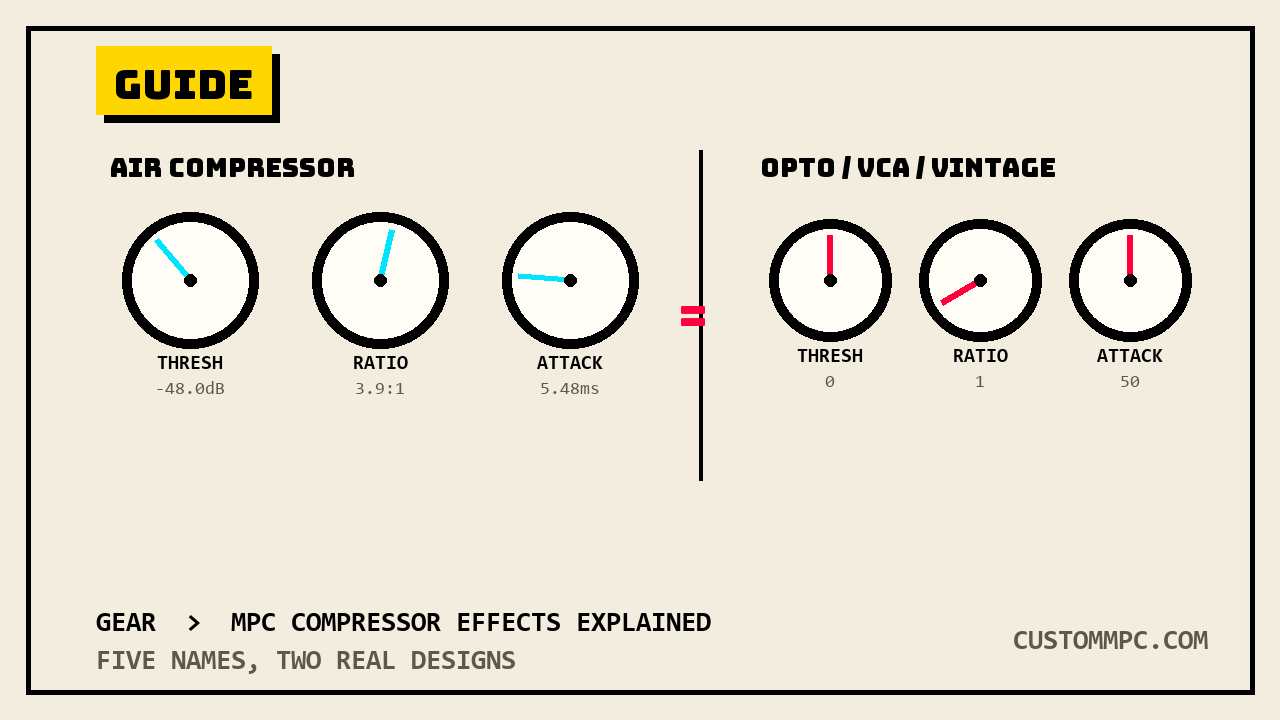
Five named compressors share the Dynamics category, but only AIR Compressor uses real time units and a true ratio. Three of the other four turn out to share one byte-identical parameter table, same ranges, same defaults, different names.
 GUIDE
GUIDE
Three EQ effects share the same four-band idea, but AIR Para EQ can switch its outer bands between shelf and bell while PEQ 4-Band shares byte-identical frequency fields with PEQ 2-Band and still can't.
 VS
VS
Five years newer, smaller, lighter, and double the sound-memory slots, but the MPC2000XL still loses tracks per sequence and half its MIDI outputs to the machine it followed.
 VS
VS
23 physical knobs and 8 CV/Gate outputs against 4 knobs and none, plus mic preamps and instrument inputs the Live's own spec table never lists.
 VS
VS
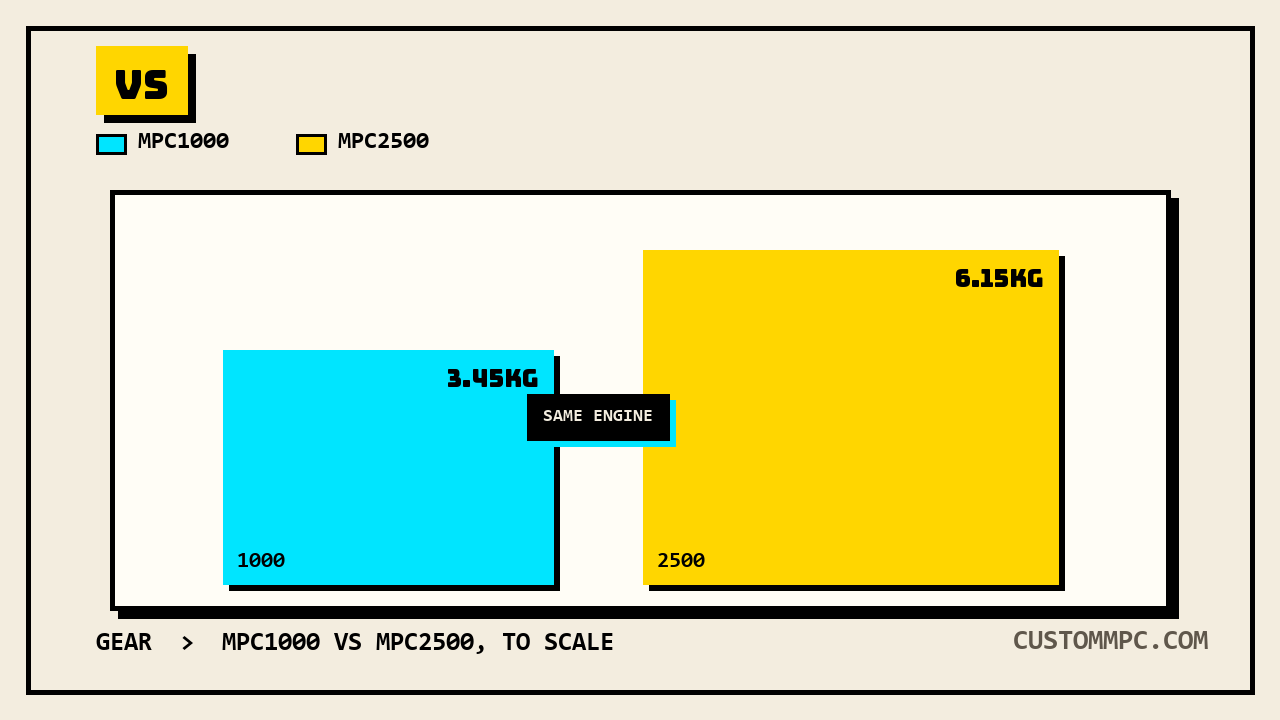
The sound engine and sequencer read almost word for word identical. What actually changed is the chassis, the I/O, and a CD drive bay one machine doesn't have.
 GUIDE
GUIDE
Delay/Reverb is the biggest effects category on the MPC, 23 entries. Six get a real name, and this article says exactly which of their parameter tables are verified and which aren't.
 VS
VS
The newer machine's battery life went down, not up. CV/Gate and Ethernet get added, and the current manual's own Live II table contradicts itself on headphone jack size.
 VS
VS
Double the polyphony and 32x the max memory, but S/PDIF and the 8 individual outputs moved from standard to an optional board on the newer flagship.
 VS
VS
Three years apart: double the polyphony, 16x the max memory, and Akai's first-ever USB port, with the same optional-board gate on digital I/O on both machines.
 GUIDE
GUIDE
Every pad hides a second effects rack: 8 slots, 14 effect types, 1 knob each. Two share names and engines with fully-documented Insert effects. The other 12 get a name and nothing else.
 GUIDE
GUIDE
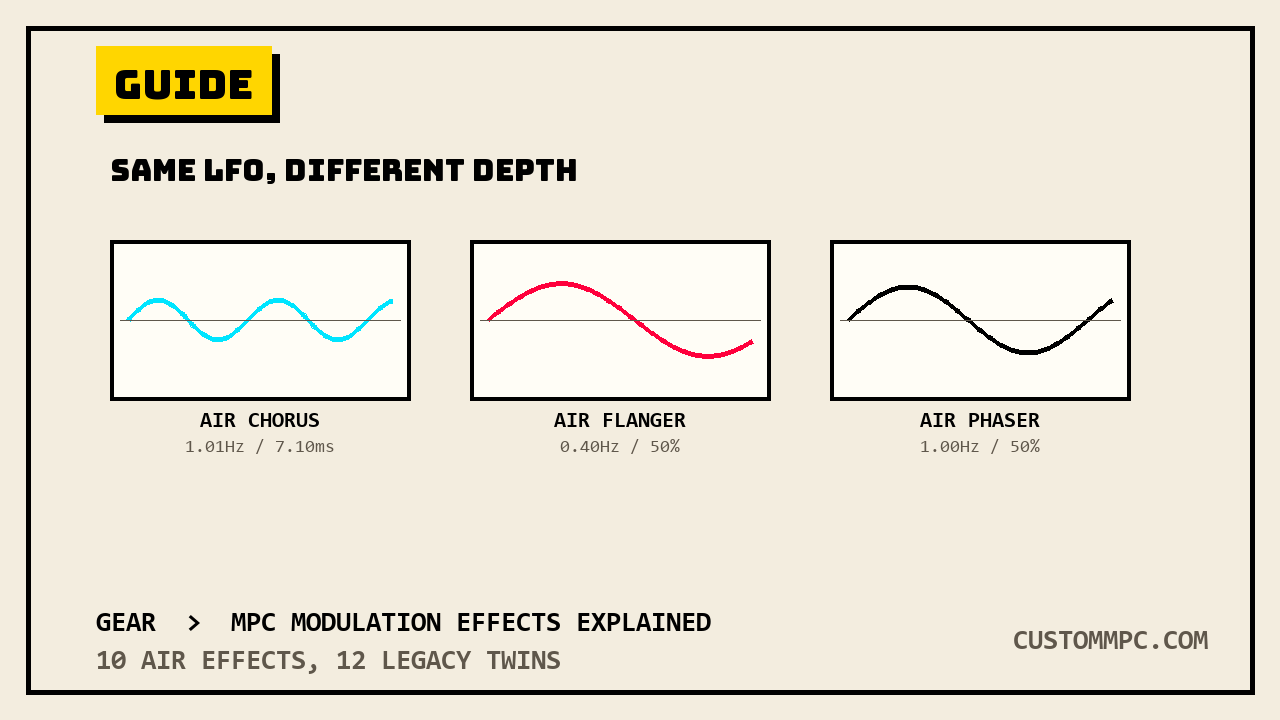
Modulation is the MPC's second-biggest effects category, 22 entries. Ten carry the AIR prefix and get full tables here; the other twelve pair up and share every default except Rate's own units.
 GUIDE
GUIDE
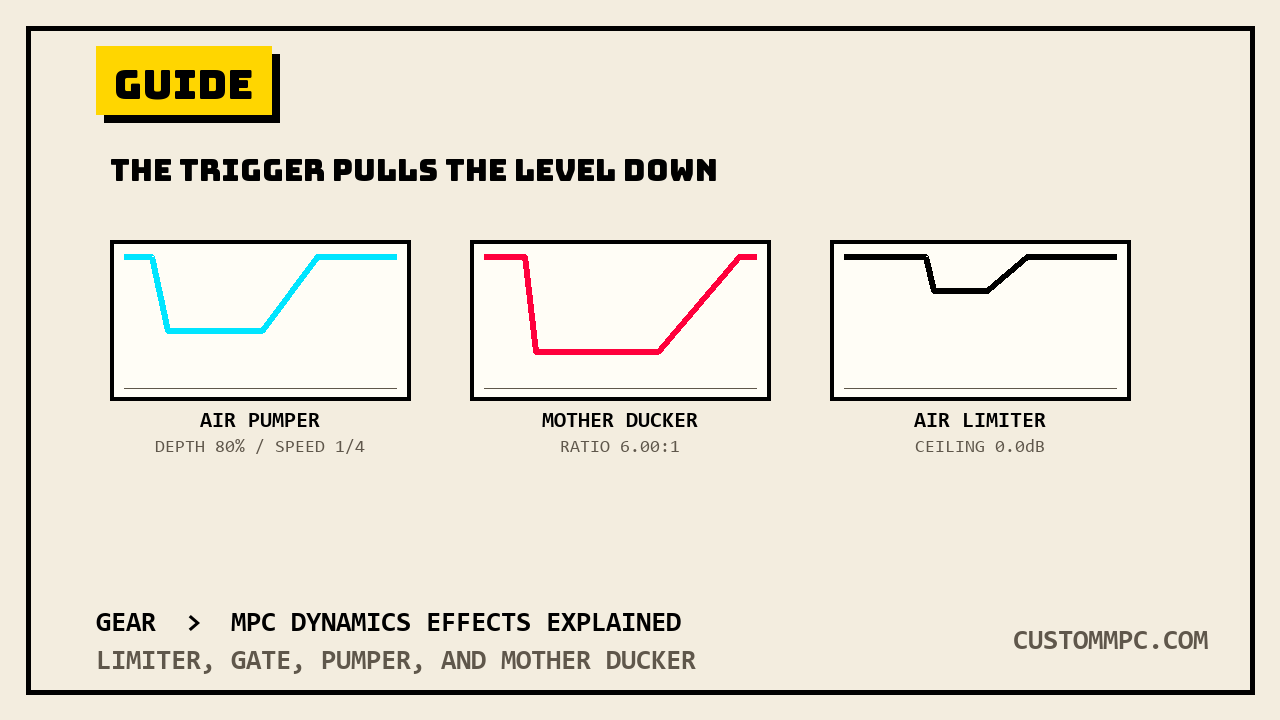
The compressor article scoped out eight Dynamics effects and one Channel Strip tab. This one opens all of them up, including the real sidechain tool it promised a full article: Mother Ducker.
 VS
VS
Two different flagships, five years apart. The X's own table lists 23 knobs to the Key 61's 4, but the keyboard adds three pedal jacks and Ethernet the X doesn't have.
 VS
VS
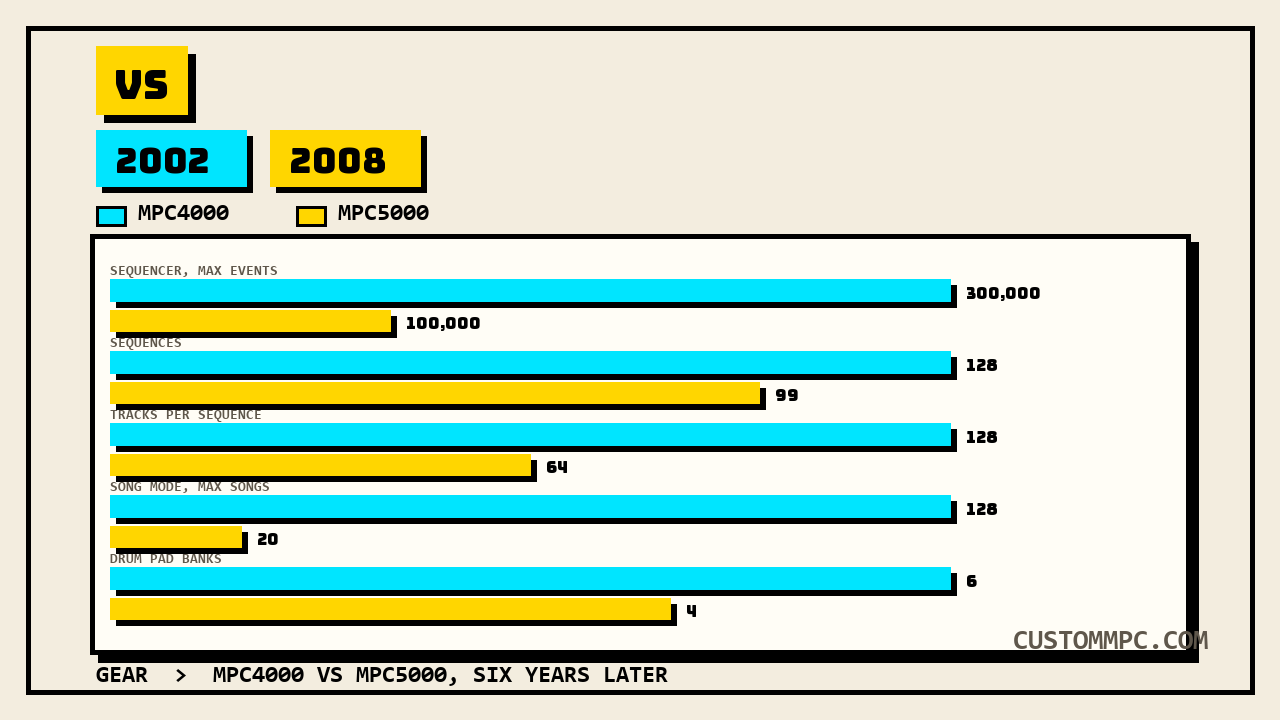
Six years apart, same flagship title. The 2008 machine loses on sequencer size and sample rate but gains a real filter section, an arpeggiator, and standard digital I/O.
 GUIDE
GUIDE
The smallest effects category in the catalog, just three. Doubler and Harmonizer share a field called Lead Volume with two different ranges, and a field called Timing in two different units.
 VS
VS
Nine years and $1,200 apart. The $799 newcomer names an 8-core chip, doubles the RAM, and adds Wi-Fi the X's table has never had, but the X still wins on knobs, mic ins, and outputs by a mile.
 VS
VS
Smaller, lighter, and three years later, but not a shrunk MPC1000: the MPC500 drops four pads, drops to a character LCD, and loses individual outs and S/PDIF. What it gains: real battery power.
 GUIDE
GUIDE
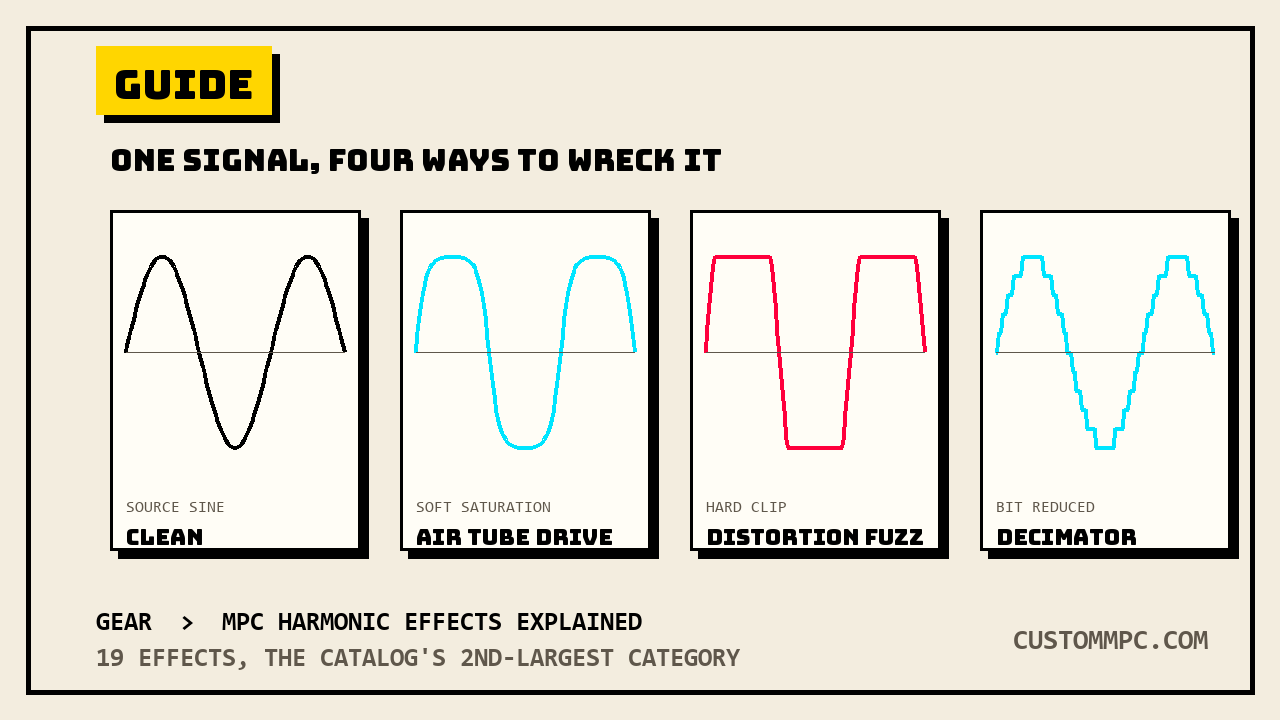
The catalog's 2nd-largest category, all 19. Two effects are literally named Granulator with different defaults, and AIR Freq Shift shares almost the same name as Frequency Shifter while sharing none of its fields.
 VS
VS
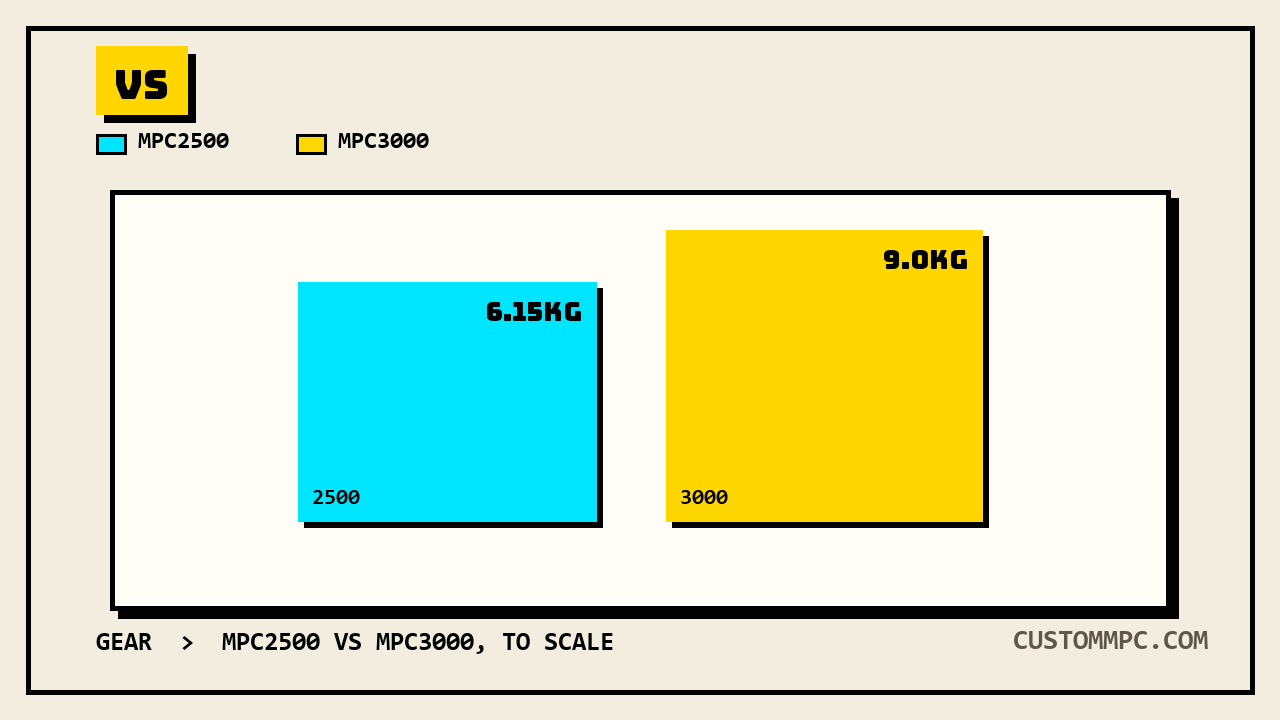
Eleven years later, SCSI is gone entirely. Eight times the stock sound memory and more sequencer headroom, but the 3000 still wins tracks per sequence and its own power spec is the one the 2500's manual leaves genuinely unclear.
 VS
VS
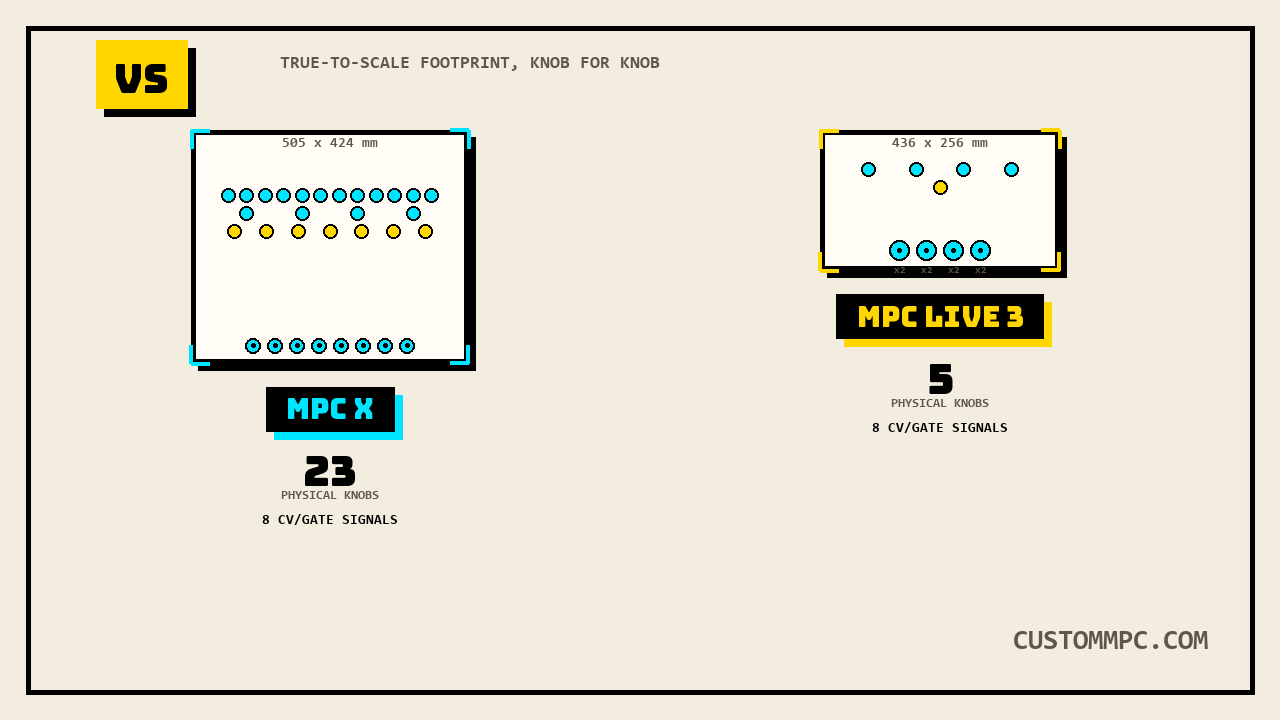
Eight years apart. The Live 3 quadruples the RAM and adds a battery the X has never had, but the X still wins on knobs, input jacks, and a footswitch port the Live 3's table drops entirely.
 VS
VS
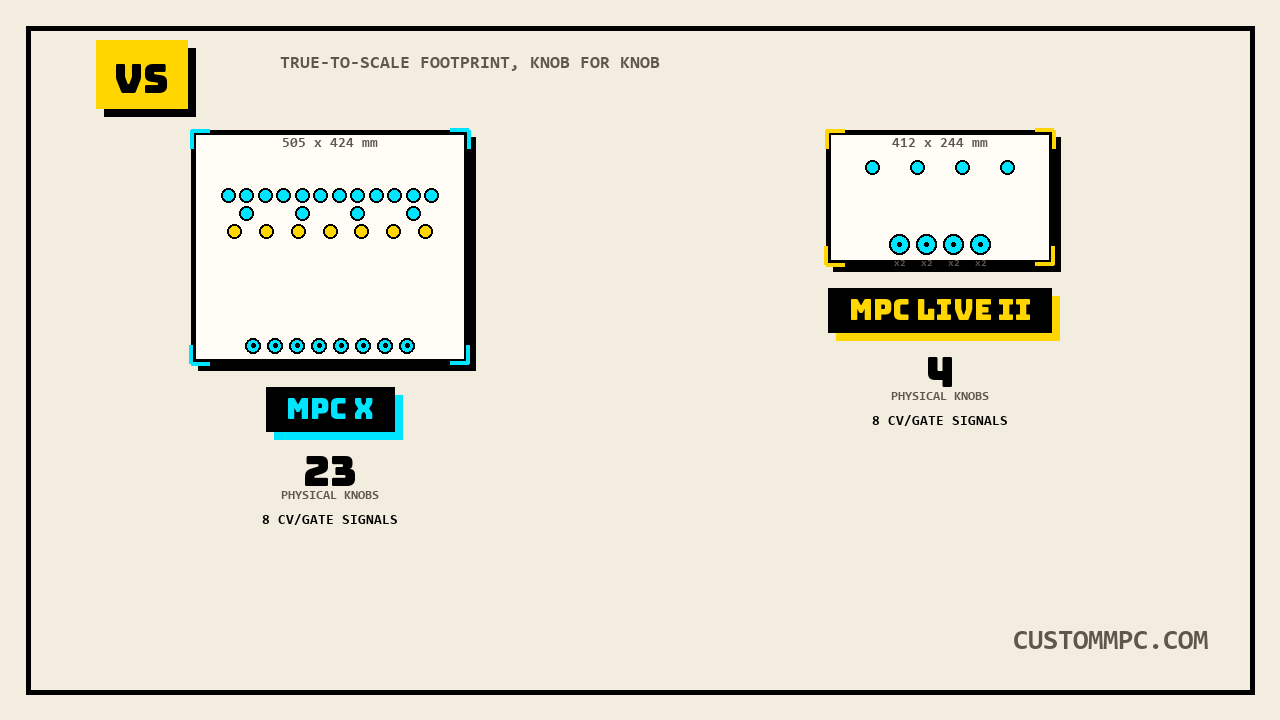
Three years apart, and Akai's own manual ties them exactly on RAM and storage. The Live II names its own chip and adds Ethernet the X has never had, but the X still wins knobs 23 to 4.