GUIDE Effects
MPC vocal effects: the smallest category, all three of them
Vocal is the smallest of the six effects categories in the MPC's shared 98-effect catalog, just three effects: AIR Vocal Doubler, AIR Vocal Harmonizer, and AIR Vocal Tuner. Small doesn't mean simple. Doubler and Harmonizer both carry a field called Lead Volume, and the two fields don't share a range. Doubler and Harmonizer both carry a field called Timing, and the two fields don't even share a unit, one runs in milliseconds and the other in percent. Harmonizer and Tuner share Key, Scale, Voice Range, and a Reference pitch field Doubler has none of. Checked field by field against Akai's own manual, not assumed from the shared names.
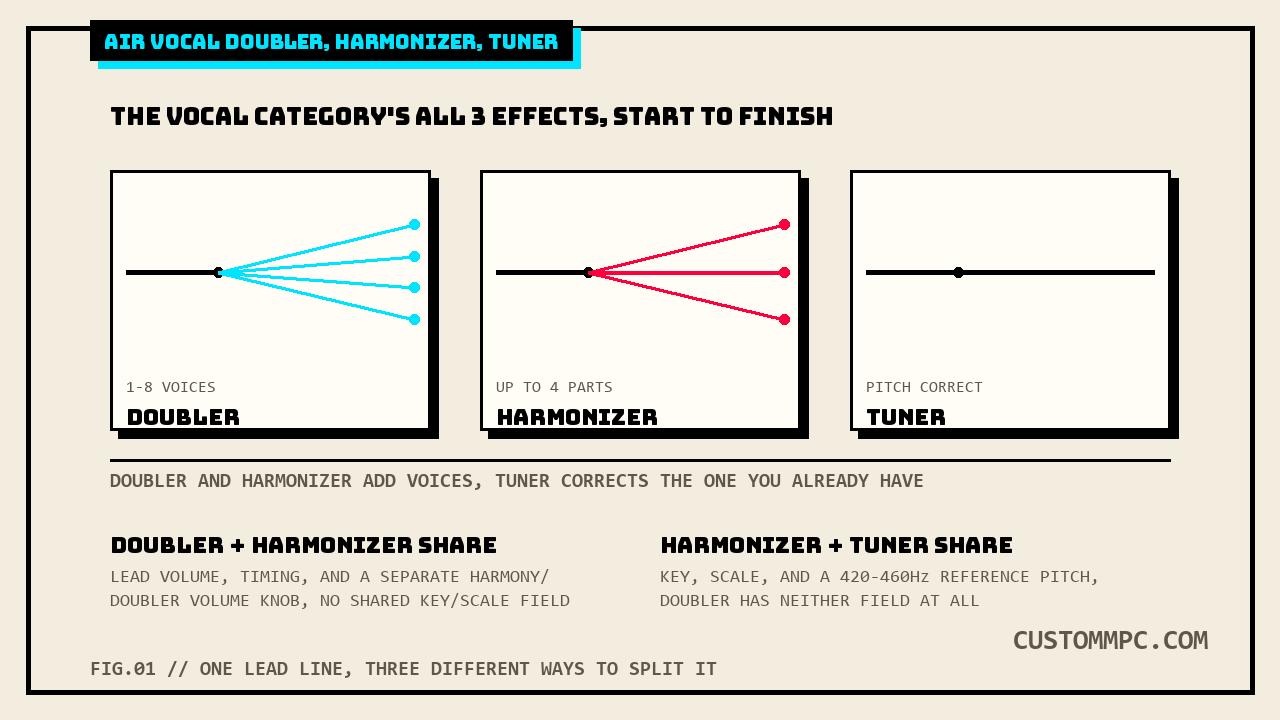
The short version
This site's own insert vs send/return effects article counted every category in the shared 98-effect catalog, and Vocal came in dead last by a wide margin:
"Delay/Reverb 23, Dynamics 14, EQ/Filter 17, Harmonic 19, Modulation 22, Vocal 3, total 98."
Three effects, and they don't split evenly into "adds voices" versus "corrects pitch." AIR Vocal Doubler adds up to eight offset copies of a lead voice with no music-theory awareness at all, no Key or Scale field anywhere in its table. AIR Vocal Harmonizer adds up to four scale-aware harmony parts, built around a Key/Scale pair. AIR Vocal Tuner adds nothing, it corrects the one voice already there, but shares that same Key/Scale pair with Harmonizer, plus an identical 420.0–460.0 Hz Reference pitch field. Doubler and Harmonizer, meanwhile, both have a field called Lead Volume and a field called Timing, and neither field means the same thing on both effects.
Where these live: the Vocal category
Same shared 98-effect list this site has already mapped across five prior articles, one insert-or-send/return catalog split into six categories. Vocal's own "Options:" line is the shortest of the six by a wide margin:
"Options: AIR Vocal Doubler, AIR Vocal Harmonizer, AIR Vocal Tuner"
The whole category fits on two printed pages, PDF pp.420–421, right after Modulation's own six-page run ends. With this article, five of the catalog's six categories now carry dedicated coverage on this site: Dynamics, EQ/Filter, Delay/Reverb, and Modulation already shipped, Vocal closes here, and only Harmonic, the catalog's second-largest category at 19 entries (AIR Amp Sim, AIR Distortion, Decimator, Granulator, TouchFX, XYFX among them), remains open.
AIR Vocal Doubler
Akai's own description is short and doesn't mention pitch correction, key, or scale anywhere:
"This effect creates realistic vocal doubles to add width or thickness to a vocal line."
| Parameter | Range | Default |
|---|---|---|
| Voices | 1–8 | 4 |
| Stereo Spread | 0–100% | 70% |
| Lead Volume | −Inf – +6.0 dB | 0.0 dB |
| Doubler Volume | −Inf – +6.0 dB | 0.0 dB |
| Pitch | ±0 – 250% | ±38% |
| Pitch Speed | 0–100% | 75% |
| Timing | 0–800 ms | 63 ms |
Seven fields, none of them Key, Scale, or Reference pitch. Pitch itself is a plus/minus percent (±0–250%), not cents or semitones, Akai's own table gives no conversion between the two units and this article isn't guessing one. Voices sets how many offset copies play at once, up to eight, and Stereo Spread sets how wide those copies sit in the field; Lead Volume and Doubler Volume are two separate trims, one for the original signal and one for the added copies, both sharing the same −Inf to +6.0 dB range and 0.0 dB default.
AIR Vocal Harmonizer
Harmonizer's own description names the feature Doubler's doesn't have, music theory:
"This effect can create up to four-part realistic vocal harmonies and complex doubling effects. Each vocal part has its own level, delay, formant, mode, and interval parameters."
| Parameter | Range | Default |
|---|---|---|
| Key | A–G# | C |
| Scale | Major, Minor, Harm Minor, Melo Minor, Dorian, Phrygian, Lydian, Mixo, Locrian, Chromatic, Penta, Maj Triad, Min Triad, Root | Major |
| Lead Volume | −Inf – 0.0 dB | 0.0 dB |
| Harmony Volume | −Inf – 0.0 dB | −2.5 dB |
| Timing | 0–100% | 42% |
| Tuning | 0–100% | 14% |
| Smooth | 5–200 ms | 8 ms |
| Voice Range | Very Low, Low, Mid, Mid High, Very High | Mid |
| Root Mode Split | A–G# | E |
| Reference | 420.0–460.0 Hz | 440.0 Hz |
| Delay Sync | Off, On | On |
| Harmony 1–4 | Off, On | printed as "1 On" (see note below) |
Twelve fields, the densest table in this category by a wide margin. The Harmony 1–4 row's own default reads "1 On" in the extracted table, which this article is reading as only the first harmony part defaulting on and parts 2 through 4 defaulting off, consistent with a four-part harmonizer not stacking all four voices before you've chosen to, but the manual's own table doesn't spell that reading out in a full sentence, so it's disclosed here rather than stated as certain. Lead Volume tops out at 0.0 dB, not the +6.0 dB Doubler's own Lead Volume field allows, and Harmony Volume defaults to −2.5 dB rather than Doubler's 0.0 dB default on the equivalent second-voice trim.
AIR Vocal Tuner
Tuner's description is the only one of the three that names pitch correction directly:
"This effect applies pitch correction for natural sounding or hard-tuned vocal effects."
| Parameter | Range | Default |
|---|---|---|
| Detection | Unworried, Default, Selective, Picky, Blind | Default |
| Voice Range | Very Low, Low, Mid, Mid High, Very High | Mid |
| Key | A–G# | A |
| Scale | Major, Minor, Harm Minor, Melo Minor, Dorian, Phrygian, Lydian, Mixo, Locrian, Chromatic, Penta, Maj Triad, Min Triad, Root | Minor |
| Retune Time | 1–1000 ms | 32 ms |
| Reference | 420.0–460.0 Hz | 440.0 Hz |
Six fields, the shortest table of the three. Detection is the one field with no equivalent anywhere else in this category, five named tracking modes running from "Unworried" (loosest) to "Blind" (presumably the most aggressive, though Akai's own table gives no further description of what separates the five beyond the names themselves), controlling how the pitch-detection algorithm reads the incoming signal before Retune Time decides how fast it corrects toward the target note.
Shared fields, different rules
Diffed field by field across all three tables above, not assumed from the shared naming:
| Field name | On Doubler | On Harmonizer | On Tuner |
|---|---|---|---|
| Lead Volume | −Inf – +6.0 dB | −Inf – 0.0 dB | no equivalent field |
| Timing | 0–800 ms | 0–100% | no equivalent field |
| Key / Scale | no equivalent field | A–G# / 13-scale list | A–G# / 13-scale list, identical option set |
| Voice Range | no equivalent field | 5-step Very Low–Very High | 5-step Very Low–Very High, identical option set |
| Reference | no equivalent field | 420.0–460.0 Hz / 440.0 Hz | 420.0–460.0 Hz / 440.0 Hz, identical range and default |
Two real traps sit in that first pair of rows. Lead Volume exists on both Doubler and Harmonizer with the exact same name, but Doubler's copy can push the original signal up to +6.0 dB while Harmonizer's copy caps at 0.0 dB, unity gain, no boost available at all. And Timing exists on both with the exact same name, but it isn't the same kind of field, Doubler's Timing is a straight millisecond delay (0–800 ms) while Harmonizer's Timing is a percent (0–100%) with no stated millisecond equivalent anywhere in the table, reading a "63" carried over from Doubler onto Harmonizer's Timing knob would set something close to two-thirds of whatever range Harmonizer's own percent scale covers, not 63 milliseconds of anything.
Harmonizer and Tuner, by contrast, genuinely share structure: identical Key range (A–G#), the exact same thirteen-entry Scale list word for word, the same five-step Voice Range list, and byte-identical Reference field (420.0–460.0 Hz, default 440.0 Hz). What differs between the two is only the defaults, Harmonizer opens on Key C / Scale Major, Tuner opens on Key A / Scale Minor, Voice Range defaults to Mid on both. Doubler has none of these five fields, full stop, it doesn't track key or scale at all.
Side by side
| Effect | Fields | Key/Scale aware | Adds voices | Corrects pitch |
|---|---|---|---|---|
| AIR Vocal Doubler | 7 | No | Yes, up to 8 | No |
| AIR Vocal Harmonizer | 12 | Yes | Yes, up to 4 | No, tunes to the chosen interval, not a fixed reference pitch of the source note |
| AIR Vocal Tuner | 6 | Yes | No | Yes |
Common mistakes
Mistake: assuming Lead Volume behaves the same on Doubler and Harmonizer because the field name matches. Doubler's Lead Volume can boost the original signal up to +6.0 dB; Harmonizer's Lead Volume caps at 0.0 dB with no boost headroom at all.
Mistake: carrying a Timing value over from Doubler to Harmonizer, or the reverse. Doubler's Timing is milliseconds (0–800 ms); Harmonizer's Timing is a percent (0–100%) with no stated ms equivalent. The two knobs don't measure the same thing despite the identical field name.
Mistake: expecting AIR Vocal Doubler to track a key or scale. It has no Key, Scale, or Reference field anywhere in its seven-field table; the Pitch field is a plain plus/minus percent detune, not a musical interval. Key/Scale awareness is a Harmonizer and Tuner feature only.
A note on manual versions
Every parameter table above is checked directly against Akai's Standalone OS User Guide, Manual Version 3.9, cross-checked line-for-line against Manual Version 3.7. A direct diff of both manuals' Vocal-category pages (v3.9 PDF pp.420–421, v3.7 PDF pp.399–400), normalized for whitespace and page-number lines, returned zero content differences, every effect name, description sentence, and parameter value identical between editions. The chapter sits at the same flat plus-21 page offset between versions this site keeps finding across the manual (420 minus 399 equals 21, 421 minus 400 equals 21), a sixth confirmed data point that the whole effects appendix shifted as one contiguous block between v3.7 and v3.9 rather than section by section.
Verdict
VERDICT
Want width and thickness on a lead vocal with no music-theory setup: AIR Vocal Doubler, up to eight offset copies, no Key or Scale to configure at all. Want actual harmony parts built off a chosen key and scale: AIR Vocal Harmonizer, up to four parts, but check its Lead Volume ceiling (0.0 dB, no boost) and its percent-based Timing field before assuming either behaves like Doubler's equivalent. Want pitch correction on the voice that's already there, not more voices: AIR Vocal Tuner, the only one of the three with a Detection field, and the only one that shares its Key/Scale/Reference structure directly with Harmonizer.
Run into a session where Harmonizer's percent-based Timing field tripped you up expecting Doubler's milliseconds? Tell us about it.