VS Comparison
MPC1000 vs MPC2500: what's actually the same
Line the two spec appendices up side by side and something unusual happens: the sound engine, the effects list, and the sequencer read almost word for word identical. Akai didn't build a smaller sampler and a bigger sampler here, it built the same internals twice and changed the box around them. What actually moved is the chassis, the individual outputs, the MIDI channel count, and one storage option the MPC2500 has that the MPC1000's own manual never mentions at all. Every figure below is checked directly against Akai's own MPC1000 v2 Operator's Manual and MPC2500 Operator's Manual.
The short version
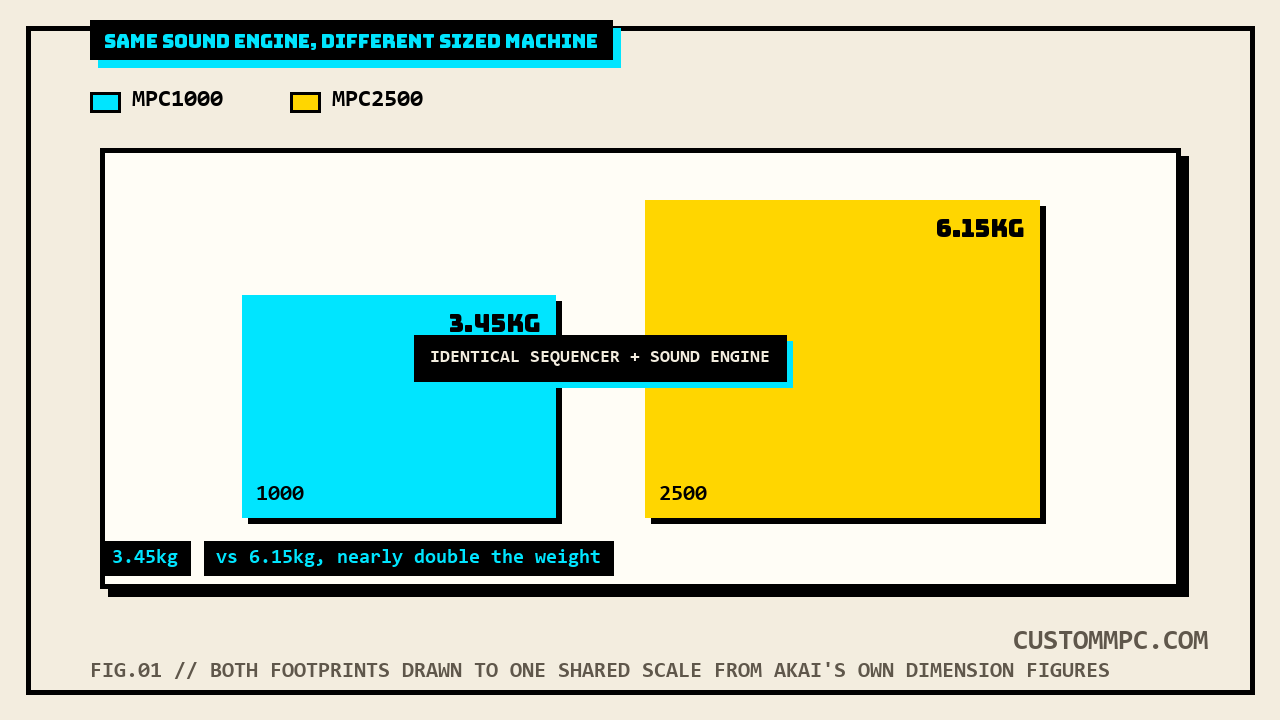
Shop for either of these on the used market and the pitch usually frames the MPC2500 as "the bigger, better MPC1000." That's true for the box, not for what's inside it. Sampling rate, bit depth, polyphony, filter design, preset sound memory, program count, the full effects list, and the entire sequencer block, maximum events, resolution, sequence count, tracks per sequence, are documented in matching language in both machines' own spec appendices. What actually changed between them: the MPC2500 is nearly double the weight (6.15kg vs 3.45kg), doubles the individual outputs (8 vs 4) and MIDI output channels (64 vs 32), runs its outputs balanced instead of unbalanced, and has a dedicated front-panel bay for an optional CD drive that never appears anywhere in the MPC1000's manual.
DEX'S NOTE: if someone's trying to sell you a 2500 as "the same as a 1000 but better in every way," that's not quite it either. The engine's the same, full stop, so don't pay a premium expecting better sound out of the 2500. What you're actually paying for is more outputs, more MIDI channels, balanced I/O, and a bigger chassis. If none of that matters to your setup, the 1000 gets you the same sampler for less money and less desk space.
Sold side by side, not one replacing the other
The MPC1000 launched in 2003 at a $1,499 list price and stayed in production through 2009 across its v1/v2 revisions. The MPC2500 followed in January 2007, reviewed at launch with a £1,199.99 UK price (no US price given in that review). That means for roughly two years, 2007 through 2009, Akai was selling both machines new at the same time, not retiring the 1000 the moment the 2500 shipped. That's a different relationship than the MPC2000XL-to-MPC3000 pairing this site already covered, where the newer machine arrived five years after the older one left the flagship spot; here it's a tiered lineup, budget and mid-tier standalone sold in parallel, which explains why the core sampling engine reads identical below rather than showing the kind of generational spec creep a strict successor comparison usually turns up.
Spec sheet, side by side
Every figure below comes straight from Akai's own documentation: the MPC1000 v2 Operator's Manual's own Specifications appendix for the 1000, and the MPC2500 Operator's Manual's own Specifications appendix for the 2500. Where the two machines are identical, the row says so rather than manufacturing a difference that isn't there.
| Spec | MPC1000 | MPC2500 |
|---|---|---|
| Released | 2003 | 2007 |
| Sampling rate | 44.1kHz | 44.1kHz, same |
| Sample format | 16-bit linear | 16-bit linear, same |
| Sound memory, stock | 16MB (11.5MB for sound) | 16MB (11.5MB for sound), same |
| Sound memory, max expanded | 128MB via EXM128 | 128MB via EXM128, same |
| Recording time (16MB mono) | 136 sec. | 136 sec., same |
| Polyphony | 32 | 32, same |
| Dynamic filtering | 2 x 2-pole filter per voice | 2 x 2-pole filter per voice, same |
| Preset sound memory | 5MB | 5MB, same |
| Number of programs | 24 | 24, same |
| Effects | 2 stereo + master effect | 2 stereo + master effect, same |
| Sequencer max events | 100,000 notes | 100,000 notes, same |
| Sequences / tracks per sequence | 99 / 64 | 99 / 64, same |
| Song mode | 20 songs, 250 steps | 20 songs, 250 steps, same |
| Drum pads / banks | 16 / 4 | 16 / 4, same |
| MIDI output channels | 32 (16 x 2 ports) | 64 (16 x 4 ports) |
| Individual outputs | 4, unbalanced +11dBu, max +17dBu | 8, balanced +11dBu, max +22dBu |
| Stereo out headroom | Unbalanced, max +17dBu | Balanced, max +22dBu |
| CD drive bay | None documented | Front panel, optional IDE CD drive |
| Internal HDD option | 2.5" drive + HDM10 kit, behind front panel | Internal HDD, own installation chapter |
| CF card slot | 32MB-2GB | 32MB-2GB, same |
| Power requirement | 19W | 21W |
| Dimensions | 330 x 75.5 x 228.2mm | 415 x 93.5 x 332.9mm |
| Weight | 3.45kg | 6.15kg |
The identical core
This is the part that doesn't usually show up in a "which one should I buy" thread. Read the two manuals' own Sound Generator and Sequencer blocks and the wording lines up almost field for field: same 44.1kHz sampling rate, same 16-bit linear format, same 32-voice polyphony, same 2x2-pole dynamic filter per voice, same 5MB of preset sound memory, same 24-program ceiling, and the exact same effects roster, Chorus, Flanger, Bit grunger, 4-band EQ, Compressor, Phase shifter, Tremolo, Flying pan, Reverb, Delay, plus a master 4-band EQ and Compressor, worded identically in both appendices. The sequencer block matches just as closely: 100,000-note maximum events, 96 parts-per-quarter-note resolution, 99 sequences, 64 tracks per sequence, 20-song song mode with 250 steps per song, and the same 16-pad, 4-bank, velocity-and-pressure-sensitive pad layout. The two spec appendices even agree on stock and maximum sound memory (16MB standard, 11.5MB usable for sound, expandable to 128MB through the same EXM128 board) and recording time down to the same "136sec." figure at 16MB mono. None of that is a coincidence of similar-sounding machines, it's the same sound engine and sequencer documented twice, which is also why JJOS and other third-party OS replacements for the vintage MPC line have historically targeted this same platform family rather than treating the two machines as needing separate development.
I/O and MIDI: where the 2500 pulls ahead
This is where the two machines actually diverge, and it's a real practical gap, not a cosmetic one. The MPC1000 gives you 4 individual outputs, unbalanced, topping out at +17dBu. The MPC2500 doubles that to 8, and runs them balanced at a higher +22dBu ceiling:
"4 individual outputs 1/4-inch phone x 4 unbalanced +11dBu, output impedance 1k Ohms, Max. output level +17dBu" (MPC1000). "8 individual outputs 1/4-inch phone x 8 balanced +11dBu, output impedance 1k Ohms, Max. output level +22dBu" (MPC2500).
Balanced connections reject cable-induced noise over long runs in a way unbalanced ones don't, so a 2500 wired into a rack a few feet away from a noisy patchbay or power supply has a real, physical advantage the 1000's identical-sounding engine doesn't get to use. MIDI tells the same story: the 1000's two independent output ports give 32 usable channels, the 2500's four ports give 64. If your rig routes a lot of outboard synths or drum machines off the MPC's own MIDI outs instead of through a separate interface, that's double the addressable channel count on the bigger machine, one of the only places in this whole comparison where "bigger" cleanly means "more capable" rather than just "heavier."
Storage: the CD drive bay the 1000 doesn't have
Both manuals document an optional internal hard disk upgrade. The MPC1000 takes a 2.5" laptop-style drive through a dedicated bay behind the front panel, installed with the optional kit-HDM10:
"2.5 inch Hard Disk drive Bay: Internal Hard Disk drive is installed inside. (The installation is done by removing the Front Panel.) The kit-HDM10 (optional) and the 2.5 inch Hard Disk drive are needed."
The MPC2500 documents its own internal hard disk option throughout the manual, referenced across the Save/Load, USB transfer, and a dedicated "Installation of Internal Hard Disk Drive" chapter at printed page 122. But the 2500 also has something the 1000's manual never mentions once, anywhere: a dedicated front-panel bay for an optional CD drive, listed as the very first item in the 2500's own Front Panel walkthrough:
"01. CD Drive bay: You can install an optional IDE CD drive."
A third-party Sound on Sound review of the 2500 independently corroborates this, describing "optional internal hard drive (20-80GB) and CD-RW drive" among the machine's launch features, matching what the 2500's own manual documents in its own words. Practically: a 2500 can be built out as a fully self-contained sample-and-burn station with disc backup on board, a workflow the 1000 was never designed to support even with the HDM10 kit installed, since that kit only ever adds a hard drive, never optical media.
Used market reality
Pricing on both machines is a small, honestly scattered sample rather than a clean market average, the same caveat this site's own buying guides for each machine carry individually. A bundled MPC1000 listing (JJOS plus a memory card included) sold Used-Good at $792.47, though that's a bundled-condition price, not a base-unit figure; a separate community price-floor citation puts a bare MPC1000 closer to $470. Standard-condition MPC2500 listings run higher, roughly $719 to $849 depending on condition, with the XL Special Edition and LE variants tracking their own separate, higher range well above that. That gap tracks reasonably well with the spec table above, the 2500 isn't charging a premium for a better-sounding engine, it's charging for the extra outputs, the extra MIDI channels, and the bigger, heavier chassis with room for a CD drive the 1000 was never built to hold.
Verdict
VERDICT
Buy the MPC2500 if you need more than 4 individual outputs, more than 32 MIDI channels off the unit's own ports, balanced I/O for a noisy rack, or an optical-disc storage path the 1000 was never designed for, and you're comfortable paying roughly $200-$400 more on the used market for it. Buy the MPC1000 if none of that applies, it's the same sound engine and the same sequencer in a smaller, lighter, cheaper box, and the money saved goes further toward CF cards, a HDM10 hard-drive kit of its own, or a JJOS license than toward outputs you may never patch in. Either way, don't let a seller sell you the 2500 on "better sound," the manuals agree it isn't, what you're actually paying for is I/O and a chassis.
Buying either one used? The MPC1000 buying guide and the MPC2500 buying guide cover the full physical-condition checklist this article doesn't repeat. Already own a 1000 and thinking about the HDM10 route? Our full MPC1000 mod build guide covers that kit alongside the rest of the pad/screen/shell menu.