VS Comparison
MPC Live II vs MPC X: what's actually different
Three years apart, and Akai's own current manual lands the two on an exact tie no other machine in this site's "vs MPC X" series has ever hit: 2 GB of RAM and 16 GB of storage, both expandable via SATA, identical on both tables. The Live II adds a named quad-core processor where the X's own table has never had a Processor row, and a dedicated Ethernet port the X's current documentation doesn't list at all. Then the story reverts hard: the X still carries 23 physical knobs to the Live II's 4, a mic preamp, an instrument input, and footswitch jacks the Live II's own table has none of.
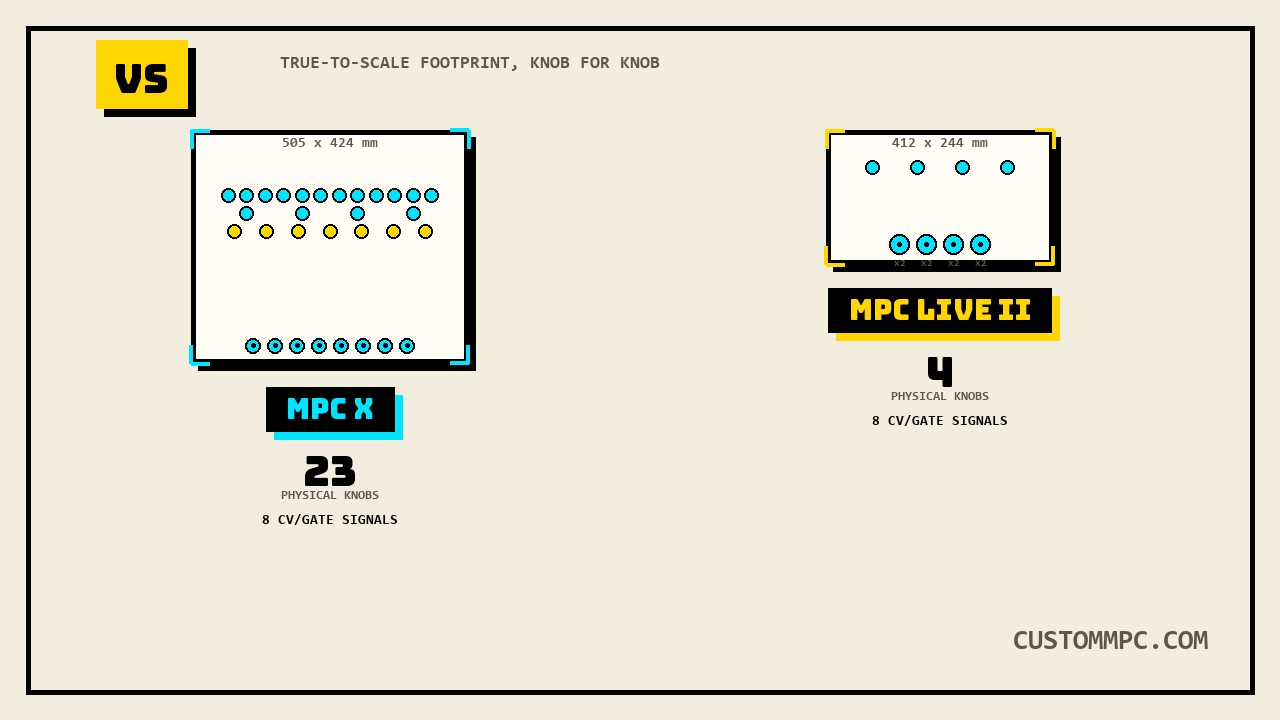
The short version
The MPC X and the MPC Live II have never been compared head to head on this site before, even though the site already covers the X against the original Live, the Key 61, the One G2, and the Live 3, and separately covers the Live II against the original Live and against the MPC One. Read Akai's own current Technical Specifications appendix side by side and the first finding is a real tie: the base MPC X and the Live II document the identical 2 GB of RAM and 16 GB of internal storage, both expandable via SATA connections, a match this site's other four "vs MPC X" pairings have never landed on. The Live II's own CPU block also names its processor directly, "Quad-core ARM® processor," where the X's table still has no Processor row at all, and its Connections block lists a dedicated Ethernet port the X's own current documentation doesn't have anywhere. Then the split runs the other way just as hard: the X's own Mechanical block still lists 23 physical knobs against the Live II's 4, a mic preamp and an instrument input the Live II's table has neither of, and two dedicated footswitch jacks its own Connections block drops entirely.
SAM'S NOTE: I went in expecting another "cheaper machine wins the chip, X wins the I/O" writeup, the same shape as the Live 3 and One G2 pieces. The RAM and storage tie caught me off guard. Same 2 GB, same 16 GB, same SATA expansion path, on a $1,999 rack unit and a $1,199 portable one three years apart. Everything else about this pair splits the usual way. That one row doesn't.
Three years apart, closing the last gap in this series
The MPC X launched in the first quarter of 2017 at a reported $1,999 street price, Akai's rack-style, full-I/O standalone flagship, covered in full in this site's own mpc-x-buying-guide article and already compared against the original Live, the Key 61, the One G2, and the Live 3 in four earlier pieces on this site. The MPC Live II followed in May 2020 at a $1,199 launch price, the second-generation redesign of the original 2017 MPC Live, itself already compared against the original Live and against the MPC One in two earlier pieces on this site. Both machines sit in the same current v3.9 Standalone OS User Guide, the same document that covers the whole modern lineup, and this pairing is the one this site's own coverage had not gotten to yet: the X had been checked against Live, Key 61, One G2, and Live 3; the Live II had been checked against Live and One; the X-to-Live-II leg of that grid was the gap. Sweetwater's own current listings show both the original Live and the standalone Live II as no longer available for new purchase, per this site's own already-published mpc-live-vs-live-ii article, the same discontinued status the nine-years-old X carries as well.
Spec sheet, straight from the manual
Every figure below is quoted or paraphrased directly from Akai's own MPC_Standalone_OS_User_Guide_v3.9.pdf Technical Specifications appendix: the "MPC X / MPC X Special Edition" table at printed footers 468-470 and the "MPC Live II" table at printed footers 473-474, both independently re-extracted for this article via a position-sorted `page.get_text("blocks")` pymupdf pass (sorted by y, then x) rather than a linear text pull, the extraction method this site's own mpc-live-vs-live-ii article already found necessary on these exact pages after an initial linear read produced a visibly scrambled Mechanical/CPU block. A second, independent linear extraction of the same page range was run for this article as a cross-check; both methods agreed on every figure used below, no scrambling reproduced this pass. Figures shown are for the base MPC X where the table splits by variant.
| Spec | MPC X | MPC Live II |
|---|---|---|
| Display | 10.1" / 256mm, 1280x800, capacitive multi-touch | 6.9" / 176mm diagonal, resolution not stated |
| Pads | 16 velocity- and pressure-sensitive pads, RGB-backlit, 8 banks | |
| Knobs | 16 Q-Link + 7 gain/mix + 1 data encoder = 23 | 4 Q-Link + 1 data encoder |
| Buttons | Not named in this table | 27 dedicated function buttons |
| Processor | Not named in this table | Quad-core ARM |
| RAM | 2 GB (X) / 4 GB (X SE) | 2 GB |
| Internal storage | 16 GB, 6 GB user (X); 48 GB, 10 GB user (X SE), expandable via SATA | 16 GB, expandable via SATA connections (user/system split not stated) |
| Line inputs | 2x XLR+1/4" TRS combo (mic or line mode) plus 2x TRS-only (Input 3/4) | 2x balanced 1/4" TRS (line only, no XLR) |
| Instrument inputs | 2x unbalanced 1/4" TS | None documented |
| Phono inputs | 2x unbalanced RCA | 2x unbalanced RCA |
| Footswitch / pedal inputs | 2x 1/4" TS footswitch (FS 1/2) | None in Connections block |
| Outputs | 8x 1/4" TRS (4 stereo pairs) | 6x 1/4" TRS (3 stereo pairs) |
| Headphone out | 1/4" TRS + 1/8" TRS (2 separate jacks) | 1/8" TRS (spec block) or 1/4" TRS (Connections block), tables disagree |
| MIDI DIN | 2 in, 4 out | 2 in, 2 out |
| CV/Gate | 8x 1/8" TS jacks, 1 signal each, 8 signals total | 4x stereo 1/8" jacks, 2 signals each, 8 signals total |
| Ethernet | Not documented | 1x Ethernet link port |
| USB / SD | 2x Type-A, 1x Type-B, 1x SD card slot | 2x Type-A, 1x Type-B, 1x SD card slot |
| Power | External adapter, 19V 3.42A, no battery | External adapter, 19V 3.42A, plus li-ion battery, up to 4 hr |
| Dimensions (w x d x h) | 505 x 424 x 87mm (flat) | 411.5 x 243.8 x 45.7mm |
| Weight | 5.66 kg / 12.57 lb. | 3.38 kg / 7.45 lb. |
23 knobs against 4, the pattern holds
The X's own Mechanical block lists three rows of physical rotary controls: 16 touch-sensitive Q-Link knobs, 7 additional 270-degree knobs dedicated to gain, mix, and level, and a data encoder, 23 knobs total by this site's established counting convention that excludes the encoder. The Live II's own Mechanical block lists one: 4 touch-sensitive Q-Link knobs across 4 Q-Link columns, plus the same style of data encoder, no dedicated gain or volume knob of any kind. This is the third time this site has found the exact 23-to-4 split against the X, matching what the mpc-key61-vs-mpc-x and mpc-one-g2-vs-mpc-x articles already found on the Key 61 and One G2. It is not, however, the same number the Live 3 carries: this site's own mpc-live-3-vs-mpc-x article found the Live 3 at 5 knobs, not 4, because its table adds a dedicated volume knob the Live II's table has no equivalent of. The Live II follows the older, more common 4-knob convention; the Live 3 is the outlier in this family, not the Live II. Worth a small, separate note: the X's own Mechanical block has no Buttons row of any kind, the same style of documentation gap as its missing Processor row below. The Live II's own table names 27 dedicated function buttons directly. Neither table is hiding the other figure on purpose, the X's table simply never itemizes a button count for any of its controls the way the newer-format machines do.
A named chip, and a memory tie no one saw coming
The Live II's own CPU block names its processor directly: "Processor: Quad-core ARM® processor." The X's Technical Specifications table has no Processor or CPU row anywhere in it, and never has, the same gap this site's mpc-key61-vs-mpc-x, mpc-one-g2-vs-mpc-x, and mpc-live-3-vs-mpc-x articles already found and flagged. Naming a chip is where every prior "vs MPC X" article on this site found the newer or cheaper machine pulling ahead on memory too, and this pair breaks that pattern. The same CPU block that names the Live II's processor also states its RAM and storage: "RAM: 2 GB," "Storage: 16 GB, expandable via SATA connections." The base MPC X's own Memory block states the identical pair of figures: "RAM 2 GB (MPC X)," "Internal Storage 16 GB (MPC X) (6 GB user storage)... Expandable via SATA connections." Read straight, a $1,999 flagship from 2017 and a $1,199 portable machine from 2020 document the exact same 2 GB of RAM and the exact same 16 GB of raw storage, both expandable the same way. No other pairing in this site's "vs MPC X" series has landed on a tie this precise; the Live 3 quadrupled the X's RAM outright, the One G2 doubled it, the Key 61 matched the X's own Special Edition rather than the base unit. This is the first time the base X itself has tied a newer machine on both figures at once. The tie is real but not total: the X's own table further breaks its 16 GB down into 6 GB of user storage against the rest reserved for the system and pre-installed content, a split its table states explicitly. The Live II's own CPU block states only the gross 16 GB figure, with no user-versus-system breakdown documented anywhere in its current table. Both machines document 16 GB of raw internal storage; only the X's own table says how much of that a user actually gets to keep sounds and projects on.
CV/Gate ties in count, breaks in format, again
Both tables land on 8 CV/Gate signals total, and this pair repeats a finding this site's own mpc-one-g2-vs-mpc-x and mpc-live-3-vs-mpc-x articles already established against two different machines: the total signal count matching does not mean the physical jack format matches. The X's own Connections block lists "(8) 1/8" (3.5 mm) CV/Gate outputs," 8 discrete jacks, 1 signal each. The Live II's own Connections block lists "(4) Stereo CV/Gate outputs," 4 physical jacks, each carrying 2 signals via a stereo breakout, the same 4-jack breakout format already confirmed on the One G2 and the Live 3. The practical cabling difference is the same one this site has now confirmed on three separate machines: sequencing a modular rig from the X means 8 individual patch cables into 8 individual jacks; doing the same from a Live II means 4 TRS-to-dual-mono breakout cables, even though both machines can drive the same 8 destinations.
No XLR, no phono preamp gain, no instrument input
The X's own Digital Audio System block documents four distinct categories of analog input: 2 balanced XLR+1/4" TRS combo jacks that switch between mic and line mode with a full preamp spec, including a -135 dBu EIN noise floor and a 58 dB gain range, 2 additional balanced 1/4" TRS-only jacks (Input 3/4, line level only, no XLR option), 2 unbalanced 1/4" TS instrument inputs with roughly 1 MΩ input impedance, and 2 unbalanced RCA phono inputs, 8 physical input jacks across 4 categories. The Live II's own block documents one input category beyond phono: "Line Inputs (2) balanced 1/4" (6.35 mm) TRS," a plain line-level pair with a 29.5 dB gain range and no EIN or preamp specification at all, no XLR option, no separate mic-mode row. Its own table has no Inst Inputs row anywhere. Phono is the one input category where the two genuinely match: both document 2 unbalanced RCA phono inputs, the X's own spec listing a 108 dB dynamic range and 0.005% THD+N, the Live II's a close 108.5 dB dynamic range and 0.011% THD+N, close enough to call the same phono stage in practice even though the exact THD figures differ. Practically: neither machine's current documentation gives the Live II a mic preamp or an instrument input the way the X's own table does. Plugging a mic straight into the Live II's line inputs, or a guitar or bass with no DI box in between, isn't something its current spec table supports the way it is on the X.
A jack the Live II's table drops too
The X's own Connections block lists 2 dedicated 1/4" TS footswitch inputs (FS 1/2). The Live II's own Connections block, read in full, has no footswitch jack of any kind: line inputs, line outputs, headphone output, RCA inputs, MIDI in/out, CV/Gate, an Ethernet port, USB-A, USB-B, SD slot, power input, and nothing else. This is the same real, practical gap this site's own mpc-live-3-vs-mpc-x article already found on the newer Live 3: sustain-style footswitches for punch-in recording or live performance plug directly into the X, and the current Live II and Live 3 documentation both offer no equivalent dedicated physical port.
An Ethernet port, and a jack that disagrees with itself
Here the split runs backward from the pattern established so far. The Live II's own Connections block lists "(1) Ethernet link port," a wired network jack. The X's own Connections block, read in full for this article, has no Ethernet row anywhere, and none of this site's own prior X comparisons (against the original Live, the Key 61, the One G2, or the Live 3) found one either. The older, cheaper, more portable machine documents a port the newer, pricier flagship's own current table does not. Independently cross-checked against a separate Akai document rather than trusted on this one table alone: the older MPC_Standalone_OS_User_Guide_v3.7.pdf's own Live II Technical Specifications section, already checked in a prior pass for this site's own mpc-live-2-vs-live-3 article, confirms the same Ethernet port on the Live II under a flat page-offset from the v3.9 table used here, the identical finding on two separate manual revisions. The Live II's own table also contains a genuine internal contradiction on headphone jack size, already flagged once before by this site's own mpc-live-vs-live-ii article and reconfirmed directly for this article: its Digital Audio System block states "Headphone Output (1) 1/8" (3.5 mm) stereo headphone," while its own separate Connections block, same table, states "(1) 1/4" (6.35 mm) stereo headphone output." The original MPC Live's equivalent two blocks agree with each other (1/8" in both), and the X's own table lists both a 1/4" and a separate 1/8" headphone jack as two distinct physical outputs rather than one contested size, confirming this is a Live II documentation quirk specific to its own table, not a systematic pattern applied elsewhere. Stated plainly rather than resolved: whether a Live II ships with a 1/8" or 1/4" headphone jack isn't settled by its own current manual, which disagrees with itself on the exact figure a buyer would need to know before assuming a headphone cable fits.
The one thing only the Live II has
The Live II's own Power block documents both an external adapter and a battery: "via power adapter: 19 V, 3.42 A, center-positive, included," and "via battery: lithium-ion, rechargeable, up to 4 hours of battery life." The X's own Power block documents the adapter only, "via power adapter: 19 V, 3.42 A, center-positive, included," identical voltage and amperage to the Live II's own adapter, with no battery row at all. Unlike the Live 3, whose battery lives in its own separate manual outside the shared v3.9 document, the Live II is named directly in the shared Battery Usage section's own sentence, no separate-document complication to disclose here: "Important: Only MPC Live and MPC Live II may use battery power. MPC X, One, One G2, Key 61, Key 37, and Key 37 G2 must be connected to a power outlet," the same citation this site's mpc-one-g2-vs-mpc-x and mpc-live-3-vs-mpc-x articles already used for the rest of the current lineup. Worth a precise note rather than a rounded-off one: a "6 hour" battery figure does circulate for "Live 2" in some secondary coverage, but that number belongs to the original MPC Live, not the Live II, a conflation this site's own mpc-live-2-vs-live-3 SOURCES.md already caught and corrected in an earlier pass. The Live II's own current manual is unambiguous at 4 hours, matching what this article's own fresh extraction found, not 6.
A resolution number that isn't there, and a correction
The X's table states its screen resolution explicitly: "10.1" (25.6 cm) full-color 1280x800 display with capacitive multi-touch." The Live II's own table states only a diagonal size and panel type: "6.9" / 176 mm (diagonal)," "5.9" x 3.7" / 150 x 93 mm (width x height)," "Full-color LED-backlit display with touch interface," no pixel resolution figure anywhere in that row. A correction is due here rather than a repeated claim: this site's own mpc-one-g2-vs-mpc-x article stated in its sources note that "this site's own gear/mpc-live-ii-vs-one and gear/mpc-live-vs-live-ii articles both confirmed 1280x800 as the shared resolution across the Live II, One, and original One G2's sibling tables." Rechecked directly against both of those articles' own published HTML for this pass, that isn't what either one actually says. The mpc-live-vs-live-ii article's own spec table lists the Live II's display as "6.9" / 176mm diagonal, LED-backlit touch (resolution not restated)," and the mpc-live-ii-vs-one article's own table lists it as "6.9" / 176mm, 150x93mm" with no resolution figure for either machine in that pairing. The 1280x800 figure that does exist on these pages belongs to the original MPC Live's own table, one row above the Live II's on the same page pair, not to the Live II. This article does not carry the earlier overclaim forward.
Weight, footprint, and one shared power brick
The X weighs 5.66 kg (12.57 lb.) against the Live II's 3.38 kg (7.45 lb.), the Live II running roughly 60 percent of the X's weight. Footprint runs the same direction: the X's 505 x 424mm chassis covers roughly 214,100 square millimeters against the Live II's 411.5 x 243.8mm rectangle at roughly 100,300, the X's footprint is a little over double the Live II's by area. As with the Live 3 comparison, the X and the Live II share the exact same external power spec, 19V, 3.42A, center-positive, meaning a spare X adapter genuinely could run a Live II in a pinch, and vice versa, one of the only points of hardware overlap between an otherwise divergent pair.
What they actually cost right now
The MPC X launched at a reported $1,999 street price in Q1 2017; the MPC X Special Edition followed on April 26, 2023 at $2,499, per this site's own already-published mpc-x-buying-guide article. The MPC Live II launched May 2020 at a $1,199 launch price, per this site's own already-published mpc-live-vs-live-ii and mpc-live-ii-vs-one articles. At $1,199, the Live II cost 60 percent of the base X's own $1,999 launch price and roughly half of the Special Edition's $2,499, for a machine that ties the base X's own RAM and storage exactly, names its own processor where the X's table doesn't, and adds a battery and an Ethernet port the X has never documented, while losing badly on knob count and standard analog input variety. Both figures are launch-era prices rather than current listings; Sweetwater's own current pages already show both machines as no longer available for new purchase, so a specific used-market asking price should be confirmed directly before buying either one.
Common mistakes
Mistake: assuming the RAM and storage tie means the Live II matches the X across the board. Its own table has no mic preamp, no instrument input, no footswitch jack, and a fifth of the X's knob count; a tie on one row isn't a tie on the machine.
Mistake: expecting a mic preamp from the Live II's line inputs. Its own table lists a plain 29.5 dB gain-range line input with no EIN or preamp specification, not the XLR combo jack with a full mic preamp spec the X's own table documents.
Mistake: buying 8 single-signal patch cables for a Live II's CV/Gate rig. Its own Connections block documents 4 stereo breakout jacks carrying 8 signals, not 8 discrete jacks the way the X uses; the cabling is different even though the total signal count matches.
Mistake: assuming a 6-hour battery figure for the Live II. That number belongs to the original MPC Live; the Live II's own current manual is unambiguous at up to 4 hours.
Mistake: buying a 1/4" or 1/8" headphone cable for a Live II on the strength of just one row in its own spec table. Akai's own current document disagrees with itself on this exact figure, 1/8" in one block and 1/4" in another; check the unit directly rather than trusting either row alone.
A note on sources
Both spec tables cited in this article sit in the current v3.9 Standalone OS User Guide's Technical Specifications appendix, "MPC X / MPC X Special Edition" at printed footers 468-470 and "MPC Live II" at printed footers 473-474, each independently re-extracted directly for this article via both a position-sorted pymupdf blocks pass and a plain linear text pull, which agreed on every figure used. Several findings in this article cross-reference this site's own previously published, independently sourced work rather than re-deriving the same primary-source citations from scratch: the X/Key 61, X/One G2, and X/Live 3 knob-gap and CPU-gap findings (gear/mpc-key61-vs-mpc-x, gear/mpc-one-g2-vs-mpc-x, gear/mpc-live-3-vs-mpc-x), the CV/Gate breakout-format finding (gear/mpc-one-g2-vs-mpc-x, gear/mpc-live-3-vs-mpc-x), the shared Battery Usage citation and footswitch gap (gear/mpc-live-3-vs-mpc-x), the Live II's own headphone-jack self-contradiction (gear/mpc-live-vs-live-ii), the Live 2/Live II battery-figure conflation correction and the Ethernet port cross-check against the v3.7 manual (gear/mpc-live-2-vs-live-3), and both machines' own launch pricing (gear/mpc-x-buying-guide, gear/mpc-live-vs-live-ii, gear/mpc-live-ii-vs-one). All were independently re-checked against the primary manual passages cited here during this pass rather than assumed correct, and matched. One exception is disclosed above rather than silently repeated: a display-resolution characterization in gear/mpc-one-g2-vs-mpc-x's own sources note, rechecked directly against the two articles it cited, did not hold up and is corrected in the display section of this article rather than carried forward.
Launch dates and pricing for both machines came from WebSearch-indexed press coverage rather than direct retailer fetches, consistent with this site's established practice on pricing claims; both figures are cross-referenced from this site's own mpc-x-buying-guide, mpc-live-vs-live-ii, and mpc-live-ii-vs-one articles rather than re-derived from scratch.
Verdict
VERDICT
The specs: the Live II's own table names a quad-core processor where the X's table never has, ties the base X exactly on RAM and raw storage, adds a battery and an Ethernet port the X has never documented, and undercuts the X's weight by 40 percent. The X answers back with 23 physical knobs against 4, a real mic preamp and instrument input the Live II's table has neither of, dedicated footswitch jacks its own Connections block drops entirely, and a CV/Gate format that stays 8 discrete jacks rather than the Live II's 4-jack breakout for the same total signal count. The purchase: the Live II is the grab-and-go pick for someone who wants a wired network connection and a battery untethered from a wall outlet and doesn't need a mic preamp or an instrument input built in; the X is still the knob-dense, full-I/O studio hub for anyone plugging in a mic, an instrument, and a sustain pedal without an interface in between. The money: at a $1,199 launch price against the X's $1,999 (or $2,499 for the Special Edition), the Live II cost roughly 60 percent as much for a machine that ties the base X's memory outright, adds portable power and a network port the X has never offered, and loses the input-and-control-surface argument just as clearly. Both are discontinued now, so match the machine to which argument actually matters for your rig before chasing either one on the used market.
Own either one, or found a spec this checklist missed? Tell us what happened.