BUYING GUIDE MPC X
Akai MPC X buying guide: original vs Special Edition
This site's mpc-one-buying-guide and mpc-key-buying-guide articles both found a naming trap: one model name hiding more than one real spec table. The MPC X line runs the opposite way. "MPC X" and "MPC X Special Edition" are the same spec table in Akai's own current manual, not two, differing in exactly two rows. Real specs from the Technical Specifications appendix on the richest I/O of any current standalone MPC, the internal storage figure that reads smaller than "flagship" implies, and what the 35th-anniversary SE actually changed.
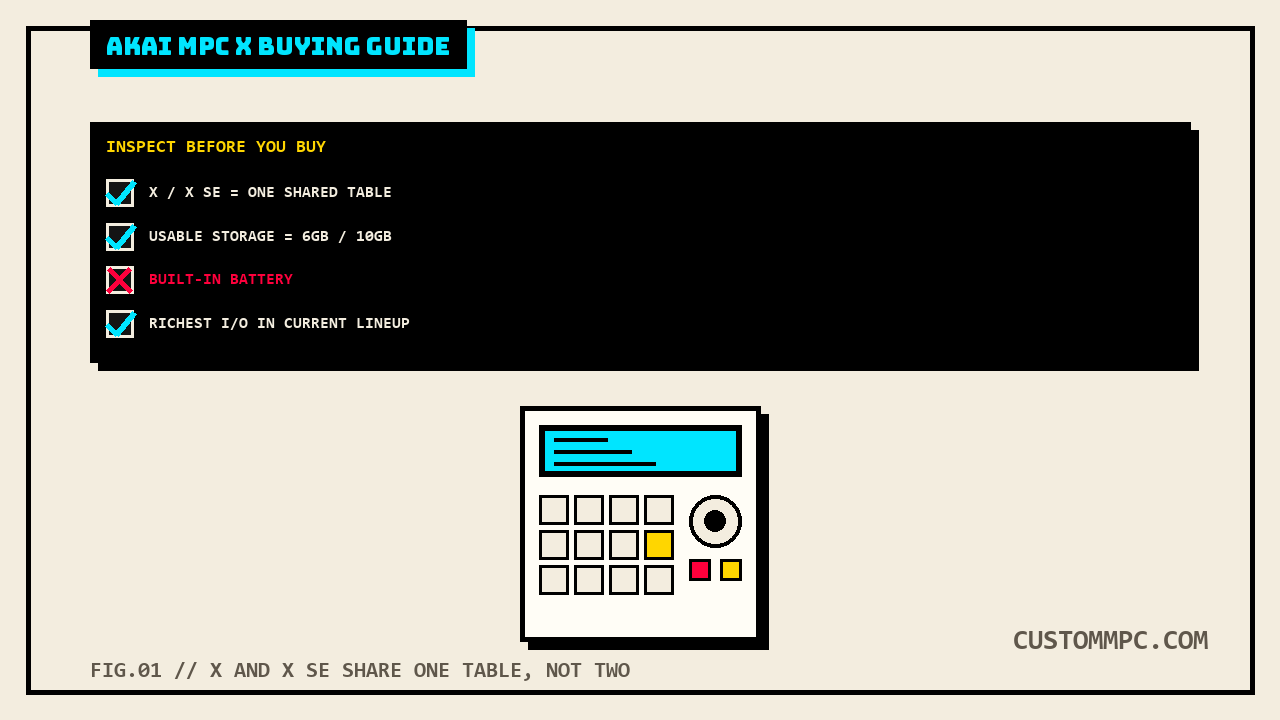
The short version
The Akai MPC X launched in the first quarter of 2017 at a street price of $1,999, announced alongside the battery-powered MPC Live as Akai's first standalone MPC generation, the rack-style flagship built around a 10.1" touchscreen and a full pro-audio interface rather than the compact all-in-one shells the rest of the lineup would later use. On April 26, 2023, Akai released the MPC X Special Edition worldwide at $2,499 to mark the MPC platform's 35th anniversary, dating from the original 1988 MPC60, in a retro grey color scheme matching the same-era Special Edition treatments given to the MPC Live II and MPC One. Akai's own current Standalone OS User Guide (v3.9) documents both machines under a single combined "MPC X / MPC X Special Edition" heading in its Technical Specifications appendix, not two separate tables the way it treats the three Key-family machines, and reading that shared table closely shows the two differ in exactly two rows: RAM and internal storage.
SAM'S NOTE: "Special Edition" sounds like it should mean a different machine, the way MPC One versus One+ or Key 37 versus Key 37 G2 usually do on this site. It doesn't here. Akai's own manual treats X and X SE as one hardware platform with two memory configurations and, per the press coverage, a repainted faceplate. If you're buying used and the RAM/storage sticker isn't visible in the listing photos, ask before you assume which one you're getting.
One table, two RAM figures
Every other current-lineup buying guide on this site has found real, multi-row spec differences hiding behind a shared family name: the Key 61, Key 37, and Key 37 G2 each get their own separate table with different processors, wireless rows, and connections; the MPC One and One+ share a table but differ in storage and power adapter rating. The MPC X pair is the simplest split of the bunch. Per Akai's own current manual, RAM is 2GB for the standard MPC X and 4GB for the Special Edition; Internal Storage is listed as 16GB (6GB of actual user storage) for the standard unit and 48GB (10GB of user storage) for the SE. Every other row in the table, audio I/O, pads, knobs, display, connections, power, dimensions, and weight, is identical between the two, confirmed by reading the shared table line by line rather than assuming parity. WebSearch-indexed coverage of the SE launch independently corroborates the same RAM and storage jump and adds the one difference the manual's spec table doesn't carry: a retro grey color scheme, cosmetic only, with no external hardware or connection changes reported.
Real specs, straight from the manual
Every figure below is quoted or paraphrased directly from Akai's own MPC_Standalone_OS_User_Guide_v3.9.pdf Technical Specifications appendix, PDF pages 468-470 (printed page footers 468-470, a flat, zero-offset match between PDF page index and printed footer at this point in the appendix), independently confirmed via a direct pdftotext -layout extraction cross-checked against a page-indexed pymupdf read of the same three pages.
| Spec | MPC X | MPC X Special Edition |
|---|---|---|
| RAM | 2 GB | 4 GB |
| Internal storage | 16 GB (6 GB user storage) | 48 GB (10 GB user storage) |
| Storage expansion | Via SATA connections, plus a dedicated SD card slot | |
| Display | 10.1" full-color 1280x800 touch display, capacitive multi-touch | |
| Pads / knobs | 16 velocity- and pressure-sensitive RGB pads (8 banks); 16 touch-sensitive Q-Link knobs; 7 knobs for gain/mix/level; 1 data encoder | |
| Audio inputs | 2 combo XLR/TRS mic/line, 2 TRS line, 2 TS instrument, 2 RCA phono/line | |
| Audio outputs | 8 TRS outputs total (Main L/R + 3 stereo pairs), 2 headphone (1/4" + 1/8") | |
| CV/Gate | 8 x 1/8" TS outputs | |
| MIDI DIN | 2 x 5-pin in, 4 x 5-pin out | |
| Footswitch | 2 x 1/4" TS inputs | |
| USB | 2x USB Type-A, 1x USB Type-B | |
| Power | External adapter, 19V, 3.42A, center-positive | |
| Built-in battery | None; wall power required | |
| Weight | 12.57 lb. / 5.66 kg | |
The richest I/O in the current lineup
Three findings worth knowing before you shop this machine against the rest of the standalone family. First, the MPC X's own Connections list carries more physical jacks than any other current-lineup spec table on this site: 8 CV/Gate outputs against the MPC One's 4 and the MPC Live's zero, plus 2 five-pin MIDI inputs and 4 five-pin MIDI outputs, more MIDI DIN ports than the MPC Live's 2-in/2-out pair or the MPC One's single in/out pair. This site's mpc-cv-gate-tracks article already established that the MPC X's CV/Gate jacks are TS-only, one signal per jack, with no TRS breakout option the way MPC Live II, One, One G2, Key 37, and Key 37 G2 have; the 8-jack count here is a real quantity advantage, not a quality one, over those TRS-breakout machines' 4-jack-plus-cable arrangement for the same 8 total signals. Second, the internal storage figure is a real trap for anyone assuming "flagship" means "roomy": 16GB total on the standard MPC X resolves to just 6GB of actual usable user storage once the OS and system files are accounted for, and even the Special Edition's 48GB only nets 10GB usable, both figures stated directly by Akai rather than inferred. Neither figure is a hard ceiling in practice, since the same Connections list documents both a dedicated SD card slot and SATA expansion for a full internal drive swap, but the out-of-box number is genuinely small for a machine in this price bracket and worth planning for before the pads are loaded up. Third, like every other current standalone MPC except the Live and Live II, the MPC X and X SE have no built-in battery at all; Akai's own manual states this in the same sentence that covers the rest of the lineup, so a battery-powered MPC X isn't an option Akai documents in any configuration.
This site's mpc-qlink-knobs article already covers the MPC X and X SE's other real hardware distinction in full detail: the only current standalone MPCs whose Q-Link knobs each carry their own OLED parameter-name strip, rather than reading Q-Link assignments off the main touchscreen the way every other model does. Not re-derived here; see that article for the complete workflow breakdown.
The checklist: storage, battery, jacks
Run these in order before you commit to a specific listing.
1. Confirm which unit you're buying by RAM or storage, not by trusting the listing title
Since the external hardware is identical between the two, a seller's title alone doesn't guarantee which one is in the box. Ask for the RAM/storage figure from the unit's own System Info screen, or for a photo of the retro grey Special Edition faceplate, before paying an SE premium.
2. Budget storage expansion into the purchase, not as an afterthought
6GB of usable storage on the standard MPC X fills up fast once expansions and multitrack projects are loaded. An SD card handles portable kits like this site's own free Starter Rack without any drive work; a SATA internal drive is the move for a permanent library.
3. Don't shop this machine expecting battery power under any configuration
Neither the standard MPC X nor the Special Edition can run on internal battery in any documented configuration; only MPC Live and MPC Live II can. Plan for wall power or a third-party power solution if portability matters.
4. If you're planning a modular CV rig, confirm TS vs TRS before you buy cables
The MPC X's 8 CV/Gate jacks are TS-only, one signal per jack; don't buy TRS breakout cables expecting the same two-signals-per-jack trick that works on MPC Live II, One, One G2, or the Key 37 pair.
What they actually cost right now
The original MPC X launched in Q1 2017 at a reported $1,999 street price, announced alongside the MPC Live as Akai's first standalone-MPC generation. The MPC X Special Edition launched April 26, 2023 at $2,499, a $500 premium over the original's launch price for double the RAM, roughly triple the total internal storage, and the retro grey cosmetic treatment, six years after the original and priced for the platform's 35th-anniversary positioning rather than as a straight successor. Both figures are launch/street prices from press coverage rather than current retailer listings, which shift with periodic sale pricing; confirm the specific unit's current asking price directly before buying.
Common mistakes
Mistake: assuming "Special Edition" means a different spec table, the way it does for other MPC families on this site. Akai's own manual treats MPC X and MPC X SE as one combined table differing in exactly two rows: RAM and internal storage.
Mistake: reading "48GB" or "16GB" as the usable storage figure. Akai's own table states usable user storage as 10GB (SE) and 6GB (standard) respectively, well below the advertised total.
Mistake: buying TRS breakout cables for the MPC X's CV/Gate jacks. They're TS-only, one signal per jack, per this site's own mpc-cv-gate-tracks findings; TRS breakout cables work on other current models, not this one.
Mistake: expecting battery operation because the machine is the flagship. Only MPC Live and MPC Live II carry a built-in battery in Akai's current lineup; the MPC X and X SE both require wall power in every documented configuration.
A note on sources
The MPC X / MPC X Special Edition table sits at PDF pages 468-470 (printed footers 468-470) in the current v3.9 Standalone OS User Guide; the identical table, word for word, sits at PDF pages 443-445 (printed footers 443-445) in the earlier v3.7 manual, a flat +25-page offset with zero content differences confirmed by direct comparison of both tables in full, the same book-growth-not-new-features pattern this site has now independently confirmed for four separate spec tables across different manual sections (this article, mpc-air-plugins, mpc-sample-edit-process-menu, and mpc-pad-perform-mode). Both PDF page indices were independently cross-checked against their printed page footers via pymupdf, and both matched exactly, meaning no offset exists between the PDF's internal page count and Akai's own printed numbering at this specific point in either manual version.
Launch dates and pricing for both the original MPC X and the MPC X Special Edition came from WebSearch-indexed press coverage rather than direct retailer fetches, consistent with this site's established practice on pricing claims; where a specific figure appears in this article, it's attributed to that press source rather than upgraded to a primary-source claim. The Special Edition's cosmetic retro-grey detail and its "no other hardware changes" characterization are likewise press-sourced, since Akai's own spec table doesn't document color or cosmetic finish at all; both independently agree with, and add color to, the RAM/storage figures the primary manual confirms directly.
Verdict
VERDICT
The specs: MPC X and MPC X Special Edition share one table in Akai's own current manual, differing only in RAM (2GB vs 4GB) and internal storage (16GB/6GB usable vs 48GB/10GB usable), plus a press-confirmed retro grey cosmetic treatment on the SE that never appears in the spec table itself. The MPC X carries the richest physical I/O of any current standalone MPC, 8 CV/Gate jacks and 6 total MIDI DIN ports, but those CV/Gate jacks are TS-only with no breakout option. The purchase: confirm which unit a listing actually is by RAM/storage or faceplate color rather than trusting the title, budget an SD card or SATA drive immediately given how little storage ships usable out of the box, and don't buy TRS breakout cables for the CV rig. Neither model has a built-in battery under any configuration. The money: the original launched at a press-reported $1,999 in Q1 2017; the Special Edition launched April 26, 2023 at $2,499 for the platform's 35th anniversary, a real spec bump for a real price bump, six years apart rather than a direct year-over-year refresh. Get the RAM/storage figure confirmed first and the rest of this checklist runs quick.
Bought one recently, or found something this checklist should have caught? Tell us what happened.