BUYING GUIDE MPC2000
Akai MPC2000 buying guide: what's actually different from the 2000XL
A lot of used listings say "MPC 2000" when they mean the 2000XL, and a lot of buyers assume the two are the same machine a few years apart. They aren't. The original MPC2000 is a real, distinct product with its own Owner's Manual, its own spec sheet, and several concrete differences from the XL that matter the moment you're planning a mod or checking whether your sample library will actually load. Here's what Akai's own manual says the original 2000 can and can't do, straight from the primary source, not a forum recap.
The short version
The Akai MPC2000 is a 1997 standalone sampler/sequencer, two years ahead of the MPC2000XL that eventually replaced it and is far more commonly seen on the used market today. Stock, the original 2000 ships with 2MB of sound memory expandable to 32MB across two SIMM slots, 128 sounds held in memory at once, 32 simultaneous playback voices, 16-bit/44.1kHz sampling, and a 25-pin D-type SCSI connector. None of those numbers match the MPC2000XL that came after it, and the gap is bigger than most buyers expect. This article exists because "MPC2000" and "MPC2000XL" get used interchangeably in listings and forum posts constantly, and if you're specifically shopping for one or the other, the difference changes what fits in memory, what SCSI hardware you'll need for a storage mod, and how much sequence you can actually record.
DEX'S NOTE: I almost bought a "2000" off a local classifieds listing once assuming it was shorthand for a 2000XL, the way people say "an XL" and mean the whole family. It wasn't. Different SCSI connector than the SCSI2SD kit I already owned, half the sound slots I was expecting. Worked out fine once I knew what I was actually looking at, but I paid XL money for the ask before I checked. This guide is the five minutes of manual-reading that would have saved me the trip.
What the original MPC2000 actually is
Akai's own feature summary for the 2000 opens the same way the 2000XL's does two years later: a 248 x 60 dot graphic LCD with six function keys under it, a built-in 1.44MB floppy drive for both sequences and sound data, and a built-in SCSI interface for external hard disk storage. It's the same core idea as every MPC in this family: a self-contained sampler and MIDI sequencer, no computer required to load a sound, chop it, program a drum track, and sequence a full arrangement. What it isn't is a smaller-numbered rebadge of the 2000XL. It shipped first, in 1997, running Software Version 1.0 out of the box, and Akai treated it as its own product with its own printed Owner's Manual, not an addendum to the XL's documentation. If you're seeing "MPC2000" on a listing today, it usually is genuinely the earlier, separate machine, not shorthand, and the checklist below is written for that machine specifically.
Real specs, straight from the manual
Every number below is quoted or paraphrased directly from Akai's own MPC2000 Owner's Manual, downloaded fresh from archive.org for this article (no readable local copy existed for the original 2000 before now; only the 2000XL's Operator's Manual and an image-only, textless MPC2000/2000XL Service Manual scan were previously on file here).
| Spec | Figure |
|---|---|
| Sound memory | 2MB standard, expandable to 32MB via two 72-pin SIMM slots (70ns) |
| Sample format | 16-bit linear, 44.1kHz stereo |
| Max sounds in memory | 128 |
| Simultaneous playback voices | 32 |
| Sound programs | 24 max |
| Filter | 12dB/octave dynamic resonant lowpass, per voice |
| Sequencer capacity | Manual states two different figures for the same spec, see the sources note below |
| Sequences / tracks | 99 sequences, 64 tracks per sequence |
| Sequencer resolution | 96 ppq (parts per quarter note) |
| Song mode | 20 songs, 250 steps per song |
| Pads | 16, velocity and pressure sensitive, across 4 banks |
| MIDI | 2 independent output ports (32 channels total), 2 mergeable inputs |
| Storage | 3.5" 2HD/2DD floppy drive, plus Apple 25-pin D-type SCSI connector (fixed ID 6, terminated) |
| Display | 248 x 60 dot graphic LCD |
| Dimensions / weight | 405(W) x 126(H) x 328(D) mm, 6.3kg |
| Power | 100 to 120V / 220 to 240V AC, 50/60Hz, 23W (13W without options) |
Most of that table lines up with what you'd expect from an MPC of this era. Two rows don't, and they're the two that actually change a buying or modding decision, covered in full in the next section: the SCSI connector isn't the same physical connector the 2000XL uses, and the sequencer capacity figure is genuinely unclear because Akai's own manual states it two different ways.
What's actually different from the 2000XL
Five concrete differences, each pulled directly from both manuals rather than assumed from the model numbers being close together.
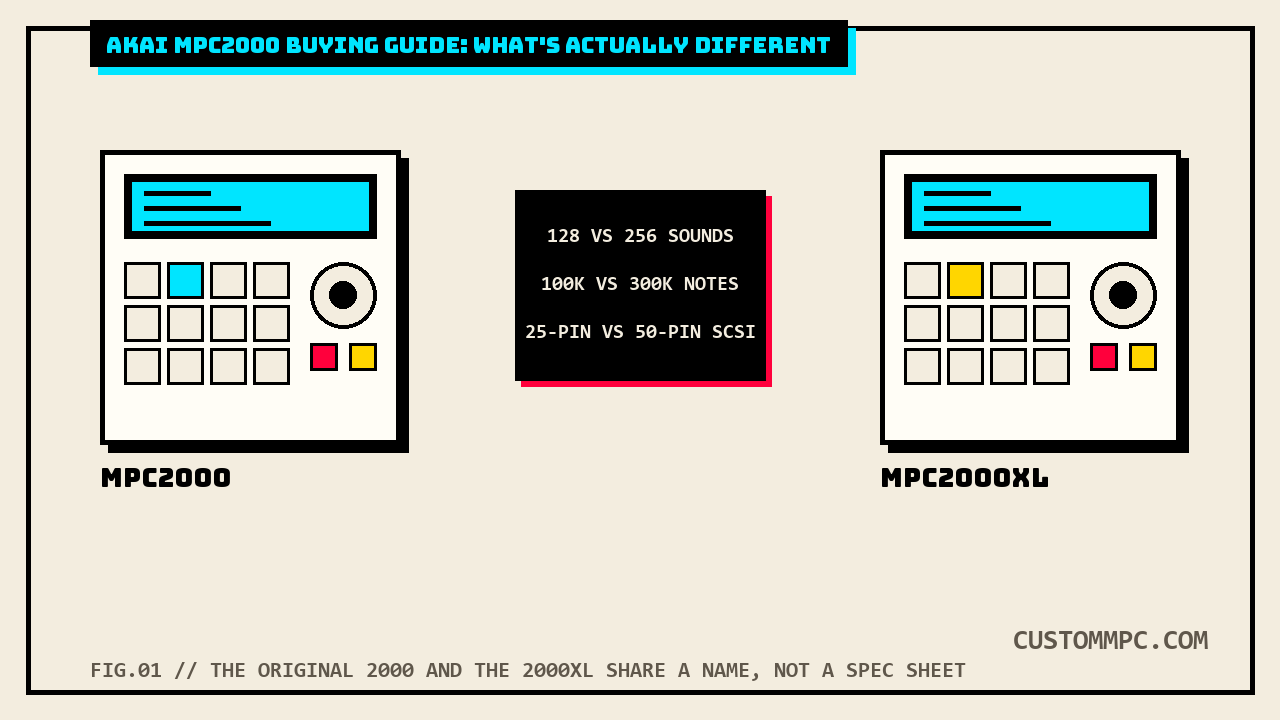
Sound slots: 128 vs 256
The original 2000 holds a maximum of 128 sounds in memory at once. The 2000XL doubles that to 256. Everything else in the two manuals' opening Sampler feature lists is worded identically, same bullet order, same phrasing, right up to this one number. If you're planning to load a large multi-sampled kit rather than a handful of one-shots, this is the number that determines whether it fits.
SCSI connector: 25-pin vs 50-pin, a genuinely different cable
The original 2000 uses an Apple 25-pin D-type SCSI connector. The 2000XL uses a 50-pin high-pitch SCSI connector. These aren't the same port with a different name, they're physically different connectors requiring different cables and, if you're installing a SCSI2SD or ZuluSCSI board, a different kit than the one built for the 2000XL. Our own SCSI to SD mod guide was written against 2000XL-era hardware; if you're modding an original 2000, confirm the kit you're buying is listed for the 25-pin connector specifically, not the XL's 50-pin one, before you order anything.
Sequencer capacity: the 2000's own manual disagrees with itself, and both readings are behind the XL
This is the murkiest one, stated here as a genuine unresolved conflict rather than smoothed into a single confident number. In the same spot in both manuals, Chapter 1's Sequencer feature list, the 2000XL states "Sequencer memory equivalent to 300,000 notes." The original 2000's Chapter 1 Sequencer feature list, at the identical position, states "10,000 note sequencer memory capacity." That's already a 30-times gap between the two models at the exact same citation point. But the original 2000's own Technical Specifications appendix, later in the same manual, gives a different figure for what appears to be the same "Maximum events" spec: 100,000 notes. Two different figures for the same spec inside the same manual, 10,000 versus 100,000, a full order of magnitude apart, and this research can't resolve which one is correct from the primary source alone. What can be stated with confidence either way: even the higher 100,000-note reading is still well short of the 2000XL's stated 300,000-note capacity. If sequence length for long, complex arrangements matters to you, treat the original 2000 as the smaller-capacity machine of the two regardless of which of its own numbers you believe.
Simultaneous programs: the 2000XL added a layering feature the original lacks
The 2000XL's Sampler feature list includes a line the original 2000's list doesn't have at all: "A maximum of up to 4 programs can be played simultaneously." Every other bullet around it, program count, polyphony/mono selection, note-stealing behavior, is worded identically between the two manuals; this one sentence is simply absent from the 2000's list. If your workflow depends on layering multiple programs across a single performance, that's a 2000XL-only capability per Akai's own documentation.
No WAV import/export, no built-in timestretch on the original
Two more lines present only in the 2000XL's feature list: "Reading and writing of PC compatible .WAV sound files," and "Timestretch, resample, wave pattern edit functions, etc. are available." Neither appears anywhere in the original 2000's Chapter 1 feature summary. Practically: getting modern WAV samples onto an original 2000 means going through a SCSI-attached drive or a conversion step the 2000XL's own built-in WAV support skips entirely, and there's no in-machine timestretch to lean on if a sample doesn't match your session tempo.
The physical checklist
Run these in order, cheapest and fastest checks first, before you commit to anything expensive to verify later. This mirrors the checklist in our 2000XL buying guide where the hardware overlaps, adjusted for the two spec differences above.
1. Confirm it's actually the original 2000, not a mislabeled XL
Before anything else, check the front panel badge and, if possible, the rear panel SCSI connector in listing photos: a 25-pin D-type connector confirms the original, a 50-pin high-pitch connector means it's actually a 2000XL regardless of what the listing title says. Sellers mislabel these in both directions, sometimes calling a 2000XL a "2000" for short, sometimes the reverse; don't rely on the listing title alone.
2. Power on and check the OS version screen
Hold SHIFT and press OTHER (8 on the numeric pad), then press F3 to open the Version screen, which displays the operating system version currently loaded. Ask the seller what version is installed before you show up. It matters more on this model than the XL: Akai's own manual notes that the EB16 effects board, the FMX008M flash ROM board, and the IB-M20T SMPTE board are all "Not supported by V1.0 version software. It requires the OS software version upgrade in future." If a listing advertises any of those three option boards as installed, confirm the OS has actually been updated past V1.0, or the board may be physically present and non-functional.
3. Inspect the screen itself, not just whether it turns on
Same 248 x 60 dot graphic LCD as the 2000XL, and the same age-related degradation risk. Check every corner and edge under good light, not just the center. A unit with visible pixel dropout is a screen replacement in your near future regardless of which of the two models it is.
4. Test the floppy drive under real load, not just once
Bring a floppy disk and actually save and reload a sequence more than once, ideally after the unit has been powered on for fifteen to twenty minutes rather than immediately after power-up. Community reports on this generation of drive describe failures that specifically show up after runtime rather than on a cold first load. A used replacement floppy drive listed as compatible with "Akai MPC 2000 or 2000 XL" runs about $75.90 from mpcstuff at the time of writing, the same part covers both models.
5. Check the SCSI port matches what you're planning to connect
Confirmed factory ID 6, terminated at the factory, same as the 2000XL, but a physically different 25-pin connector. Ask whether the unit has run an external SCSI drive or a storage mod, and if you're planning your own SCSI2SD or ZuluSCSI install, buy a kit and adapter cable rated for the 25-pin connector specifically, not a 2000XL kit assuming it'll fit.
6. Ask about the battery, and don't expect a confirmed answer
Same honest gap as the 2000XL: this research could not locate a readable Akai service manual confirming the exact backup battery part number or chemistry for either model, covered in more detail in our own battery backup replacement guide. Treat settings or memory loss between power cycles as a symptom worth a tech's direct diagnosis, not something this guide can pre-diagnose from a listing photo.
7. Play every pad, hard and soft, and watch for cross-talk
Sixteen pads, velocity and pressure sensitive, across four banks, identical spec to the 2000XL. Play each one across its full dynamic range and watch for a neighboring pad lighting up when you hit a different one cleanly. If you hear or see cross-talk, that's a sensor board issue, covered in full, including the honest gap in what Akai's manuals document about pad calibration on this hardware generation, in our pad repair and calibration guide.
What they actually cost right now
The original 2000 is meaningfully rarer on the used market than the 2000XL, which sold in far greater numbers and for longer. A check of current Reverb listings at the time of writing shows working original MPC2000 units trading from roughly $399 up to around $999, with a real Good-condition listing at $530 (marked down from an original $650 asking price) sitting closer to the middle of that spread, noticeably below the 2000XL's current $900 to $1,300 range covered in our 2000XL guide, reflecting lower demand for the earlier, lower-capacity model rather than actual scarcity driving a premium. That price gap is worth weighing against the spec gap above: you're paying less, but you're also getting half the sound slots, a smaller (and internally disputed) sequencer capacity, no built-in WAV support, and a SCSI connector that won't work with a 2000XL-branded storage mod kit out of the box.
Common mistakes
Mistake: assuming "MPC2000" in a listing title always means the 2000XL. It often doesn't. Check the SCSI connector in photos, or ask directly, before you assume compatibility with a 2000XL-specific mod kit or accessory.
Mistake: buying a unit with EB16, FMX008M, or IB-M20T option boards installed without confirming the OS version. All three are explicitly unsupported on the factory V1.0 software per Akai's own manual.
Mistake: treating the sequencer capacity number as settled. Akai's own manual states it two different ways in two different sections. Don't quote either the 10,000 or the 100,000 figure to someone else as a confirmed spec; both are directly sourced, and this research couldn't determine which one is the error.
Mistake: buying a 2000XL-branded SCSI2SD kit for an original 2000, or vice versa. The connectors are physically different (25-pin D-type vs 50-pin high-pitch); confirm the kit is rated for your specific model before ordering.
A note on sources
This article's central finding is the sequencer capacity conflict covered in full above: Akai's own Chapter 1 feature summary states "10,000 note sequencer memory capacity" for the original MPC2000, while the same manual's own Technical Specifications appendix states "Maximum events (notes equivalent): 100,000 notes" for what appears to be the identical spec. Both figures were independently re-checked directly against the raw extracted manual text, not the column-reflowed layout extraction, to rule out an OCR misread before citing either one. This site's standing rule is that a conflict inside a primary source gets stated, not quietly resolved, and this is a genuine one: a full order of magnitude apart, in the same document, describing the same machine.
Separately: as with the 2000XL buying guide, the MPC2000/2000XL Service Manual on file has no extractable text layer, an image-only scan across all sixteen pages. Everything in the checklist above that touches physical hardware condition is sourced to the Owner's Manual (which does have a readable text layer once freshly downloaded and extracted for this article) plus community forum reports, labeled as such, not to a service manual this research doesn't have readable access to.
Verdict
VERDICT
The specs: 2MB sound memory expandable to 32MB, 128 sounds in memory, 32 voices, 16-bit/44.1kHz, and a 25-pin D-type SCSI port, all confirmed straight from Akai's own manual. What's different from the 2000XL: half the sound slots (128 vs 256), a physically different SCSI connector, a sequencer capacity that's smaller either way you read the 2000's own conflicting numbers, no simultaneous multi-program layering, and no built-in WAV import or timestretch. The purchase: confirm you're actually looking at the original before assuming XL-era accessories or mod kits will fit, check the OS version if any option boards are claimed installed, and run the same screen/floppy/SCSI/battery/pad checks that matter on any 25-plus-year-old MPC. The money: real listings put the original 2000 meaningfully below 2000XL prices right now, which can be a fair trade if you know exactly what you're giving up for it.
Bought one recently, or found something this checklist should have caught? Tell us what happened.