BUYING GUIDE MPC KEY
Akai MPC Key buying guide: Key 37, Key 37 G2, or Key 61
This site's mpc-one-buying-guide already covered one modern-standalone family with a naming trap built in; the Key line has the same problem from a different angle. "MPC Key" today means three real machines across two body styles, and the spec differences don't sort the way the model numbers suggest. The 61-key flagship has no wireless radio at all, while the compact 37-key original does, and the newer, pricier Key 37 G2 quietly drops a Bluetooth profile its own predecessor shipped with. Real specs from Akai's own current manual, straight from the Technical Specifications appendix, before you spend money on any of the three.
The short version
Akai's first standalone keyboard MPC, the MPC Key 61, launched in June 2022 as a 61-key semi-weighted workstation built around the same MPC 2.0 engine as the Live and One lines, followed in early 2024 by the compact MPC Key 37, a 37-key synth-action version in a different, smaller chassis. On June 18, 2026, the same day Akai announced the MPC One G2, it also announced the MPC Key 37 G2, an 8-core redesign of the compact keyboard replacing the original Key 37's quad-core-class hardware, while the Key 61 has received no G2 refresh at all as of this writing. Akai's own current Standalone OS User Guide (v3.9) documents all three machines with dedicated Technical Specifications tables, and reading them side by side surfaces a genuine surprise: the flagship 61-key model has no Wi-Fi or Bluetooth row anywhere in its table, while the smaller, cheaper original Key 37 does. None of the three has a built-in battery, the same real, easy-to-assume-wrong point this site's mpc-one-buying-guide found for the One family: only the MPC Live and MPC Live II can run off internal power in the current lineup.
SAM'S NOTE: People assume the Key line is just "MPC One with a keyboard bolted on," bigger keybed, bigger price, same guts. It isn't. The 61 and the two 37s aren't the same hardware platform wearing different plastic, and the wireless gap in particular runs opposite to what you'd guess: the cheapest one in this lineup is the one with Wi-Fi and Bluetooth built in.
Three machines, two body styles
The MPC Key 61 is the oldest and physically largest of the three: a 61-key semi-weighted keybed with aftertouch, built-in stereo audio interfacing with combo XLR/TRS mic and line inputs, an Ethernet port unique to this model among the Key line, and internal power via a standard IEC cable rather than an external brick, all confirmed directly in Akai's own current spec table. The original MPC Key 37, released in early 2024, is a different, smaller chassis entirely: 37 synth-action keys (Akai's own marketing has compared the feel to a Mini Moog), no Ethernet port, no built-in audio interface with mic preamps, and power via an external 12V, 3A adapter rather than an internal supply. The MPC Key 37 G2, announced June 18, 2026, keeps the same 37-key synth-action chassis and the same external 12V/3A power adapter as the original, but replaces the internals: an eight-core processor against a table that never names one for its predecessor, 4GB RAM against 2GB, and 64GB storage against 32GB, plus a USB-C port where the original has USB-B.
Real specs, straight from the manual
Every figure below is quoted or paraphrased directly from Akai's own MPC_Standalone_OS_User_Guide_v3.9.pdf Technical Specifications appendix. The Key 61 table sits at PDF pages 479-481 (printed page footers 479-481); the original Key 37 table sits at PDF pages 482-483 (printed footers 482-483); the Key 37 G2 table sits at PDF pages 484-485 (printed footers 484-485), a flat continuation with no page-number offset at this point in the appendix, confirmed by direct pdftotext -f 479 -l 486 extraction against the isolated pages, independently cross-checked against a second, position-sorted pymupdf pass on the same pages.
| Spec | MPC Key 61 | MPC Key 37 | MPC Key 37 G2 |
|---|---|---|---|
| Processor | Not named in this table | Not named in this table | Eight-core ARM processor |
| RAM | 4 GB | 2 GB | 4 GB |
| Storage | 32 GB, expandable via SATA | 32 GB | 64 GB |
| Keybed | 61 semi-weighted keys, aftertouch | 37 synth-action keys, aftertouch | |
| Pads / knobs | 16 velocity- and pressure-sensitive RGB pads (8 banks), 4 Q-Link knobs | ||
| Display | 7.0" full-color LED-backlit touch display | ||
| Wi-Fi | None documented in this table | 2.4/5 GHz, 802.11a/b/g/n/ac | 2.4/5 GHz, 802.11a/b/g/n/ac |
| Bluetooth | None documented in this table | v5, HID + A2DP profiles | v5, HID profile only |
| Audio I/O | 2 combo XLR/TRS mic/line, 2 unbalanced inst in, 4 TRS out, headphone | 2 balanced TRS line in, 2 TRS out, headphone (no mic pres) | |
| CV/Gate | 8 TS mono outputs | 4 TRS stereo outputs | 4 TRS jacks, 8 outputs total |
| USB | 2x USB-A, 1x USB-B | 1x USB-A, 1x USB-B | 1x USB 3.0 A, 1x USB 3.0 Type-C |
| Ethernet | 1 port | None documented in either table | |
| Power | Internal, IEC cable, 100-240V AC 65W | External adapter, 12 V, 3 A, center-positive | |
| Built-in battery | None on any of the three; wall power required | ||
| Weight | 17.9 lbs / 8.1 kg | 8.82 lbs / 4 kg | 9.61 lbs / 4.36 kg |
The wireless split runs backwards
Three real findings worth knowing before you shop this lineup on spec sheets alone. First, and most counterintuitive: Akai's own current spec table for the Key 61, the largest, heaviest, and historically the model with the built-in audio interface, has no Wi-Fi or Bluetooth row anywhere in it, while the original Key 37, a smaller and cheaper machine, documents both. Second, the wireless story isn't even consistent across the two Key 37 generations: the original's Bluetooth row lists two profiles, HID (for MIDI-over-Bluetooth-style control) and A2DP (for audio streaming), while the G2's own table lists HID only, meaning the newer, $100-pricier machine ships with one fewer Bluetooth profile than the model it replaces, not one more. Third, neither the Key 61 table nor the original Key 37 table names an actual processor anywhere in Akai's own current documentation, listing only RAM and storage figures; the Key 37 G2 is the only one of the three whose table states a specific chip, an eight-core ARM processor, leaving buyers of the other two machines with real spec gaps in Akai's own reference material rather than a documented number to compare against.
Worth flagging directly rather than resolving quietly: a third-party support article comparing the original Key 37 to the Key 37 G2 states the original shipped with 16GB of storage and a "MCS I" processor, both of which conflict with Akai's own current Standalone OS User Guide, whose Key 37 table plainly states 32GB of internal storage and never names a processor at all. Both are Akai-published documents, they simply disagree with each other; the Standalone OS User Guide's Technical Specifications appendix is this site's primary reference for hardware specs across every article, so 32GB is what's used in the table above, with the conflict stated here rather than silently dropped.
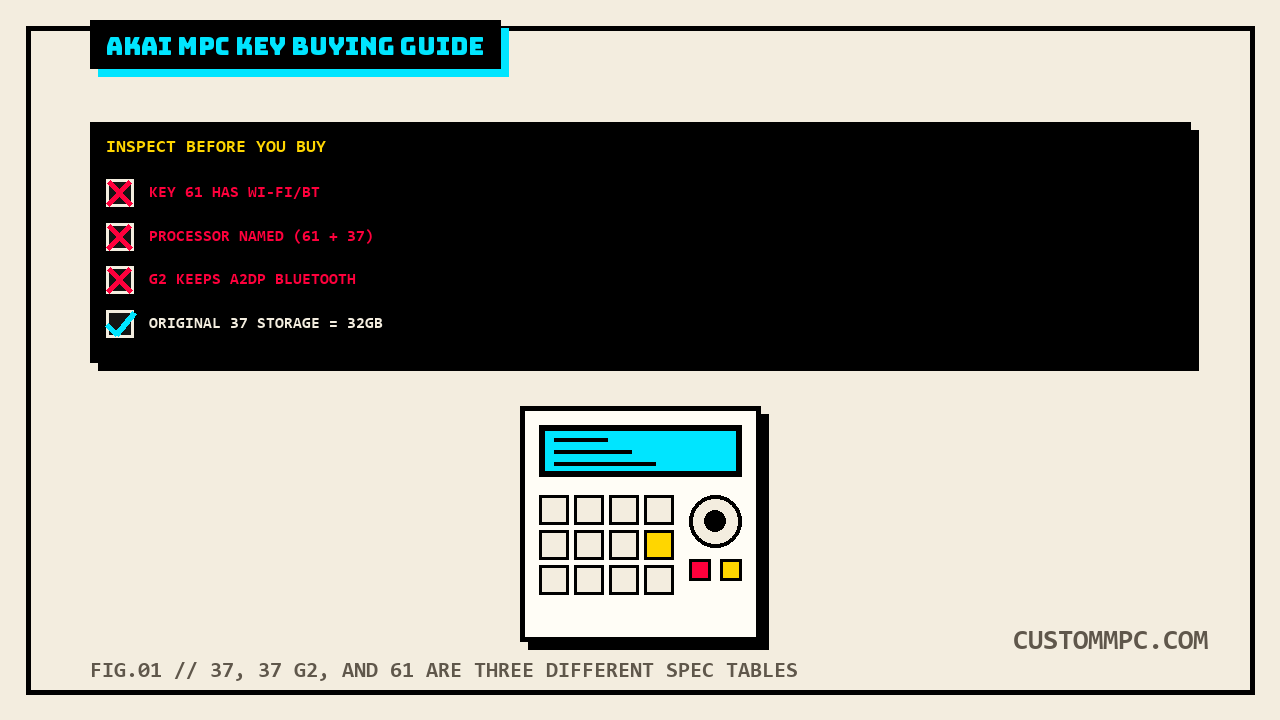
The checklist: wireless, processor, storage
Run these in order before you commit to a specific listing.
1. Don't assume the flagship has the flagship's features
If wireless file transfer or Bluetooth MIDI control matters to your workflow, the Key 61, despite being the largest and most expensive machine in the lineup with the built-in audio interface, is the one without it in Akai's own current spec table. Confirm this on the specific unit if it's a deciding factor.
2. If Bluetooth audio streaming matters, the G2 isn't automatically the better pick
A2DP, the profile that streams stereo audio over Bluetooth, is present on the original Key 37 and absent from the Key 37 G2's own table, which lists HID only. Anyone relying on Bluetooth audio out from a Key 37 should verify this before assuming the newer model carries every feature forward.
3. Treat "processor" claims for the Key 61 and original Key 37 as unverified against Akai's own primary table
Third-party listings and comparison pages sometimes name a specific chip for these two machines; Akai's own current manual doesn't, for either. Where a processor figure matters to a buying decision, that's a real gap in the primary documentation, not a settled spec.
4. Confirm storage against the manual, not a third-party comparison page, if the figure changes your decision
Akai's own current Standalone OS User Guide states 32GB for the original Key 37; at least one Akai-published support article states 16GB for the same machine. If storage capacity is close to a deciding factor, verify the specific unit's actual usable space directly rather than trusting either figure blind.
5. Budget for a power bank if portability matters
None of the three Key-family machines has a built-in battery; Akai's own manual states plainly that only the MPC Live and MPC Live II can run off internal power. A genuinely portable Key rig means a third-party power solution, not a feature the hardware includes out of the box.
What they actually cost right now
The MPC Key 61 launched in 2022 at a reported $1,499, though this figure is press-sourced rather than pulled from a current Akai listing, since retail pages for the model shift with periodic sale pricing. The original MPC Key 37 launched in early 2024 at $899. The MPC Key 37 G2 launched June 18, 2026 at $999 US ($849 UK, $999 EU per the announcement's own listed regional pricing), a $100 premium over the original's launch price for the eight-core processor, double the RAM, and double the storage, offset against the loss of the A2DP Bluetooth profile noted above. The Key 61 remains the only one of the three with a built-in audio interface and no G2 successor as of this writing, a real consideration for anyone comparing this lineup on interface I/O rather than processing headroom alone.
Common mistakes
Mistake: assuming the Key 61, as the largest and priciest machine, has every feature the smaller Key 37 has. Akai's own current spec table gives the Key 61 no Wi-Fi or Bluetooth row at all, a real gap against both Key 37 variants.
Mistake: assuming the Key 37 G2 is a strict feature upgrade over the original Key 37. It drops the A2DP Bluetooth profile the original documents, alongside real gains in processor, RAM, and storage; check the specific feature you need rather than assuming "newer" means "more."
Mistake: trusting a specific processor name for the Key 61 or original Key 37. Akai's own current manual doesn't name one for either machine; only the Key 37 G2's table states a chip.
Mistake: trusting a single support article's storage figure for the original Key 37 over the current user guide. A G2-comparison FAQ states 16GB; the Standalone OS User Guide's own Technical Specifications appendix states 32GB. Both are Akai documents; they disagree.
Mistake: expecting built-in battery power because a sibling model has it. Only the MPC Live and MPC Live II can run off internal battery per Akai's own manual; every Key-family machine needs a wall outlet or a third-party power bank.
A note on sources
Rule two on this site is that conflicts get stated, not quietly resolved, and this article surfaced a real one: a support article on Akai's own site comparing the original MPC Key 37 to the Key 37 G2 lists the original's storage as 16GB and names its processor as "MCS I," while the current v3.9 Standalone OS User Guide's own Technical Specifications appendix, a separate Akai-published document, states 32GB for the same machine and names no processor at all. Both extraction passes against the primary manual (a direct linear pdftotext pull and an independent position-sorted pymupdf pass) agree with each other on the 32GB figure and the absence of a processor row, so the primary-source reading itself isn't in doubt; the support-article figures are presented as a genuine, unresolved conflict against that reading rather than assumed wrong. This is a different flavor of conflict than the press-vs-manual gap this site's mpc-one-buying-guide found for Wi-Fi/Bluetooth claims on the One+; here, both conflicting documents are Akai's own.
Pricing for all three machines came from WebSearch-indexed press and review coverage rather than direct retailer fetches; where a specific dollar figure is stated in this article, it's attributed to that press source rather than upgraded to a primary-source claim. The MPC Key 37 G2 announcement date, price, and headline specs came from WebSearch-indexed coverage of Akai's own June 18, 2026 announcement, cross-checked against the hardware's own spec table inside the already-verified local copy of MPC_Standalone_OS_User_Guide_v3.9.pdf, which independently confirms the processor, RAM, and storage claims from that press coverage. A direct full-text search of the prior MPC_Standalone_OS_User_Guide_v3.7.pdf (this site's other locally-held Standalone OS manual) for "Key 37 G2" returned zero hits, confirming the G2 model postdates that manual version entirely rather than the usual page-drift comparison this site runs between versions; there was nothing to diff.
Verdict
VERDICT
The specs: Key 61, Key 37, and Key 37 G2 are three separate tables in Akai's own current manual, and the wireless story runs backwards from what the model lineup suggests: the Key 61 has no Wi-Fi or Bluetooth at all, the original Key 37 has both, and the G2 keeps Wi-Fi but drops the A2DP Bluetooth profile its own predecessor shipped with. Neither the Key 61 nor the original Key 37 gets a named processor in Akai's own documentation; only the G2 does. The purchase: confirm which of the three a listing actually is, don't assume the priciest or newest machine carries every feature forward, verify the original Key 37's storage figure directly if 16GB versus 32GB changes your decision (Akai's own two documents disagree), and budget separately for a power bank since none of the three has a built-in battery. The money: the Key 61 launched at a press-reported $1,499 with no G2 successor to date, the original Key 37 launched at $899, and the Key 37 G2 launched June 18, 2026 at $999, a real spec jump for a real price jump, with one real feature loss (A2DP) buried in the fine print. Get the model right first and the rest of this checklist is quick to run.
Bought one recently, or found something this checklist should have caught? Tell us what happened.