BUYING GUIDE MPC500
Akai MPC500 buying guide: what to check before you buy
This site's buying-guide family already covers the MPC1000, MPC2000, MPC2000XL, MPC2500, MPC3000, MPC4000, MPC5000, and MPC60, and skipped Akai's smallest and cheapest classic-family MPC until now. Here's what the MPC500 actually is straight from Akai's own Operator's Manual, the real ways it's a genuinely different machine from every one of its siblings already covered on this site, and the checklist to run before you pay for one.
The short version
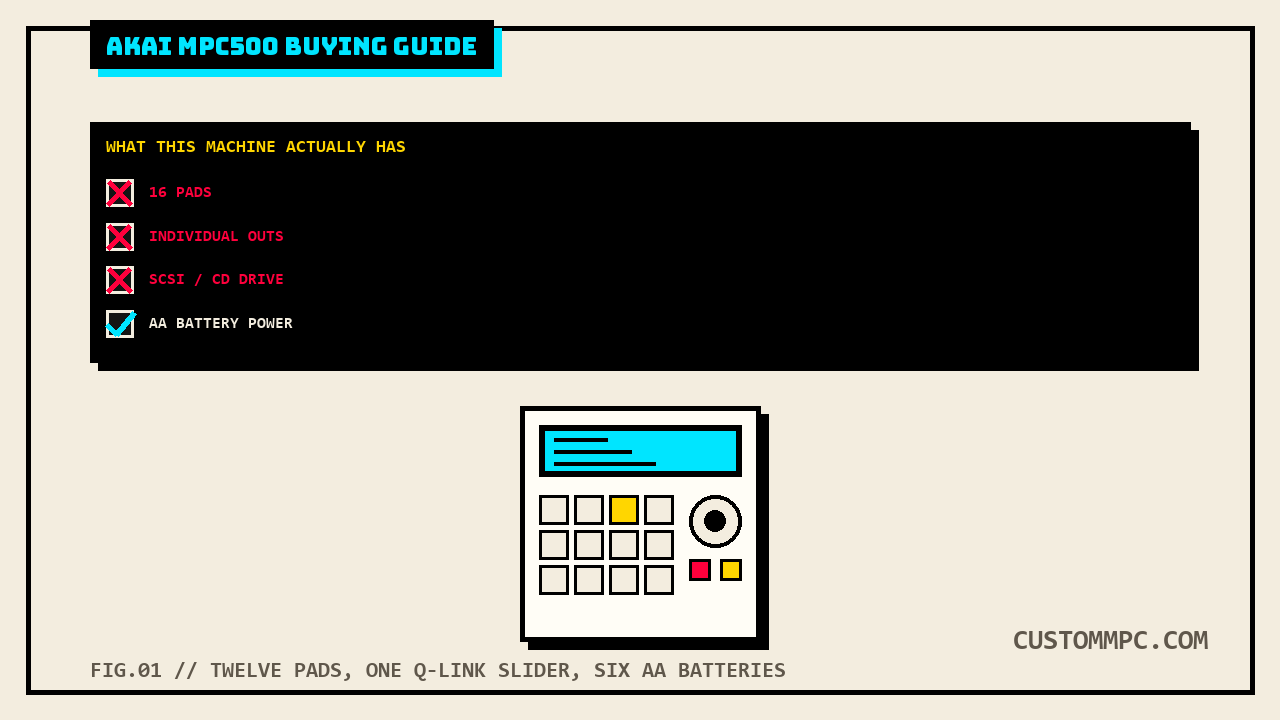
The MPC500 is Akai's smallest and cheapest classic-family standalone MPC, its official site going live in September 2006, reviewed by Sound on Sound in May 2007 and by MusicRadar that November. It's a 32-voice, 44.1kHz/16-bit sampler with 16MB of sound memory standard, expandable to 128MB through a single EXM128 card slot, same as the site's already-covered MPC1000 and MPC2500. What's genuinely different is everything around that sound engine: 12 pads across 4 banks instead of the usual 16, one Q-Link slider instead of a bank of knobs, a 2-line by 16-character LCD instead of a full graphic display, strictly stereo main outputs with no individual outs and no digital I/O at all, and the one feature none of this site's other seven buying-guide machines has: real, Akai-documented operation on six AA batteries. There's no SCSI port anywhere on this machine either, confirmed by a full-text search of the entire manual returning zero matches for "SCSI," the same confirmed-absence pattern this site already found on the MPC2500.
DEX'S NOTE: I almost skipped this one for years because it looks like a toy next to a 3000 or a 5000. It isn't. It's a genuinely different design brief, portable first, everything else second, and once you stop expecting it to behave like a 1000 with fewer pads it's a fun little machine to actually finish beats on away from a desk.
What the MPC500 actually is
Akai's official MPC500 site went live September 19, 2006, though the announcement post itself carried no confirmed release date or price from Akai directly; a comment on that same post cited a Harmony Central listing figure of $1,299 as the MSRP, explicitly framed by the commenter as a listing price rather than a confirmed Akai announcement. MusicRadar's own November 2007 review independently states the same $1,299 US price, a second source corroborating the figure rather than one claim repeated. Sound on Sound's own review, published six months earlier in May 2007, states a UK launch price of £399 including VAT, a real conflict this article states plainly rather than resolving: two press sources, six months apart, in different regions, at prices that don't convert cleanly into each other at any period exchange rate. Reviewer Mike Senior's verdict at Sound on Sound called it "the most affordable way to lay your hands on the MPC sampling and sequencing feature set," while flagging real limitations against the larger machines: a single filter type per voice instead of the dual multi-mode filters and tempo-synced LFO this site's MPC2500 guide documents, a smaller display that "undermines one of the traditional advantages of using an MPC," and no way to monitor an external MIDI module without an external mixer, something he called a genuine frustration in day-to-day use. MusicRadar's own review reached a similar conclusion from a different angle, calling it a machine that "might strip back a few MPC features, but it offers true portability in their place," while noting directly that it ships with "12 pads rather than the usual 16" due to space constraints and is "lacking the outputs and facilities of its larger brothers."
Real specs, straight from the manual
Every figure below is quoted or paraphrased directly from Akai's own MPC500 Operator's Manual rev 1.0, "Specifications" section, printed page 107 (PDF page 114). This is a clean single-source Akai PDF, not a scan, and its Specifications table extracted correctly in one linear pass, no interleaving issue like the two-column layouts this site hit on the MPC2500 and MPC AIR Plugins spec tables.
| Spec | Figure |
|---|---|
| Memory | 16MB standard (11.5MB usable for sound memory), expandable to 128MB via 1x EXM128 card slot |
| Polyphony | up to 32 voices (dependent on processing) |
| Sample format | 16-bit linear |
| Sampling rate | 44.1kHz |
| Recording time | 136 sec mono at 16MB, 24m28s mono at 128MB |
| Filters | 2-pole lowpass filter per voice; single filter type, no dual multi-mode filter or LFO |
| Preset sound memory | 5MB, 24 programs |
| Effects | 2 stereo effects plus Master effect; Chorus, Flanger, Bit grunger, 4-band EQ, Compressor, Phase shifter, Tremolo, Flying pan, Reverb, Delay; Master effect limited to 4-band EQ and Compressor |
| Sequencer capacity | 100,000 notes maximum, 96 parts per quarter note (ppq) |
| Sequences / tracks | 99 sequences, 48 tracks per sequence |
| MIDI output channels | 16 |
| Song mode | 20 songs, 250 steps per song |
| Pads | 12, velocity and pressure sensitive, 4 banks (not 16 pads like every modern standalone MPC) |
| Q-Link controls | 1 slider (not a bank of knobs like the MPC2500's 4 Q-Link controls) |
| Sync mode | MIDI clock |
| Storage | CompactFlash card slot, 32MB to 2GB supported; no internal HDD option, no CD drive option, no SCSI |
| Display | 2 x 16 character LCD with backlight (not a graphic display) |
| Analog I/O | Stereo record input (pseudo balanced -40dBu, max +10dBu), stereo main out only (pseudo balanced +11dBu, max +5dBu), 1/4" stereo phones out; no individual outs, no digital I/O |
| USB | Slave connector x1, Mass Storage Class support (Windows 2000/Me/XP+ or Mac OS 9.x/10.x+) |
| MIDI | 1 input, 1 output, 5-pin DIN |
| Options | EXM128 (128MB expansion memory card) is the only documented option anywhere in the manual; no undocumented options found |
| Power | 12V DC 600mA, negative tip adapter, or 6 AA batteries; approximately 4.5 hours continuous use on batteries with the LCD backlight on |
| Dimensions / weight | 266 x 175 x 44mm, 1.34kg |
Why it's still worth buying in 2026
Four real reasons. First, the sound engine underneath is closer to this site's already-covered MPC1000 and MPC2500 than the smaller footprint might suggest: all three document the identical 16MB-standard-expandable-to-128MB memory ceiling, 32-voice polyphony, 16-bit/44.1kHz sampling, and 100,000-note sequencer in their own respective spec sheets. This is genuinely the same core engine in a smaller, cheaper, battery-powered box, not a lesser chip. Second, it's the only buying-guide-family machine on this site that genuinely runs on its own battery power: this site's MPC One Buying Guide confirms zero built-in battery across the entire modern MPC One family, and none of the other six vintage machines already covered here (MPC1000, MPC2000, MPC2000XL, MPC3000, MPC4000, MPC5000, MPC60) document battery operation of any kind. The MPC500 takes 6 AA batteries directly, confirmed in its own manual, roughly 4.5 hours of continuous use with the backlight on, a real and rare feature for a hardware sampler this old. Third, storage stays genuinely simple: a CompactFlash slot rated 32MB to 2GB, no SCSI, no CD drive, no internal HDD option to plan around or track down, so there's no SCSI2SD-style mod project the way there is for the SCSI-equipped MPC2000XL, MPC3000, or MPC4000. Fourth, real cross-loading with several other Akai formats: Akai's own Data Compatibility table documents MPC1000 and MPC2500 files loading as SEQ/WAV/PGM directly, MPC2000/2000XL files loading with most PGM parameters intact, MPC4000 and Z4/Z8 files loading DRUM-program-only with note assign and tune data carried over, and MPC3000/S5000/6000 data loading as WAV or SND through a connected computer, useful if you're carrying a sample library forward from an already-owned MPC.
What it isn't: a machine you buy expecting MPC2500-or-larger control surface or I/O. Twelve pads across 4 banks instead of 16, one Q-Link slider instead of a bank of knobs, a small 2-line character LCD instead of a graphic display, and strictly stereo main outputs with zero individual outs and zero digital I/O are all real, permanent, Akai-documented design choices, not missing features on a broken unit. Buy it for what it actually is, covered directly in the checklist next.
The checklist: what this machine has and doesn't
Run these in order. The first two clear up the two points of confusion that come up most when someone's mental model of "an MPC" is really the MPC1000 or MPC2500.
1. Count the pads and confirm 4 banks before you buy expecting 16
The MPC500 has 12 pads across 4 banks (A-D), not the 16 pads standard on every modern MPC and most vintage ones, and its Full Level equivalent button is explicitly named "12 Levels," not "16 Levels." This site's own Note Repeat and 16 Levels guide covers the modern standalone MPC family's 16-pad version of that feature directly; the MPC500 is a genuine, disclosed exception to that article's scope, not a citation error in either piece. If your muscle memory is built on a 16-pad layout, budget real practice time before a session that matters.
2. Confirm the outputs are strictly stereo before you plan a routing
There is exactly one stereo main output pair and one headphone jack on this machine, no individual pad outs, and no digital I/O of any kind, a real step down from the MPC2500's 8 individual outs and RCA S/PDIF in/out. If your workflow depends on routing individual pads or a full kit to separate mixer channels, this isn't that machine; everything comes out one stereo pair.
3. Confirm you have the negative-tip power adapter or working batteries
Akai's own spec sheet documents the power requirement as "12v DC 600mA (negative tip)," and a lost or swapped generic adapter is a real, common risk on a 20-year-old unit since most off-the-shelf 12V adapters ship positive tip. The real advantage here over every other buying guide on this site is that a missing or wrong adapter doesn't necessarily strand you: the unit runs on 6 AA batteries directly, confirmed in the manual, roughly 4.5 hours continuous with the backlight on, so you can test a used unit's core functions with fresh batteries alone before you've sourced the correct adapter at all.
4. Treat the EXM128 slot as the only real expansion path, nothing else
A direct search of the full manual text for "option" turns up exactly one hardware expansion anywhere in the document: the single EXM128 RAM expansion slot, bringing sound memory from 16MB standard up to 128MB. There's no internal hard disk option, no CD drive option, and no SCSI path documented anywhere in this manual, unlike the MPC2500 and MPC5000 guides already on this site, where real options existed but weren't listed in the printed Options table. This machine's spec sheet is honestly complete: what you see in the table above is everything it has.
What they actually cost right now
Real used listings run noticeably lower than either period launch price. Search-indexed Reverb data shows asking prices roughly in the $265 to $360 range for playing-condition units, well below both the $1,299 US figure cited at 2006-2007 and the £399 UK figure Sound on Sound quoted at its May 2007 review. That's ordinary depreciation for a 20-year-old entry-level standalone sampler, not a sign of anything unusually wrong with cheaper listings; this was Akai's budget MPC when new and the used market prices it that way now too.
Common mistakes
Mistake: expecting 16 pads or a 16-pad "Full Level" workflow. The MPC500 documents exactly 12 pads across 4 banks, and its own equivalent button is named "12 Levels," not 16.
Mistake: assuming individual outs or digital I/O exist because other MPCs have them. This machine documents strictly stereo main outputs and a headphone jack, nothing else on the audio side.
Mistake: buying a generic 12V adapter without checking polarity. Akai's own spec sheet calls out negative tip specifically; most generic 12V wall adapters ship positive tip.
Mistake: expecting an internal hard disk, CD drive, or SCSI path like the site's other vintage guides found. Unlike the MPC2500 and MPC5000, where real undocumented options existed, this manual's Options list is genuinely complete: EXM128 RAM only.
A note on sources
Rule two on this site is that conflicts get stated, not quietly resolved, and this article surfaced a genuine one worth calling out plainly: MusicRadar's November 2007 review and a Harmony Central-sourced forum comment from September 2006 both independently point to a $1,299 US price, while Sound on Sound's own review, published in between the two in May 2007, states a £399 UK price including VAT. Neither figure converts cleanly to the other at any period exchange rate, and this article presents both as real, differently-timed, differently-regioned price points rather than picking one as more correct.
A second honest note: this is the first buying guide on this site sourced from an official Akai/inMusic CDN PDF rather than an archive.org scan, and it was a genuinely clean single-pass extraction, no interleaved spec table and no missing pages the way earlier vintage guides on this site have run into. A WebSearch hit for a generically-titled archive.org listing was checked directly before use and found to almost certainly be the same manual already cited on this site's MPC2500 guide, not a distinct MPC500 source, and was not used anywhere in this article.
One general vendor-sourcing note also applies here, consistent with every other buying guide on this site: direct fetches of the specific Reverb item pages were not attempted this pass, so those figures rest on WebSearch's indexed summaries rather than a direct page fetch. Where a direct fetch succeeded, Sound on Sound, MusicRadar, and the MatrixSynth announcement post all fetched directly via WebFetch, that's stated as such above.
Verdict
VERDICT
The specs: 32 voices, 44.1kHz/16-bit sampling, a 100,000-note sequencer across 48 tracks, and a 128MB memory ceiling identical to the site's MPC1000 and MPC2500 guides, all confirmed straight from Akai's own Operator's Manual. The tradeoffs: 12 pads across 4 banks instead of 16, one Q-Link slider instead of a bank of knobs, a small 2-line character LCD, and strictly stereo outputs with zero individual outs and zero digital I/O, real and permanent design choices, not defects. The one real advantage nothing else on this site has: genuine, Akai-documented operation on 6 AA batteries, roughly 4.5 hours per set with the backlight on, real portability none of this site's other seven buying-guide machines can match. The money: roughly $265 to $360 for a playing-condition used unit per current search-indexed Reverb data, against a disclosed, unresolved conflict between a $1,299 US price (MusicRadar, Harmony Central) and a £399 UK price (Sound on Sound) at launch. Buy it knowing exactly what it is, the smallest, cheapest, most battery-portable classic MPC Akai ever built, not a 1000 or a 2500 with a few pads missing.
Bought one recently, or found something this checklist should have caught? Tell us what happened.