VS Comparison
MPC Key 61 vs MPC X: what's actually different
Both have been Akai's highest-launch-price standalone machine in their own moment, the X at $1,999 in 2017, the Key 61 at $1,499 in 2022, and this site has separately covered each in its own buying guide but never put them side by side. Real specs from Akai's own Technical Specifications appendix on the 23-to-4 knob gap that runs backwards from what the price tags suggest, three pedal jacks only the keyboard documents, and a CV/Gate count that ties exactly where almost nothing else does.
The short version
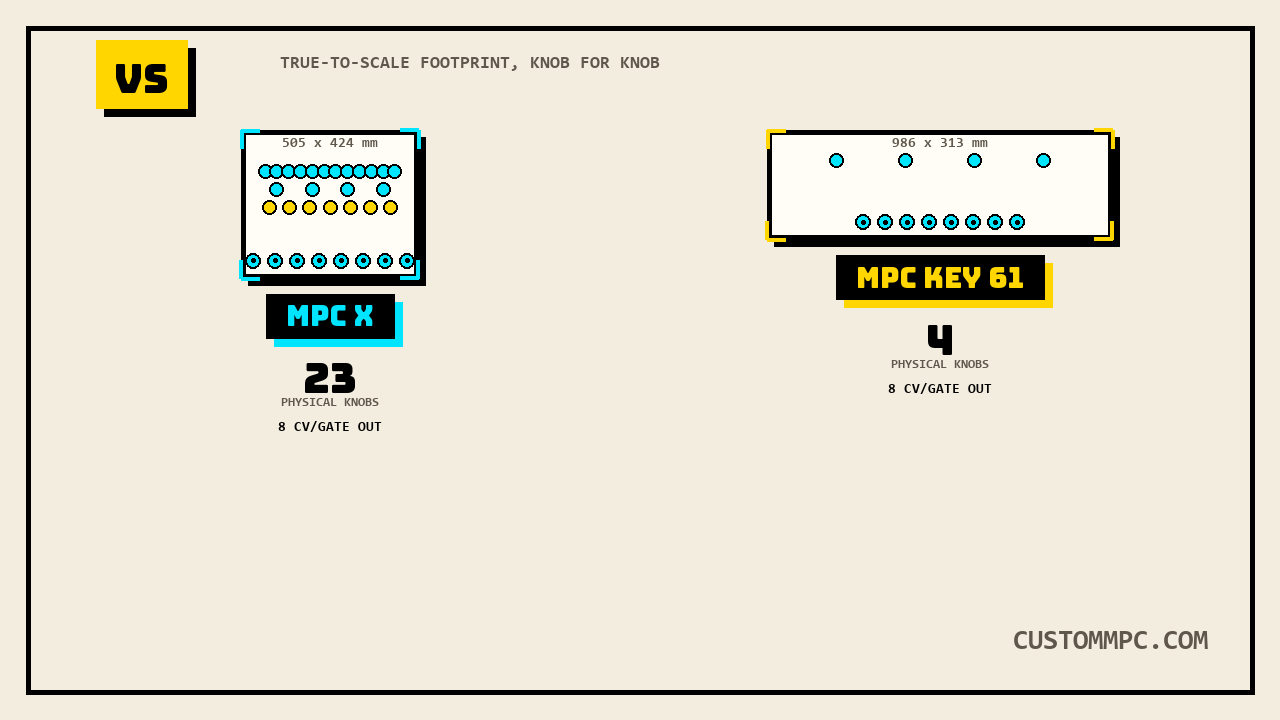
The MPC X and the MPC Key 61 have never been each other's obvious cross-shop, five years and a different form factor apart, but they share something no other pair in this site's current-lineup coverage does: each was the single most expensive standalone MPC Akai sold at its own launch moment. Akai's own Technical Specifications appendix, read side by side, shows two machines built for opposite jobs. The X carries 23 physical knobs (16 Q-Link, 7 dedicated gain/mix, plus an encoder not counted in that figure) against the Key 61's 4; the Key 61 answers with a full 61-key semi-weighted keybed, three individually documented pedal inputs, and an Ethernet port, none of which the X's table lists at all. And on exactly one spec, the two tie: both document 8 CV/Gate outputs, in the identical 1/8" TS mono format.
SAM'S NOTE: I get asked which one is "the real flagship" more than I expected for two machines that don't even compete for the same buyer. Wrong question. The X is a studio hub built around 23 knobs and zero keys; the Key 61 is a keyboard workstation built around 61 keys and 4 knobs. Price tag doesn't tell you which one you actually need, the spec table does.
Five years apart, both a flagship price
The MPC X launched in the first quarter of 2017 at a reported $1,999 street price, Akai's rack-style, full-I/O standalone flagship, covered in full in this site's own mpc-x-buying-guide article. The MPC Key 61 launched five years later, in June 2022, at a reported $1,499, Akai's first standalone keyboard workstation, built around the same MPC 3 operating system the X now shares but wrapped in a 61-key semi-weighted chassis with a built-in audio interface, covered in full in this site's own mpc-key-buying-guide article. Both remain in Akai's current lineup as of this writing, documented side by side in the same current v3.9 Standalone OS User Guide alongside the Live, Live II, One, One+, One G2, Key 37, and Key 37 G2, and neither has received a direct successor: no MPC X II exists, and the Key 61 has had no G2 refresh while the smaller Key 37 got one in June 2026.
Spec sheet, straight from the manual
Every figure below is quoted or paraphrased directly from Akai's own MPC_Standalone_OS_User_Guide_v3.9.pdf Technical Specifications appendix: the "MPC X / MPC X Special Edition" table at PDF pages 468-470 (printed footers 468-470) and the "MPC Key 61" table at PDF pages 479-481 (printed footers 479-481), both extracted directly via fitz page-by-page reads of the isolated pages rather than a linear full-document pull, and cross-checked against this site's own already-published mpc-x-buying-guide and mpc-key-buying-guide articles, which independently sourced the same two tables. Figures shown are for the base MPC X where the table splits by variant; the Special Edition's RAM and storage jump is covered in the storage discussion below.
| Spec | MPC X | MPC Key 61 |
|---|---|---|
| Keybed | None (pad-only) | 61 semi-weighted keys, aftertouch |
| Display | 10.1" / 256mm, 1280x800, capacitive multi-touch | 7" / 177mm diagonal, resolution not stated |
| Pads | 16 velocity- and pressure-sensitive RGB pads, 8 banks | |
| Knobs | 16 Q-Link + 7 gain/mix + 1 data encoder = 23 | 4 Q-Link + 1 data encoder |
| Processor | Not named in this table | Not named in this table |
| RAM | 2 GB (X) / 4 GB (X SE) | 4 GB |
| Internal storage | 16 GB, 6 GB user (X); 48 GB, 10 GB user (X SE) | 32 GB, expandable via SATA |
| Mic inputs | 2x XLR+1/4" TRS combo, preamp EIN -135 dBu | 2x XLR+1/4" TRS combo, preamp EIN -130 dBu |
| Instrument inputs | 2x unbalanced 1/4" TS | 2x unbalanced 1/4" TS |
| Phono inputs | 2x unbalanced RCA | None documented |
| Pedal inputs | 2x 1/4" TS footswitch (FS 1/2) only | Sustain, footswitch, expression -- 3x 1/4" TRS, individually named |
| Outputs | 8x 1/4" TRS (4 stereo pairs) | 4x 1/4" TRS (2 stereo pairs) |
| Headphone out | 1/4" TRS + 1/8" TRS | 1/4" TRS only |
| MIDI DIN | 2 in, 4 out, no thru row | 1 in, 1 out, 1 thru |
| CV/Gate outputs | 8x 1/8" TS mono | |
| Ethernet | None documented | 1 port |
| Wi-Fi / Bluetooth | Neither documented in either table | |
| USB / SD | 2x Type-A, 1x Type-B, 1x SD card slot | 2x Type-A, 1x Type-B, no SD slot |
| Power | External adapter, 19V 3.42A | Internal, IEC, 100-240V AC, 65W |
| Dimensions (w x d x h) | 505 x 424 x 87mm (flat) | 986 x 313 x 97mm |
| Weight | 5.66 kg / 12.57 lb. | 8.1 kg / 17.9 lb. |
The knob gap runs backwards
Akai's own Mechanical block for the MPC X lists three rows of physical rotary controls: 16 touch-sensitive Q-Link knobs, 7 additional 270-degree knobs dedicated to gain, mix, and level, and a data encoder. The Key 61's own Mechanical block lists exactly one knob row: 4 touch-sensitive Q-Link knobs (spread across 4 Q-Link columns accessed via a button), plus the same style of data encoder. Neither figure counts the encoder, the same convention this site's own mpc-live-vs-mpc-x article already used comparing the X against the original Live, so the two counts here are directly comparable: 23 against 4, a gap of almost six to one. That's counterintuitive on price alone. The Key 61 launched five years after the X at a lower price ($1,499 against $1,999) but is still Akai's most expensive keyboard-format machine; buyers reasoning "newer and still pricey, so probably still knob-dense" get the wrong answer from the spec table.
Three pedal jacks the X doesn't have
The Key 61's own Connections block names three individually labeled pedal inputs: a sustain pedal input, a footswitch pedal input, and an expression pedal input, each its own 1/4" TRS jack (all three noted as TS-compatible). The X's own Connections block has exactly two pedal-adjacent jacks, both labeled plainly "footswitch inputs (FS 1/2)," with no sustain or expression row anywhere in the table. This isn't a small keyboard-workstation footnote. A dedicated expression pedal input means real-time continuous-controller sweeps, filter cutoff, volume swells, whatever's mapped, from a single pedal with no MIDI interface in between; a dedicated sustain input means a keybed instrument that behaves like a piano out of the box. Neither is available on the X without an external MIDI pedal controller, since its table documents footswitch-only functionality on both of its pedal jacks.
Outputs, phono, and the headphone jack count
The X's own Connections block lists 8 main 1/4" TRS outputs across 4 stereo pairs, plus 2 RCA phono/line inputs with a full preamp spec (dynamic range, SNR, THD+N all documented) for direct turntable sampling; the Key 61's own Connections block lists 4 outputs across 2 stereo pairs and no phono row at all. The headphone count follows the same pattern: the X's table lists two headphone outputs, a 1/4" and a separate 1/8" jack, each with its own dynamic-range and THD+N figures; the Key 61's table lists a single 1/4" headphone output only. Read together with the outputs and pedal findings above, the X's own spec table reads like a studio hub built to feed a full monitoring chain and sample vinyl directly, while the Key 61's reads like a keyboard built to plug into one stereo pair and go, with the I/O budget spent on the pedal jacks and the keybed instead.
CV/Gate: the one exact tie
Given how lopsided the knob count, output count, and pedal I/O all run, the CV/Gate row is a genuine surprise: both tables document exactly 8 outputs, in the identical 1/8" (3.5mm) TS mono format, one signal per jack with no TRS breakout option on either machine. This site's own mpc-cv-gate-tracks article already established the X as carrying the most CV/Gate jacks of any current-lineup machine it checked at the time that article published; the Key 61 matches that same count exactly, a fact that article didn't have occasion to surface since it wasn't comparing these two directly. Anyone planning to sequence a modular rig or an analog drum machine from either an X or a Key 61 gets the identical 8-output ceiling regardless of which one they buy, the rare spec on this comparison where the choice genuinely doesn't matter.
Ethernet against an SD card slot
Two connectivity items split cleanly, one per machine, and neither table lists the other's. The Key 61's own Connections block includes a dedicated Ethernet link port; the X's table has no Ethernet row anywhere. The X's own Connections block includes an SD card slot alongside its 2x USB Type-A and 1x USB Type-B ports; the Key 61's Connections block lists only the 2x USB Type-A and 1x USB Type-B ports, no SD slot. Practically, that means removable-media workflows, swap a card, load a kit, hand it to someone else, favor the X; wired network transfer or a hardwired studio LAN setup favors the Key 61. Wi-Fi would make either point moot for network-only workflows, but as the next section covers, neither table documents a wireless radio at all.
Two gaps both manuals share
This site's own mpc-key-buying-guide article already flagged that the Key 61's current spec table has no Wi-Fi or Bluetooth row, a real surprise for the priciest, most audio-interface-equipped machine in the Key family. Reading the X's table directly for this article extends that same finding to a second machine: the X's Technical Specifications table has no Wi-Fi or Bluetooth row either, and no named processor, the identical documentation gap the Key 61's table has. This isn't a Key-family quirk, it's shared by Akai's other high-end standalone flagship too. The display row surfaces a smaller, related gap. The X's table states its screen resolution explicitly, "10.1" (25.6 cm) full-color 1280x800 display with capacitive multi-touch." The Key 61's table states only a diagonal size and panel type, "7" / 177 mm (diagonal), Full-color LED-backlit display with touch interface," no pixel resolution given anywhere. This site's own mpc-live-ii-vs-one and mpc-live-vs-live-ii articles both confirmed 1280x800 as the shared resolution across the Live II, One, and One G2's own tables; whether the Key 61 shares that same 1280x800 figure or runs something else isn't stated in its own current documentation, and this article doesn't assume it forward from a sibling machine's spec.
Weight, footprint, and where the mass goes
The Key 61 is the heavier machine, 8.1kg (17.9 lb.) against the X's 5.66kg (12.57 lb.), despite being newer and, on paper, the more "consumer" of the two form factors. Akai's own Dimensions block explains why: the Key 61's 986 x 313 x 97mm footprint is a full-size, 61-key semi-weighted keybed chassis, the mass sits in the keys and the internal power supply (the X runs off an external adapter brick, the Key 61 has a full IEC internal supply rated 100-240V AC at 65W). The X's 505 x 424 x 87mm footprint is a flat, roughly square pad-and-knob surface with no keybed to carry. The two footprints aren't really comparable as travel gear either way: the Key 61's shape rules out most backpacks entirely, and the X's flat square, while lighter, is still a dedicated-bag item at 12.57 lb. Neither machine is the portable pick in this site's own current-lineup coverage; that title still belongs to the battery-powered Live, covered in the mpc-live-vs-mpc-x article.
What they actually cost right now
The MPC X launched at a reported $1,999 street price in Q1 2017. The MPC Key 61 launched five years later, in June 2022, at a reported $1,499, $500 less than the X's own launch price despite arriving newer and with a full keybed and audio interface built in, a gap the knob count, output count, and phono input findings above help explain: the X's extra $500 bought 19 more knobs, 4 more outputs, phono ins, and an extra headphone jack, while the Key 61's own budget went toward the keybed, the pedal jacks, and the internal power supply instead. Both figures are launch-era press prices rather than current retailer listings, which shift with used-market pricing and the newer MPC X Special Edition (launched April 26, 2023 at $2,499 per this site's own mpc-x-buying-guide article) now sharing shelf space with the original X; confirm the specific unit's current asking price, and which X variant it actually is, directly before buying.
Common mistakes
Mistake: assuming "flagship price" means "flagship knob count." The Key 61 has been Akai's priciest keyboard-format machine since 2022, but its own Mechanical block documents 4 Q-Link knobs against the X's 23; price tier and knob density don't track together across this pair.
Mistake: expecting a dedicated expression or sustain pedal input from an MPC X. Its own Connections block lists two plain footswitch jacks and nothing else pedal-related; both of the Key 61's extra pedal types are keyboard-workstation-only in this pair.
Mistake: assuming the newer, keyboard-format Key 61 also picked up Wi-Fi or Bluetooth. Neither machine's current spec table documents a wireless radio at all; this is a shared gap, not a Key-specific one.
Mistake: assuming the Key 61's screen shares the One/Live II family's 1280x800 resolution. Akai's own current table for the Key 61 states a diagonal size only, no resolution figure; that's a real documentation gap, not a confirmed match to a sibling machine.
Mistake: planning a card-swap sampling workflow around a Key 61. Its own Connections block lists no SD card slot, only 2x USB-A and 1x USB-B; the X has the SD slot in this pair.
A note on sources
Both spec tables cited in this article sit in the current v3.9 Standalone OS User Guide's Technical Specifications appendix, "MPC X / MPC X Special Edition" at PDF pages 468-470 and "MPC Key 61" at PDF pages 479-481, each independently re-extracted directly for this article via page-indexed fitz reads rather than trusted forward from this site's own prior mpc-x-buying-guide or mpc-key-buying-guide articles, though every figure matched those two articles' own already-published tables exactly on cross-check. Four findings in this article cross-reference this site's own previously published, independently sourced work rather than re-deriving the same primary-source citations from scratch: the CV/Gate jack context (gear/mpc-cv-gate-tracks/), the Wi-Fi/Bluetooth gap on the Key 61 specifically (gear/mpc-key-buying-guide/), the 1280x800 resolution figure for sibling machines (gear/mpc-live-ii-vs-one/ and gear/mpc-live-vs-live-ii/), and the knob-count convention of excluding the encoder (gear/mpc-live-vs-mpc-x/). All four were independently re-checked against the primary manual passages cited here during this pass rather than assumed correct, and matched.
Launch dates and pricing for both machines came from WebSearch-indexed press coverage rather than direct retailer fetches, consistent with this site's established practice on pricing claims; the MPC X Special Edition's April 2023 launch price is cross-referenced from this site's own mpc-x-buying-guide article rather than re-derived.
Verdict
VERDICT
The specs: the X's own Mechanical block documents 23 physical knobs, 8 outputs, phono ins, and two headphone jacks against the Key 61's 4 knobs, 4 outputs, no phono row, and one headphone jack, but the Key 61 answers back with a 61-key semi-weighted keybed, three individually named pedal inputs, and an Ethernet port the X's table has none of. The two tie on exactly one line, 8 CV/Gate outputs each, in an identical format. The purchase: the X is the knob-dense studio hub built to take a mic, a turntable, and a footswitch, no keybed included; the Key 61 is the keyboard-first workstation built for players who want a sustain pedal and an expression pedal to just work, with a lighter knob surface and a smaller output count in exchange. Neither documents Wi-Fi, Bluetooth, or a named processor, a real gap in Akai's own current manual for both. The money: the X launched at $1,999 in 2017, the Key 61 at $1,499 in 2022, a $500 gap that buys 19 more knobs and 4 more outputs on the X's side, a keybed and dedicated pedal jacks on the Key 61's. Confirm which specific variant (X vs X Special Edition) a used listing actually is before assuming any RAM or storage figure here applies.
Own either one, or found a spec this checklist missed? Tell us what happened.