VS Comparison
MPC60 vs MPC3000: what actually changed
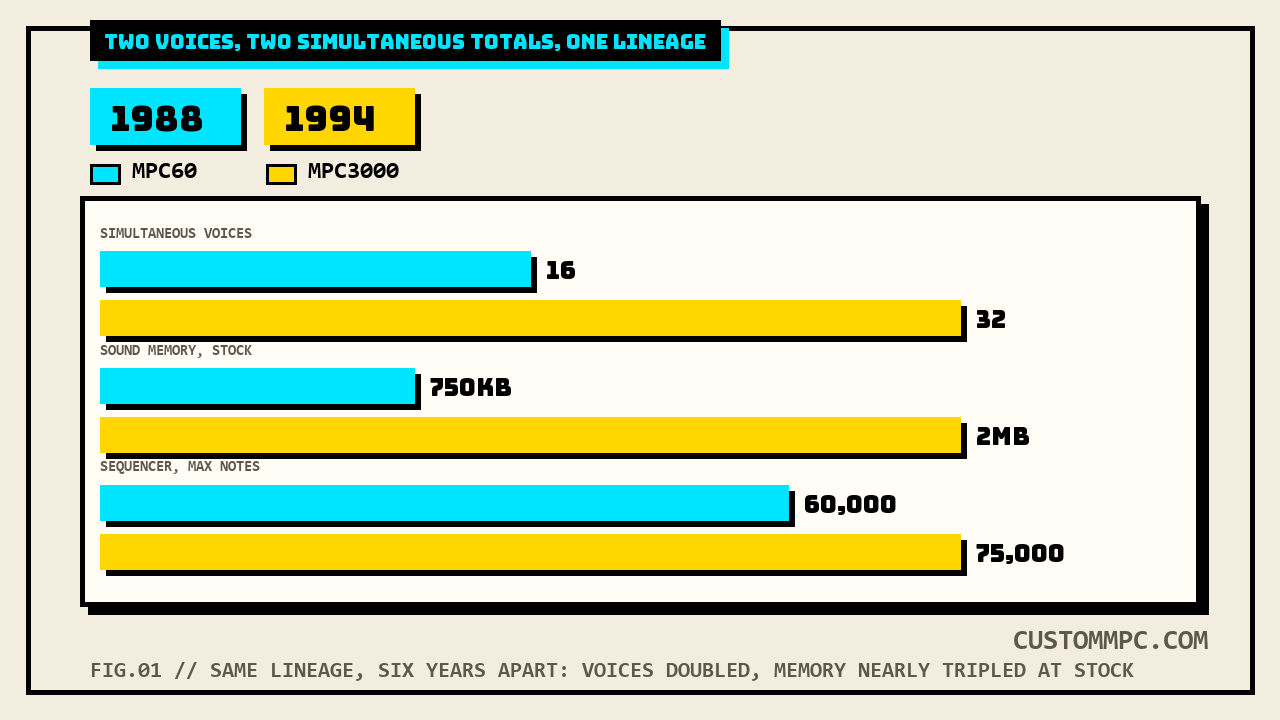
Six years and one lineage separate Akai's first two Linn-designed samplers. Voices doubled, sound memory nearly tripled at stock, and one machine got factory SCSI while the other never did. Every figure below is checked directly against Akai's own MPC60 manuals and MPC3000 service manual, including the one where the original MPC60 shipped genuinely unfinished next to the machine that replaced it.
The short version
The MPC3000 is a straightforward upgrade on paper: double the simultaneous voices, nearly triple the stock sound memory, a deeper sequencer, and a factory SCSI port the MPC60 never got. What the spec sheet undersells is that a stock, unpatched 1988 MPC60 is not the machine most of this comparison describes. Akai's own Version 3.1 update, not a hardware revision, is what took the MPC60 from 34 sounds and two pad banks to the 128 sounds and four pad banks it needed just to match what the MPC3000 shipped with in 1994. Confirm the OS version on any MPC60 you're pricing against a 3000, because "MPC60" on a listing title can mean two genuinely different machines.
DEX'S NOTE: I've owned a v2 MPC60 and I've owned a v3.1 one, and they are not the same instrument to work on. The v2 unit felt like a 1988 machine. The v3.1 unit, EPROM swap and all, felt like it was actually trying to compete with the 3000 it was sold years before. If a seller can't tell you the OS version, assume the older one and price accordingly.
Six years, one lineage
Akai released the MPC60 in 1988, co-designed with Roger Linn and sold under a licensing deal with his company, Roger Linn Design. Six years later, in 1994, Akai released the MPC3000 as its direct successor, the second and last MPC to carry Roger Linn's design lineage before the two companies' paths diverged. The MPC3000 went on to become the machine most tied to a specific run of records, J Dilla's own unit is on permanent display at the Smithsonian's National Museum of African American History and Culture, while the MPC60 carries the quieter distinction of being first: the machine every other MPC on this site, the 3000 included, is in one way or another a version of.
Spec sheet, side by side
Every figure below comes straight from Akai's own documentation: the MPC60/MPC60-II Version 3.1 Operator's Manual's technical specifications appendix for the 60, and the MPC3000 Service Manual's SPECIFICATIONS section for the 3000. Where the two machines are identical, the row says so rather than manufacturing a difference that isn't there.
| Spec | MPC60 (v3.1) | MPC3000 |
|---|---|---|
| Released | 1988 | 1994 |
| Sampling rate | 40kHz | 44.1kHz |
| Sample format | 16-bit A/D-D/A, stored as non-linear 12-bit | 16-bit linear |
| Sound memory, stock | 750KB (13.1s mono) | 2MB (21.9s mono / 10.9s stereo) |
| Sound memory, expanded | 1.5MB with EXM003 (26.2s mono) | 16MB with EXM3008 + SIMMs (188.3s mono / 94.1s stereo) |
| Simultaneous voices | 16 | 32 |
| Max sounds in memory | 128 (v3.1 update; 34 pre-v3.1) | 128, from launch |
| Sound programs | 8 (v3.1's "programs" system; v2 used SET files) | 24 max |
| Sound assignments per program | 64 | 64, same |
| Sequencer, max notes | 60,000 | 75,000 |
| Sequences / tracks per sequence | 99 / 99 | 99 / 99, same |
| Drum pad banks | 4 (v3.1 update; 2 pre-v3.1) | 4, from launch |
| MIDI output channels | 64 (16 x 4 ports) | 64 (16 x 4 ports), same |
| Storage | 793KB 3.5" DD floppy; no factory SCSI | 1.44MB 3.5" HD floppy + factory SCSI (25-pin D-sub) |
| Display | 320-char, 240 x 64 dot graphic LCD | 320-char, 240 x 64 dot graphic LCD, identical |
| Headphone output | MPC60-II only; original has none | Standard, all units |
| Foot switch inputs | 2, independently assignable | 2, independently assignable, same |
| CPU | 80186 @ 10MHz | V53 @ 16MHz |
| Dimensions | 495(W) x 127(H) x 471(D) mm | 440(W) x 121(H) x 405(D) mm, smaller |
| Weight | 10.5kg | 9kg, lighter |
The sound itself: 12-bit vs 16-bit
This is the spec people actually mean when they talk about "MPC60 crunch" versus MPC3000 cleanliness, and it's worth being precise about what Akai's own manual says rather than the shorthand version that gets repeated online. The MPC60 doesn't record in plain 12-bit linear:
"Data format: 16-bit A/D and D/A converters; samples stored in special non-linear 12-bit format for much lower noise than 12-bit linear systems."
The converters going in and out are 16-bit. What gets written to memory is a non-linear 12-bit format specifically engineered to sound cleaner than a straight 12-bit linear recording would, Akai's own manual makes that comparison explicitly. The MPC3000 skips the compression trick entirely and stores samples as full 16-bit linear at 44.1kHz, the same sample rate a CD uses. Neither figure is the flat "12-bit crunch" shorthand the used-gear market repeats. The MPC60's non-linear encoding is a deliberate noise-reduction scheme layered on top of 16-bit converters, and the MPC3000's 44.1kHz/16-bit linear path is the more transparent of the two by spec, not by reputation.
Voices and memory: what doubled, what nearly tripled
Simultaneous voices went from 16 to 32, a straight doubling, which in practice means the MPC3000 can hold twice as many overlapping hits, decays, and layered sounds ringing out at once before it starts stealing voices. Stock sound memory is a bigger jump than the headline numbers suggest once you read the actual seconds-of-sampling figures rather than the raw byte counts: 750KB on the MPC60 is 13.1 seconds mono, while 2MB on the MPC3000 is 21.9 seconds mono or 10.9 seconds stereo, close to triple the sampling time at stock before either machine takes an expansion board. Expanded, the gap widens further: the MPC60's EXM003 board tops out at 1.5MB, 26.2 seconds mono, a ceiling Akai's own Version 3.1 release notes confirm directly ("New samples may now be as long as available memory, up to 26.2 seconds in an expanded MPC60"), while the MPC3000's EXM3008 board plus a pair of SIMM sockets reaches a manual-documented 16MB, 188.3 seconds mono or 94.1 seconds stereo. One MPC60-only feature narrows that gap in practice more than the raw numbers show: Version 3.1's Sound Compression squeezes any sound into half its memory footprint at the cost of some treble fidelity, effectively doubling available sound memory if every sound in the bank is compressed, a software trick the MPC3000 documentation doesn't carry.
The v3.1 trap
Everything in the spec table above uses the MPC60's Version 3.1 figures, because that's what Akai's own current appendix documents. It's worth spelling out just how different a pre-3.1 MPC60 actually was, because a seller listing "MPC60" is not always describing the machine this comparison is built on. Akai's own Version 3.1 release notes state the change plainly:
"Total sound capacity is increased from 34 to 128 sounds."
Thirty-four sounds. Not 128. A Version 2 MPC60 was working with roughly a quarter of the sound-memory slots the MPC3000 shipped with in 1994, four years before it existed. The pad-bank story is the same shape:
"The number of pad banks has been increased from two to four for a total of 64 pad/bank combinations."
Two banks instead of four means 32 pad/bank combinations instead of 64, half the MPC3000's stock layout. Sound assignment worked differently too: Version 2 used SET files, a whole-bank swap, where Version 3.1 introduced the eight-program system quoted in the spec table above, each program drawing from a shared 128-sound bank instead of loading a redundant new file every time. Cross-machine compatibility runs one direction only, and even that direction has a real catch: Version 3.1 lets an MPC60 load MPC3000 disk files, but it can't read the MPC3000's high-density floppies natively.
"You may now load all MPC3000 disk files, including stereo sounds. However, the MPC60 cannot read the high-density MPC3000-format disks. To read MPC3000 files, they must first be saved from an MPC3000 onto an MPC60-format disk."
In practice that means an MPC3000 owner needs to babysit the transfer, resaving files onto low-density media before an MPC60 can touch them, there's no direct disk-swap workflow between the two even after the update closes the sound-count and pad-bank gaps.
SCSI: built in vs bolted on
This is the one row in the spec table that never closes, no firmware update touches it. The MPC3000 shipped with a factory SCSI port:
"SCSI port... 1 (25-pin D-sub connector)."
The MPC60 never got one, at any OS version. Its own manual is explicit that any SCSI capability comes from a third-party board, not Akai's own hardware:
"The 9th option, Select disk, will appear only if a SCSI hard disk is connected," requiring "the Marion Systems MPC-SCSI upgrade."
Marion Systems built the board, Roger Linn Design sold it, and it was certified only for Iomega Zip/Jazz and SyQuest removable drives, not an open SCSI implementation the way the MPC3000's port is. Budget for a real period board or a modern reproduction kit (this site's own scsi-to-sd-mod build covers pricing) if SCSI storage on an MPC60 matters to the purchase, it was never a stock feature at any firmware revision.
What never changed
As much signal here as in the differences.
- The screen resolution is identical. Both manuals describe the same 320-character, 240 x 64 dot graphic LCD, word for word. Whatever visual difference you remember between the two machines is aging, backlighting, and mounting hardware, not a spec difference Akai ever documented.
- Sequence and track counts match exactly. 99 sequences, 99 tracks per sequence, on both machines. The MPC3000's higher note ceiling (75,000 vs 60,000) is about how much a track can hold, not how many tracks or sequences exist.
- MIDI output capacity is the same on paper. Four independent MIDI output ports on both units, confirmed directly in each machine's own spec appendix. The MPC60's appendix spells out the resulting channel math explicitly, 64 channels from 16 channels across 4 ports; the MPC3000's own SPECIFICATIONS section lists the same 4-independent-outputs figure but the local OCR extraction of its "MIDI output channels" line is blank at that exact field, so the 64-channel total for the 3000 here is Akai's own standard 16-per-port arithmetic applied to a confirmed port count, already published this way by this site's own MPC3000 buying guide, not a literal quote pulled fresh from that specific line.
- Foot switch inputs are identical. Two, independently assignable, on both machines.
- Sound assignments per program are the same number, 64, wrapped around different systems. The MPC60's eight v3.1 programs and the MPC3000's 24 max programs both cap out at 64 assignments each; the 3000 just gives you three times as many program slots to spread them across.
Used market reality
Pricing on both machines is a small, honestly scattered sample rather than a clean market average, the same caveat this site's own buying guides for each machine carry individually. MPC60 listings ran from roughly $900 for a bare, unverified unit to nearly $3,700 for a serviced Mark II bundled with both OS 3.10 and OS 2.12 EPROMs. MPC3000 listings run higher across the board, roughly $1,800 to $2,300 for a standard unit, with MPC3000LE units tracking a much wider, collector-driven range on top of that. Neither number includes the OS-version question this article is built around. A cheap MPC60 at the bottom of that range is very likely a Version 2 machine running 34 sounds and two pad banks, not the Version 3.1 spec this comparison table describes, confirm the EPROM revision before treating any MPC60 price as directly comparable to an MPC3000 price for equivalent capability.
Verdict
VERDICT
Buy the MPC3000 if factory SCSI, more voices, more sound memory, or the deeper 75,000-note sequencer actually matter to how you work, and you're willing to pay the higher used-market floor for it. Buy the MPC60 if the goal is the machine that started the lineage and the budget favors it, but confirm the OS version before you pay: a Version 2 unit is a genuinely smaller instrument than the 3.1 figures in this article, 34 sounds and two pad banks instead of 128 and four, and no seller is obligated to mention which one you're looking at. Either way, the sound-format difference is real but overstated online: the 60's 16-bit-converter, non-linear-12-bit storage is a deliberate noise-reduction scheme, not lo-fi by accident, and the 3000's 44.1kHz/16-bit linear path is the more transparent machine by spec, not just by reputation.
Buying either one used? The MPC60 buying guide and the MPC3000 buying guide cover the full physical-condition checklist this article doesn't repeat.