GUIDE PLUGIN TRACKS
MPC's eight bundled AIR plugins, explained: Bassline to Odyssey
This site's plugin coverage stopped at how you get access to the catalog, an inMusic Profile login and an Activations screen, without ever unpacking what's actually inside it. Every standalone MPC ships with the same fixed set of eight AIR-made instrument plugins loaded onto Plugin Tracks: a mono synth, an electric piano, a modern dual-oscillator synth, an analog polysynth, an eight-voice drum engine, a tape keyboard, a string ensemble, and a licensed analog synth recreation. Here's what each one's actual sound engine does, straight from Akai's own manual, plus a real naming collision inside the effects chains and a one-per-project limit worth knowing before you build a drum kit around it.
The short version
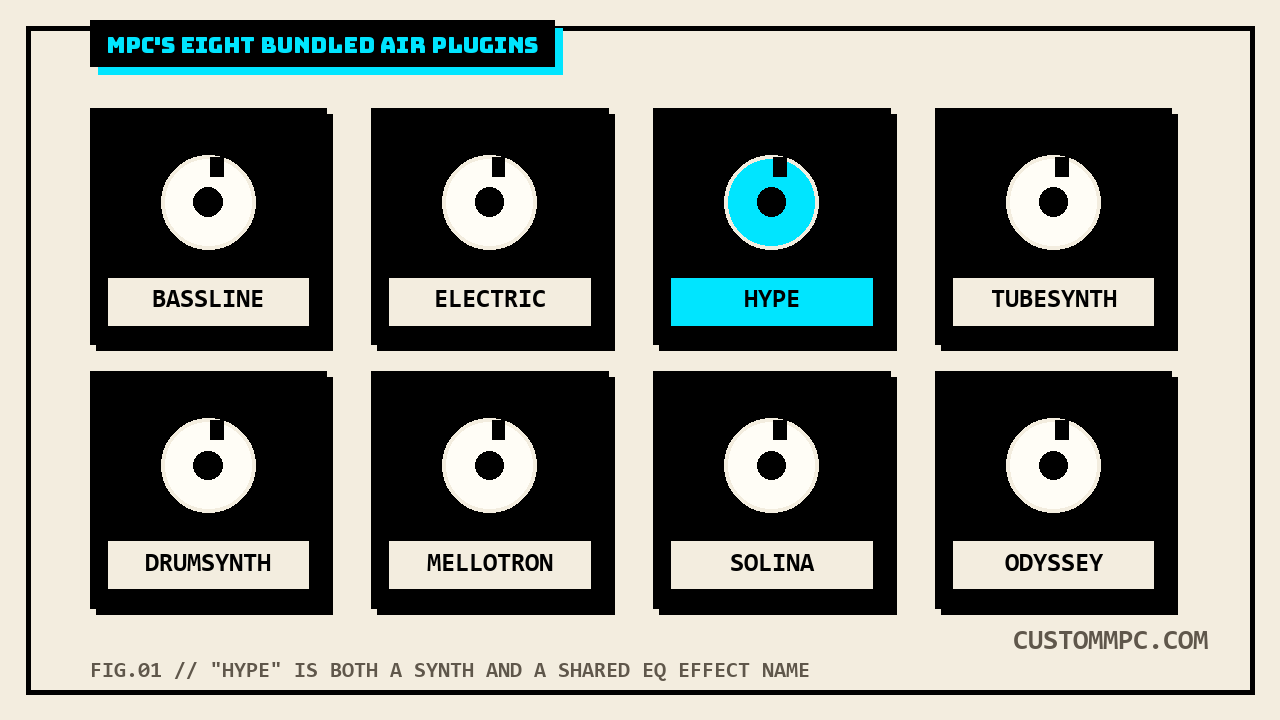
Every MPC running the Standalone OS, and every copy of MPC Software, ships with the same eight AIR-made instrument plugins: Bassline (mono synth), Electric (electric piano), Hype (modern dual-oscillator synth), TubeSynth (analog polysynth), DrumSynth (eight-voice drum engine, one plugin per drum type), Mellotron (tape keyboard), Solina (string ensemble), and the licensed WayOutWare Odyssey. One built-in effect is named "Hype," a shelving EQ that dampens or boosts high and low end, and it ships inside Bassline's and TubeSynth's own effects chains as well as inside the separate Hype instrument plugin's chain, three different places carrying the exact same effect name for two unrelated things. DrumSynth is really eight separate plugins (Clap, Crash, HiHat, Kick, Perc, Ride, Snare, Tom), each loadable individually, plus a DrumSynth:Multi that combines all eight, capped at one Multi instance per project. Details on each below, cross-checked against v3.7 to confirm what's actually new.
RIO'S NOTE: People ask which plugin is "the one" for trap 808s and it's not a fair question. Bassline gives you the sub-octave and glide, TubeSynth gives you the fatter analog stack, and neither one is a drum plugin at all. DrumSynth's Kick model is the actual 808-adjacent tool. Match the plugin to the job, not the genre.
What a Plugin Track actually loads
This site's plugin access guide already covers how you get to any of this: standalone MPC hardware doesn't scan a folder for third-party VST or AU files the way MPC Software running on a computer does, it loads a fixed, Akai-curated catalog onto Plugin Tracks through an inMusic Profile login and an Activations screen, free trial or purchased serial number either way. This article picks up exactly where that one stops: once a plugin is loaded onto a Plugin Track, what does it actually do, and what should you expect the moment you open its parameter tabs.
The catalog at a glance
| Plugin | Emulates | Core engine |
|---|---|---|
| Bassline | Classic mono synths | 1 oscillator plus sub-octave and fifth, LP and HP filter, chorus, delay, compressor, Hype EQ |
| Electric | Classic electric pianos | Pickup model, Bell and Noise layers, tremolo, tube overdrive, chorus, delay, spring reverb |
| Hype | Modern hybrid synth | 2 oscillators, LFO, modulation and distortion, six macro knobs per preset |
| TubeSynth | Classic analog polysynths | 2 variable oscillators plus 1 sub oscillator, 5 integrated AIR effects |
| DrumSynth | Classic drum machines | 8 separate drum-type plugins (Clap, Crash, HiHat, Kick, Perc, Ride, Snare, Tom), plus DrumSynth:Multi |
| Mellotron | Classic tape keyboard | 6 tape loop samples (choirs, flute, violins), Clean/Formant and Age controls |
| Solina | Classic string ensemble | 6 independent voices (Contra Bass, Cello, Viola, Violin, Trumpet, Horn), ensemble and dual modes |
| WayOutWare Odyssey | The ARP Odyssey analog synth | 2 voltage-controlled oscillators, LFO/Audio switchable frequency mode, licensed circuit modeling |
Bassline
The AIR Bassline plugin emulates the sound of classic mono synths, built around a single continuously variable oscillator (saw octave, saw, square, or sine) plus independent sub-octave and fifth oscillator amounts, a glide time control for pitch slides between notes, and a boost stage with its own envelope-controlled gain and frequency. The filter section runs a low-pass and a high-pass stage in series, with a filter envelope that can either open or close the cutoff based on the filter decay setting, and the amp envelope splits attack, decay, filter decay, and pitch mod into four independent stages. Effects run chorus, a tempo-syncable delay with its own damp and resonance controls, a compressor, and the shelving EQ effect Akai names "Hype," the same name as the separate synth plugin covered below, confirmed as three distinct occurrences of that exact word across three different plugins' effects chains.
Electric
The AIR Electric plugin emulates the sound of classic electric pianos, with a Pickup/Env tab modeling pickup type (Electro-Static or Electro-Magnetic), pickup height and distance to the tines, and a signal clip amount, plus a separate amp envelope with attack, decay, release, and peak-length keytrack controls. Every tab lets you quickly toggle a Bell layer and a Noise layer on or off, and the built-in effects chain is entirely different from Bassline's and TubeSynth's: Tremolo, Tube (Akai's own label for overdrive), Chorus, Delay, and a dedicated Spring Reverb, with no "Hype" EQ effect anywhere in Electric's chapter, confirmed by checking every effects tab name in this specific plugin's section directly rather than assuming the same effects list carries across all eight plugins.
Hype
The AIR Hype plugin is a modern-style dual-oscillator synthesizer built around six macro controls unique to each preset, designed for fast sound-shaping without digging into individual parameter tabs first. Worth flagging directly rather than smoothing over: that same Macro tab's own parameter table lists eight named controls underneath the "six macro controls" line, Cutoff, Reso, Mod, Distortion, Delay, Reverb, Pumper, and Volume, two more entries than the descriptive text above the table states, a real mismatch inside Akai's own documentation rather than something this site is introducing. The synth engine itself runs an LFO plus modulation and distortion stages on its Effects 1 tab, and includes its own internal effect also named "Hype," a high/low shelving EQ, the same effect name that shows up inside Bassline and TubeSynth as well.
TubeSynth
The AIR TubeSynth plugin emulates the sound of classic vintage analog polysynths and is built on the AIR Vacuum Pro desktop synth plugin's engine, with two variable oscillators plus a separate sub oscillator and five integrated AIR effects. Oscillator 1's Octave control runs Wide, 32', 16', 8', 4', or 2' coarse tuning, with the Wide setting unlocking a much finer +/-70-semitone Fine tuning range compared to the +/-12 semitones available at any of the fixed-octave settings, a real precision tradeoff between the two modes worth knowing before dialing in a detune. Its Compressor/Hype tab carries the same "Hype" shelving EQ name found in Bassline and inside the Hype plugin itself, confirmed word for word against Bassline's own version of the same effect.
DrumSynth
DrumSynth is not one plugin, it's eight: Clap, Crash, HiHat, Kick, Perc, Ride, Snare, and Tom each load as their own individual plugin on a track, each with a full synthesis engine emulating classic drum-machine sounds and its own Trans/Dist (transient and distortion) and EQ/Comp effects tabs. Akai's own Model parameter for each type is documented as "Varies" in the manual's parameter table rather than naming specific source drum machines directly, so this site isn't claiming a specific 808 or 909 lineage for any individual model beyond what Akai states, "classic drum machines" in general. A genuinely useful detail for anyone building a full kit: DrumSynth:Multi combines all eight drum types into one plugin instance with shared Trans/Dist, EQ/Comp, and Send FX (Delay, Diffuser, Reverb) tabs across the whole kit, but Akai's own manual caps it explicitly, "you can only have one DrumSynth:Multi plugin active per project," a real ceiling worth knowing before planning a session around multiple simultaneous Multi instances.
Mellotron
The AIR Mellotron plugin is a software recreation of the classic tape keyboard, reproducing the original tape samples in both clean and dirty versions rather than modeling the instrument's circuitry the way the synth plugins above do. Its Model tab selects between six named tape loop samples, 8 Voice Choir, Boys Choir, Flute, Violins 1, Violins 2, and Violin, with Clean/Formant and Age controls shaping how degraded or pristine the loop sounds, plus a standard amp envelope with a starting-point control for where inside the tape loop playback begins.
Solina
The AIR Solina plugin is a software recreation of the classic string synthesizer, built around six independently toggled voices, Contra Bass, Cello, Viola, Violin, Trumpet, and Horn, each with its own volume, pan, and octave setting on the Ensemble tab. A separate Ensemble/Dual/Bass Volume/Upper Volume/Level section layers a Dual mode and per-voice octave offsets, Contra Bass runs -2 to 0, Violin runs 0 to +2, and every other voice runs -1 to +1, on top of the six base voices for a thicker, chorused ensemble sound.
WayOutWare Odyssey
The WayOutWare Odyssey plugin is a licensed software recreation of the classic ARP Odyssey analog synthesizer, built by WayOutWare specifically to model the original circuit's character rather than an in-house AIR emulation like the seven plugins above it. Its VCO 1/2 tab runs a switchable LFO/Audio frequency mode per oscillator, standard pitch behavior in Audio mode versus LFO-rate modulation in LFO mode (useful for modulating VCO2 from VCO1), plus independent FM, Pulse Width, and Sync controls per oscillator, a deeper per-oscillator modulation routing than any of the other seven plugins in this catalog expose directly on their main tab.
A version note
The Plugins chapter's page numbers shift by roughly 21 pages between manual versions, Bassline runs p.401 in v3.7 versus p.422 in v3.9, a much bigger jump than the flat 4 or 5-page drift this site's other articles have found in other chapters, reflecting how much new content the Pro Pack and other additions inserted earlier in the v3.9 manual before reaching this chapter at all. Despite that large page shift, a direct line-by-line diff of the Bassline chapter's full text between v3.7 and v3.9 turned up zero content differences, every parameter name, description sentence, and value range is word for word identical between versions, the entire 21-page gap is purely earlier-chapter growth pushing this content later in the document, not new Bassline features.
Common mistakes
Mistake: assuming DrumSynth is a single plugin. It's eight separate plugins, one per drum type, plus a DrumSynth:Multi that combines them, capped at one Multi active per project per Akai's own note.
Mistake: assuming "Hype" only refers to the Hype synth plugin. Akai reused the same name for a shelving EQ effect bundled inside Bassline's, TubeSynth's, and the Hype plugin's own effects chains, three different places in the manual using the identical word for two unrelated things.
Mistake: expecting the same effects chain on every plugin. Electric's five effects (Tremolo, Tube, Chorus, Delay, Spring Reverb) share zero names with Bassline's or TubeSynth's chains; check each plugin's own Effects or Compressor tab rather than assuming parity across the catalog.
Mistake: assuming Odyssey is another in-house AIR emulation. It's a separately licensed plugin built by WayOutWare specifically, stated directly in the manual's own chapter intro rather than grouped under the AIR name the other seven plugins carry.
A note on sources
Rule two on this site is that conflicts get stated, not quietly resolved, and the Hype plugin's own Macro tab supplied a clean, verifiable example: the tab's own descriptive text states "these six macro controls are unique to each preset," directly above a parameter table listing eight named rows, Cutoff, Reso, Mod, Distortion, Delay, Reverb, Pumper, and Volume. That's Akai's own documentation containing an internal count mismatch, not an error introduced by this site's extraction or summary, and it's presented above exactly as found rather than picked one way or silently corrected to six or eight.
The Mellotron section's raw text extraction also deserves a direct note: the source PDF's two-column parameter table pulls as several interleaved label and value fragments when converted to plain text, a known artifact this site has run into before with dense parameter tables. Every claim made about Mellotron above, the six-sample list and the Age control's function specifically, was confirmed against its own standalone description sentence in the extracted text rather than inferred from which column a word happened to land in, the same discipline used on every prior article's citation-page corrections.
The DrumSynth Model parameter is documented by Akai as "Varies" per drum type without naming specific source drum machines anywhere in the chapter; this article states that directly rather than filling the gap with an assumed 808 or 909 lineage the manual itself doesn't confirm.
Verdict
VERDICT
The catalog: eight AIR-made plugins ship free with every MPC, Bassline and TubeSynth for synth bass and pads, Electric for keys, Hype for modern hybrid sounds, DrumSynth for a full eight-voice drum kit (with a real one-Multi-per-project ceiling), Mellotron and Solina for tape and string textures, and a licensed WayOutWare Odyssey for a deeper analog-modeling option than the in-house plugins offer. The catch: Akai's own documentation has a real internal mismatch on Hype's macro count, and reuses the "Hype" name across three separate plugin sections for an unrelated shelving EQ effect, both stated directly above rather than smoothed over. The takeaway: this is a genuinely deep, genuinely free instrument catalog most MPC owners never open past the Activations screen; knowing what's actually inside each one is the difference between reaching for the same three presets and building a kit that sounds like you spent time in these tabs.
Found a plugin quirk this guide should have caught? Tell us what happened.