GUIDE Effects
MPC compressor effects: five names, two real designs
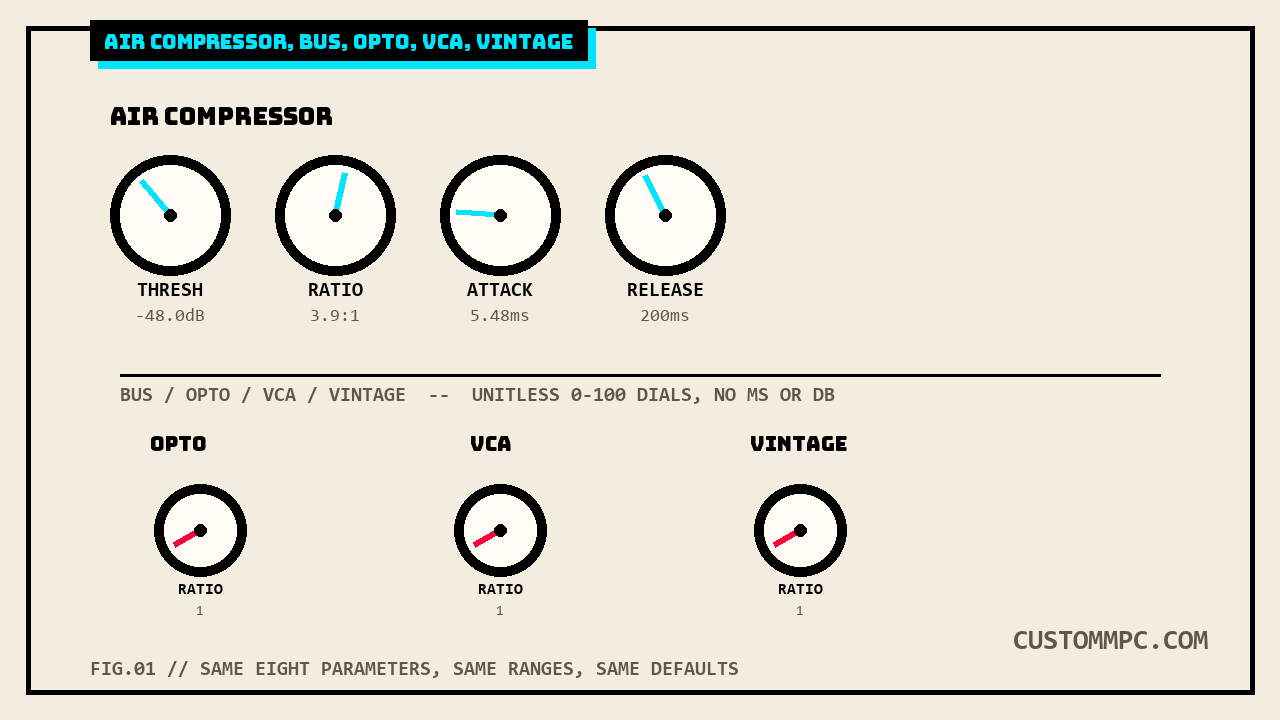
The Dynamics category's own effects list names five separate compressors: AIR Compressor, Bus Compressor, Compressor Opto, Compressor VCA, and Compressor Vintage, plus a sixth compressor bundled inside AIR Channel Strip. Only one of the five uses real time units and a true ratio notation. Three of the other four turn out to share one identical eight-parameter schema, same ranges, same defaults, down to the decimal. Checked page by page against Akai's own manual, not summarized from the catalog table this site already published.
The short version
This site's own insert vs send/return effects article already counted the Dynamics category at 14 effects and named a handful as examples. It never opened any of them up. Five of those 14 are compressors in the ordinary sense (gain reduction above a threshold), and they split into two genuinely different designs, not five:
"Options: AIR Channel Strip, AIR Compressor, AIR Limiter, AIR Maximizer, AIR Noise Gate, AIR Pumper, AIR Transient, Bus Compressor, Compressor Opto, Compressor VCA, Compressor Vintage, Mother Ducker Input, Mother Ducker, Transient Shaper"
AIR Compressor is its own design: real millisecond and second values for Attack and Release, a true "X:1" ratio up to 100:1, and controls (Mix, Knee, Output) none of the others have. Compressor Opto, Compressor VCA, and Compressor Vintage are, at the parameter level, the same effect wearing three different names, same eight fields, same ranges, same default numbers. Bus Compressor sits closest to that second group but drops two of its fields and adds one nobody else has.
Where these live: the Dynamics category
All five sit inside one insert-or-send/return effects catalog this site's own routing article already mapped, 14 effects under the Dynamics heading, out of 98 total across six categories:
"Every insert or send/return slot, regardless of location, pulls from the same shared list: 98 individual effects split across 6 categories in Akai's own Effects & Parameters appendix."
That means every compressor covered here loads exactly the way any other insert or send/return effect does, four insert slots per location, or a shared four-slot return bus, no separate menu or workflow just for dynamics processing.
AIR Compressor: the one with real units
AIR Compressor is the only one of the five whose spec table reads like outboard gear, actual time and level units rather than an abstract dial:
"This basic compressor effect changes the dynamic range of a signal by automatically reducing its gain if it exceeds a certain level (the threshold)."
| Parameter | Range | Default |
|---|---|---|
| Threshold | -60.0 to 0 dB | -48.0 dB |
| Ratio | 1.0:1 to 100.0:1 | 3.9:1 |
| Output | 0.0 to 30.0 dB | 15.0 dB |
| Mix | 0-100% (dry-wet) | 100% |
| Knee | 0-100% | 50% |
| Attack | 100 µs to 300 ms | 5.48 ms |
| Release | 10.0 ms to 4.00 s | 200 ms |
Seven fields, an actual "X:1" ratio, Attack quoted down to microseconds. Mix and Knee are unique to this effect among the five, no other compressor covered here has either one.
Opto, VCA, and Vintage: one schema, three names
Compressor Opto, Compressor VCA, and Compressor Vintage each get their own named entry with their own descriptive paragraph. Checked field by field, all three publish the identical parameter table:
| Parameter | Range | Default |
|---|---|---|
| Dry/Wet | 0-100 (dry-wet) | 100 |
| Input | -6 to 18 dB | 0 |
| Attack | 0-100 | 50 |
| Release | 0-100 | 50 |
| Threshold | -50 to 0 dB | 0 |
| Ratio | 1-20 | 1 |
| Knee | 1-100 | 1 |
| Output | -6 to 24 dB | 0 |
Same eight fields, same ranges, same defaults, every one of them. What's actually different is Akai's own prose about the modeled circuit, and only that:
"Compressor Opto: The Opto Compressor is modeled after a vintage compressor type using an optical circuit to control the volume reduction of the input signal. These compressors are usually associated with soft and unobtrusive attack and release characteristics."
"Compressor VCA: This compressor is more modern-sounding, with a slightly more transparent sound. A VCA Compressor tends to have quicker attack and release times than an Opto Compressor."
"Compressor Vintage: This compressor has a sound similar to classic tube compressors, with their gentle yet pumping response and a dash of tube saturation."
Read plainly: the manual is telling you these three sound different by design, optical, VCA, and tube-modeled circuits genuinely behave differently in real analog gear, but it isn't giving you a single documented parameter to point at as the reason. Whatever's shaping that difference lives inside the DSP algorithm behind each name, not in anything visible on the control surface. A user comparing the three by reading their knob positions alone would see no difference at all.
RIO'S NOTE from the bench: I went back through this table twice assuming I'd mistyped one of the three, because effects almost never ship with byte-identical spec tables under different names. They didn't. If you're chasing a specific compressor "feel" on an MPC insert by watching the Threshold or Ratio readout, stop, none of these three will show it to you. Trust your ears on this one, not the screen.
Bus Compressor: the odd one out
Bus Compressor sits closest to the Opto/VCA/Vintage group, four shared field names, but it isn't a fourth copy of that same table:
"This is the most transparent compressor, able to perform substantial volume adjustments without artifacts."
| Parameter | Range | Default |
|---|---|---|
| Dry/Wet | 0-100 (dry-wet) | 100 |
| Attack | 0-100 | 50 |
| Release | 0-100 | 50 |
| Threshold | -50 to 0 dB | 0 |
| Ratio | 1-20 | 1 |
| Oldskool | Off, On | Off |
| Output | -6 to 24 dB | 0 |
No Input control and no Knee control, both present on Opto/VCA/Vintage. In their place: Oldskool, a plain on/off toggle that doesn't exist anywhere else on any of the other four compressors, no explanation of what it does beyond the name itself, Akai's own text doesn't expand on it past the parameter table entry. Read plainly against the "most transparent... without artifacts" framing in its own description, Oldskool reads as the one control offered for deliberately working against that transparency, though the manual never states that outright and this article isn't guessing at what changes internally when it's engaged.
AIR Channel Strip's built-in Comp
A sixth compressor lives inside AIR Channel Strip, a combined EQ-plus-dynamics effect with its own Gate/Comp tab:
"This specially-designed plugin combines multiple effects with a fast interface. The EQ section provides a highpass filter, low and high shelves, and a fully parametric mid-band. For dynamics, the AIR Compressor and Gate algorithms are perfect for achieving hard-hitting drum sounds."
Akai's own text names AIR Compressor specifically as the algorithm behind Channel Strip's Comp section, and the numbers back it up closely, but not perfectly:
| Parameter | Channel Strip Comp | Standalone AIR Compressor |
|---|---|---|
| Ratio range / default | 1.0:1-100.0:1 / 3.9:1 | 1.0:1-100.0:1 / 3.9:1 |
| Attack range / default | 100µs-300ms / 5.48ms | 100µs-300ms / 5.48ms |
| Release range / default | 10.0ms-4.00s / 200ms | 10.0ms-4.00s / 200ms |
| Threshold range / default | 0.0 to -60.0dB / 0.0dB | -60.0 to 0dB / -48.0dB |
| Mix, Knee, Output | not present in Gate/Comp tab | present |
Ratio, Attack, and Release match the standalone effect exactly, same range, same default, to two decimal places on Attack. Threshold shares the same bounds but ships a different default, 0.0dB inside Channel Strip versus -48.0dB standalone, meaning Channel Strip's Comp section starts wide open by default while the standalone effect starts already engaged. Channel Strip also folds Comp into a larger chain with its own Enable toggles for EQ, Gate, and Comp sections independently, plus a shared Output stage (-Inf to +24.00dB) that isn't the same Output field as AIR Compressor's own 0.0-30.0dB control.
Side by side
| Effect | Threshold | Ratio | Attack / Release | Unique controls |
|---|---|---|---|---|
| AIR Compressor | -60 to 0 dB | 1.0:1-100.0:1 | real µs/ms/s | Mix, Knee, Output (0-30dB) |
| Compressor Opto | -50 to 0 dB | 1-20 | unitless 0-100 | Input, Knee (1-100) |
| Compressor VCA | -50 to 0 dB | 1-20 | unitless 0-100 | Input, Knee (1-100) |
| Compressor Vintage | -50 to 0 dB | 1-20 | unitless 0-100 | Input, Knee (1-100) |
| Bus Compressor | -50 to 0 dB | 1-20 | unitless 0-100 | Oldskool (Off/On) |
Not covered here: Mother Ducker
Real sidechain-style ducking exists on current-lineup MPCs, but it isn't filed under any of the five "Compressor" names above, it's its own separate pair of effects:
"Mother Ducker Input: Add this effect as an insert to the track you want to use as a trigger input, such as a kick drum track... Mother Ducker: Add this effect as an insert to the track you want to have the ducking effect applied to. Use the meters to monitor the level from your trigger input and tweak the Threshold and Ratio parameters to adjust the amount of ducking."
Mother Ducker runs on its own eight internal buses, a From/To bus-routing pair neither of the five compressors above has any equivalent of, and its own Ratio (1.00:1 to 60.00:1) and Knee (0.000 to 6.000dB) ranges don't match any of the tables above either. It's a genuinely different tool built for a genuinely different job, real inter-track sidechain rather than single-track dynamics, and deserves its own separate article rather than a rushed paragraph appended to this one.
Common mistakes
Mistake: expecting Opto, VCA, and Vintage to sound identical because their spec tables are identical. The parameter surface is the same; the DSP algorithm behind each name isn't documented as identical, and Akai's own descriptive text explicitly frames all three as different circuit models.
Mistake: reading a Ratio of "1-20" as a plain multiplier the way AIR Compressor's "1.0:1 to 100.0:1" reads. Akai's own text doesn't attach units or a colon notation to the 1-20 scale on Opto/VCA/Vintage/Bus, unlike AIR Compressor's explicit "X:1" format; treat the two as different scales, not directly comparable numbers.
Mistake: assuming Channel Strip's Comp section is a full copy of the standalone AIR Compressor. The Ratio/Attack/Release numbers match, but Threshold's default doesn't, and Mix/Knee aren't present in the Gate/Comp tab at all.
A note on manual versions
Every parameter table above is checked directly against Akai's Standalone OS User Guide, Manual Version 3.9, cross-checked line-for-line against Manual Version 3.7. A direct diff of both manuals' Dynamics-category pages (v3.9 PDF pp.396 and 398, v3.7 PDF pp.375 and 377), normalized for whitespace and page-number lines, returned zero content differences, every effect name, description sentence, and parameter value identical between editions. The chapter sits at a flat plus-21 page offset between versions (396 minus 375 equals 21, 398 minus 377 equals 21), a different offset from the plus-five this site's own insert-vs-send-return article found for the Effects Overview chapter earlier in the same manual, one more confirmed data point that this manual's page drift isn't one constant number applied everywhere.
Verdict
VERDICT
Want real attack/release time control and a true ratio: AIR Compressor is the only one of the five that gives you actual microseconds, milliseconds, and an "X:1" number. Choosing between Opto, VCA, and Vintage: the knobs won't tell you anything, they're parameter-identical; pick by ear against Akai's own circuit descriptions, not by watching a readout. Want a dedicated on/off character switch: that's Bus Compressor's Oldskool toggle, unique to it. Looking for sidechain/ducking behavior: none of these five do that job, Mother Ducker is the effect built for it.
Found a real audible difference between Opto, VCA, and Vintage worth naming despite the identical spec tables? Tell us what you heard.