BUYING GUIDE MPC5000
Akai MPC5000 buying guide: what to check before you buy the 2008 flagship
This site's buying-guide family already covers the MPC1000, MPC2000, MPC2000XL, MPC3000, MPC4000, and MPC60, and skipped the MPC5000 entirely until now, despite it being Akai's actual 2008 flagship and the first MPC with an onboard arpeggiator. Here's what it actually is straight from Akai's own reference manual, the CD drive and RAM card that turn out to be options rather than standard equipment, the firmware version that quietly gates an entire program type, and the checklist to run before you pay for one.
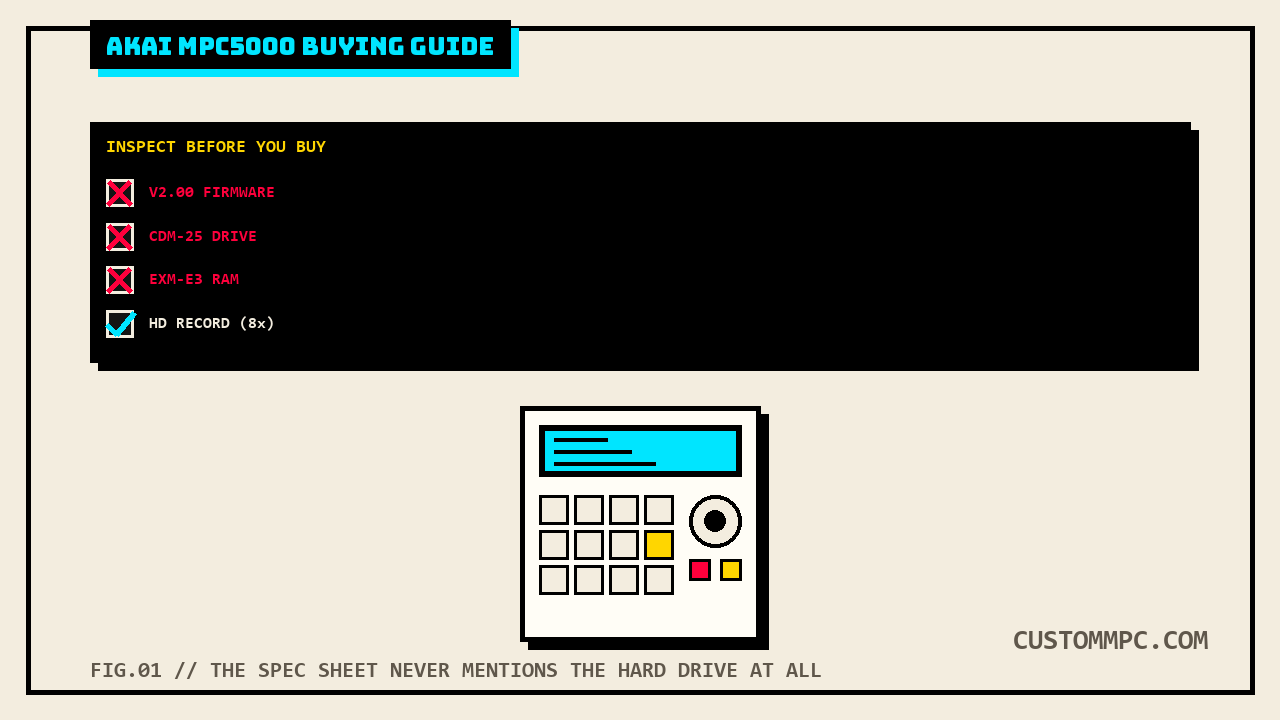
The short version
The MPC5000 is Akai's December 2008 flagship standalone MPC, a 64-voice, 44.1kHz/16-bit sampler with 64MB of sample memory standard, expandable to 192MB through a single EXM-E3 card slot, CompactFlash storage for programs and sequences, and a documented 8-track internal Hard Disk recording feature that never once shows up in Akai's own printed Specifications page. Two things matter more than any single spec on that list: the CD/DVD drive and the RAM expansion card that most listing photos treat as part of the machine are both listed under "Options" in Akai's own spec sheet, not standard equipment, and a unit still running the factory V1.0 firmware cannot build Keygroup-type Programs (multi-sampled instruments) at all, a real functional gap the free V2.00 addendum firmware closes.
DEX'S NOTE: Everybody who's shopped a used 5000 has a story about a listing photo showing a CD drive that turns out to be missing on arrival. It was never standard. Same with the RAM card. Ask what's actually installed before you send money, not after the box shows up.
What the MPC5000 actually is
Akai released the MPC5000 in December 2008 at a US launch price of $3,499 and a UK price of £1,699 including VAT, positioned as the top of the standalone MPC line above the MPC2500. Sound on Sound's launch review called it a "beefed-up big brother to the MPC2500," noting doubled 64-voice polyphony, a multitimbral 20-voice synth engine with arpeggiators, four separate multi-effects busses, and stereo file slicing as meaningful upgrades over the 2500, but reviewer Mike Senior had real reservations: 8-track hard-disk recording felt "a bit diddy" with missing auto-locate and punch-in functions, the beat-slicing algorithm was "annoyingly haphazard" on stereo files, the mixing facilities were called adequate "for a drum sampler" but not for a full production, there's no phantom power on the mic inputs, and effect routing is limited to a single send per track. He couldn't "wholeheartedly recommend" the machine except to existing MPC enthusiasts, calling it uncompetitive against contemporary workstations from Korg, Yamaha, and Roland. One figure from that review is worth flagging against Akai's own documentation rather than repeating at face value: Sound on Sound's "20-voice synthesizer" description doesn't match anything in Akai's own manual, which documents a single 64-voice polyphony figure with no separate 20-voice synth-engine spec anywhere; treated here as an unresolved discrepancy between press coverage and the primary source, not silently picked one way or the other. One detail this site's other buying guides had no reason to mention: per the MPC5000's own manual, "New to the MPC5000 is the arpeggiator," the first onboard arpeggiator in the MPC line, a feature this site's modern Standalone OS arpeggiator guide covers on the current One/Live/Key hardware more than a decade later.
Real specs, straight from the manual
Every figure below is quoted or paraphrased directly from Akai's own MPC5000 Reference Manual v2.00, "Specifications" section, printed pages 200-201 (PDF pages 214-215), independently re-extracted from the source PDF to confirm every value. The manual's own printed spec table never lists an internal hard-disk capacity anywhere, a genuine gap covered in the checklist below.
| Spec | Figure |
|---|---|
| Memory | 64MB standard, expandable to 192MB via 1x EXM-E3 card slot |
| Polyphony | 64 voices |
| Sample format | 16-bit linear |
| Sampling rate | 44.1kHz |
| Recording time | 12m48s mono at 64MB, 38m24s mono at 192MB |
| Filters | 1 State Variable Filter per voice, up to 8-pole depending on type; Low Pass, Band Pass, High Pass, Band Boost, Band Stop, Analog Modeling, Vocal Formant |
| Preset sound memory | 16MB, 128 programs |
| Effects | 4 stereo busses, 2 stereo effects per buss, plus Master effect (4-band EQ, Compressor) |
| Sequencer capacity | 100,000 notes maximum, 960 parts per quarter note (ppq) |
| Sequences / tracks | 99 sequences, 64 tracks per sequence |
| MIDI output channels | 64 (16 channels x 4 output ports) |
| Song mode | 20 songs, 250 steps per song |
| Pads | 16, velocity and pressure sensitive, 4 banks |
| Sync modes | MIDI clock, MIDI Time Code, MIDI Machine Control transport |
| Storage | CompactFlash card slot, 32MB to 2GB supported; internal Hard Disk for 8-track recording (capacity undocumented in the printed spec table) |
| Digital I/O | S/PDIF RCA in and out, ADAT optical out (8 channels) |
| Analog I/O | 2x combo mic/line inputs (balanced -40dBu, RCA phono preamp), stereo out, 8 individual outs (all balanced +11dBu, +22dBu max), 1/4" stereo phones out |
| USB | Slave connector x1, Mass Storage Class only (no MIDI or audio over USB) |
| MIDI | 2 inputs, 4 outputs, 5-pin DIN |
| Display | 240 x 128 dot graphic LCD with backlight |
| Options | EXM-E3 (128MB expansion card, upgrades to 192MB total), CDM-25 (CD-R/DVD drive), none standard |
| Dimensions / weight | 18in x 16 1/16in x 3 3/8in (6 7/8in with screen raised), 18.2 lbs |
| Power | 50W |
Why it's still worth buying in 2026
Three real reasons. First, it's the most import-compatible vintage MPC this site has covered: Akai's own Data Compatibility table lists direct loading of MPC1000 SEQ/WAV/PGM files, MPC2000/2000XL SEQ/WAV/SND/PGM files, MPC4000 SEQ/WAV/AKP (Keygroup and Drum type) files, MPC3000 SND files via a connected computer, and Akai's own Z4/Z8, S5000/6000, and S1000/3000 sampler formats, a genuinely wide net for anyone migrating a library built on older Akai gear. Second, the 8-track internal Hard Disk recording feature is real and, once you know the firmware requirement, genuinely useful: audio records straight to the internal drive rather than sample RAM, so recording length is limited only by drive space, not memory, with per-track effects and its own mixer page. Third, the price gap between "2008 flagship that launched at $3,499" and what one actually sells for today is real, covered in the pricing section below, and a machine this documented (a 235-page reference manual plus a dedicated V2.00 improvements addendum) is a genuinely well-supported used purchase by vintage-MPC standards.
What it isn't: a plug-and-play purchase, and not the studio-in-a-box its launch price implied. Sound on Sound's own review flagged real weaknesses in multitrack recording and mixing, there's no phantom power for condenser mics on the inputs, the CD drive and RAM card most listings imply are built in are both separately-installed options, and the internal hard drive is a mechanical part now roughly 18 years old with a capacity Akai's own manual never bothered to print, all covered in the checklist next.
The checklist: firmware and hardware
Run these roughly in order. The first two cost nothing and clear up the two points of confusion that come up most on a used MPC5000 listing.
1. Confirm the firmware version before you assume Keygroup Programs exist
The V2.00 Manual Addendum documents Keygroup Type Program creation, sample layer crossfade, per-sample panning, tuning and root note, keytracking, keygroup tune and transpose, and pitch bend/modwheel/aftertouch response as new features added in that release, filed under "Improvements to PROGRAM Mode." That table of contents heading only makes sense if Keygroup Programs didn't exist on the machine before V2.00: a unit still running the factory V1.0 firmware can build Drum-type Programs but not multi-sampled Keygroup instruments at all, a real functional gap for anyone planning to use the MPC5000 for melodic/multi-sampled sounds rather than drum programs. Ask the seller which firmware is installed, not just whether it "works."
2. Ask which options are actually installed, not implied by the listing photo
Akai's own spec sheet lists exactly two items under "Options": the EXM-E3 128MB memory card and the CDM-25 CD-R/DVD drive, neither one a "Standard accessory." A stock, unexpanded MPC5000 has 64MB of sample RAM and no CD/DVD drive at all, loading and saving entirely through the CompactFlash slot. Both options are real, findable upgrades on the used market, but a listing photo showing a slot-loading drive doesn't tell you whether the RAM card is also installed, and vice versa, so confirm both directly rather than assuming a fully-loaded unit from a partial photo.
3. Test the internal Hard Disk directly, not just the CompactFlash slot
The 8-track HD Recording feature depends on a mechanical internal hard drive that Akai's own printed spec table never documents the capacity of at all, a genuine omission across the entire "General," "Sound Generator," and "Inputs/Outputs" spec blocks. Sound on Sound's contemporary review states an 80GB hard drive, a figure worth noting as press context filling a gap Akai's own manual leaves open rather than an Akai-confirmed spec, since the primary document simply doesn't print a number. Whatever the original capacity, it's now a roughly 18-year-old mechanical drive: record a test track to a Hard Disk track (not just a CompactFlash sample) and play it back before you buy, not just power the unit on.
4. If the CDM-25 drive is present, test it specifically, and know it has a documented failure mode
Per forum reports on the shared MPC5000/MPC2500 CDM-25 drive mechanism, the unit uses a Teac DW-224E-labeled drive internally, and owners who've sourced replacement Teac DW-224E drives have reported the MPC5000 sometimes failing to recognize the replacement part, and separately, an "audio sync failed" error tied to a serial communication line between the mainboard and the audio processing daughtercard, with forum-reported fixes involving reseating and cleaning the ribbon cables between boards. Neither issue is confirmed in any Akai document this site has on file; both are stated here as forum-reported, real-world failure patterns worth testing for directly (load a CD, burn a disc if the unit supports it, watch for sync errors during normal operation) rather than Akai-confirmed defects.
5. Don't expect phantom power on the mic inputs
Akai's own I/O spec documents the two combo mic/line inputs as balanced -40dBu with an RCA phono preamp stage, with no phantom-power figure or mention anywhere in the Inputs/Outputs specification block. Sound on Sound's review independently flagged the same limitation from a working reviewer's perspective, calling out the lack of phantom power directly. Plan on an external mic preamp with phantom power if you're tracking condenser mics through this machine; it was never built to supply it.
What they actually cost right now
Real listings run wide. An "Excellent" condition unit was priced at $800 plus $40 shipping on Reverb, though that specific listing is now inactive per the indexed search result rather than a live current price; a currently active eBay listing for a complete MPC5000 workstation is priced at $1,500; and Equipboard's aggregated listing data shows prices starting from roughly $181.98 across a wider spread of condition and completeness. That's a genuinely wide spread even before factoring in which options are installed: a bare 64MB unit with no CD drive and no RAM card on old V1.0 firmware is a real step down in capability from a fully-optioned, V2.00-updated unit with the EXM-E3 card and CDM-25 drive both present, and the checklist above is exactly how to tell the two apart before you pay. The launch price was $3,499 in the US in December 2008, and every unit on the used market today has depreciated hard from that for real reasons, not all of which a listing photo will show you.
Common mistakes
Mistake: assuming Keygroup Programs work on any MPC5000. They don't, not on the factory V1.0 firmware; Keygroup Type Programs were added in the V2.00 addendum, per Akai's own improvements documentation.
Mistake: assuming a listing photo showing one option means both are installed. The CDM-25 drive and the EXM-E3 RAM card are two separate options per Akai's own spec sheet, and neither implies the other; confirm both directly.
Mistake: repeating a listing's "20 Voice" description as an Akai spec. Akai's own manual documents 64-voice polyphony with no separate 20-voice synth-engine figure anywhere; that language traces to a specific eBay listing's own title, not the Reference Manual.
Mistake: expecting phantom power on the mic inputs. There isn't any, confirmed both in Akai's own I/O spec and independently in Sound on Sound's contemporary review.
A note on sources
Rule two on this site is that conflicts get stated, not quietly resolved, and this article surfaced two worth calling out directly. First, Sound on Sound's launch review describes a "multitimbral 20-voice synthesizer," a figure that doesn't appear anywhere in Akai's own Reference Manual, which documents only a single 64-voice polyphony spec and a separate 32-sound multitimbral MIDI sound-module limit, neither one matching "20." Second, at least one active eBay listing repeats that same "20 Voice" language in its own title, which this article notes as the listing's own wording rather than an independently confirmed spec, consistent with how this site has handled listing-page claims in every prior buying guide.
A genuine documentation gap is also worth flagging in the other direction, not as a conflict but as a real omission: Akai's own printed Specifications page documents CompactFlash card sizing down to the exact megabyte range (32MB to 2GB) but never once states the internal Hard Disk's capacity, despite 8-track Hard Disk Recording being a fully documented feature elsewhere in the same manual. Sound on Sound's 80GB figure is used in this article specifically to fill that gap as press context, not because it contradicts anything Akai printed.
One general vendor-sourcing note also applies here, consistent with every other buying guide on this site: direct fetches of the specific Reverb item page and the MPC-Forums CD-M25 thread both failed during this research pass (HTTP 403 in both cases), so those figures rest on WebSearch's indexed summaries of that content rather than a direct page fetch. Where a direct fetch succeeded, Sound on Sound's review and the Vintage Synth Explorer Forums discussion summary in this case, that's stated as such above; where it didn't, that's stated too.
Verdict
VERDICT
The specs: 64 voices, 44.1kHz/16-bit sampling, a 100,000-note sequencer across 64 tracks, 192MB of headroom over a 64MB stock configuration, and the widest cross-format compatibility of any vintage MPC this site covers, all confirmed straight from Akai's own Reference Manual. The purchase: confirm the firmware version before assuming Keygroup Programs exist, ask directly which of the two real options (the EXM-E3 RAM card, the CDM-25 CD/DVD drive) are actually installed rather than trusting a listing photo, test the internal Hard Disk and, if present, the CD drive by hand rather than just powering the unit on, and don't expect phantom power on the mic inputs. The money: a wide, honestly scattered spread from around $180 on the low end of aggregator data up to $1,500 for a complete, actively-listed unit, against a $3,499 launch price in December 2008. Get the checklist right and you're buying the most import-compatible, most documented flagship in this site's vintage lineup, not a mystery box with options you assumed were included.
Bought one recently, or found something this checklist should have caught? Tell us what happened.