BUYING GUIDE MPC ONE
Akai MPC One buying guide: One, One+, or One G2
This site's buying-guide family has covered eight vintage MPCs (60 through 5000) and never touched the modern-standalone side, despite the MPC One being Akai's flagship budget standalone since 2020. Here's the part that actually trips people up: "MPC One" today means one of three different machines, not one product with a storage upgrade. Real specs from Akai's own current manual, the two power supplies that don't interchange, and what to check before you spend money on any of the three.
The short version
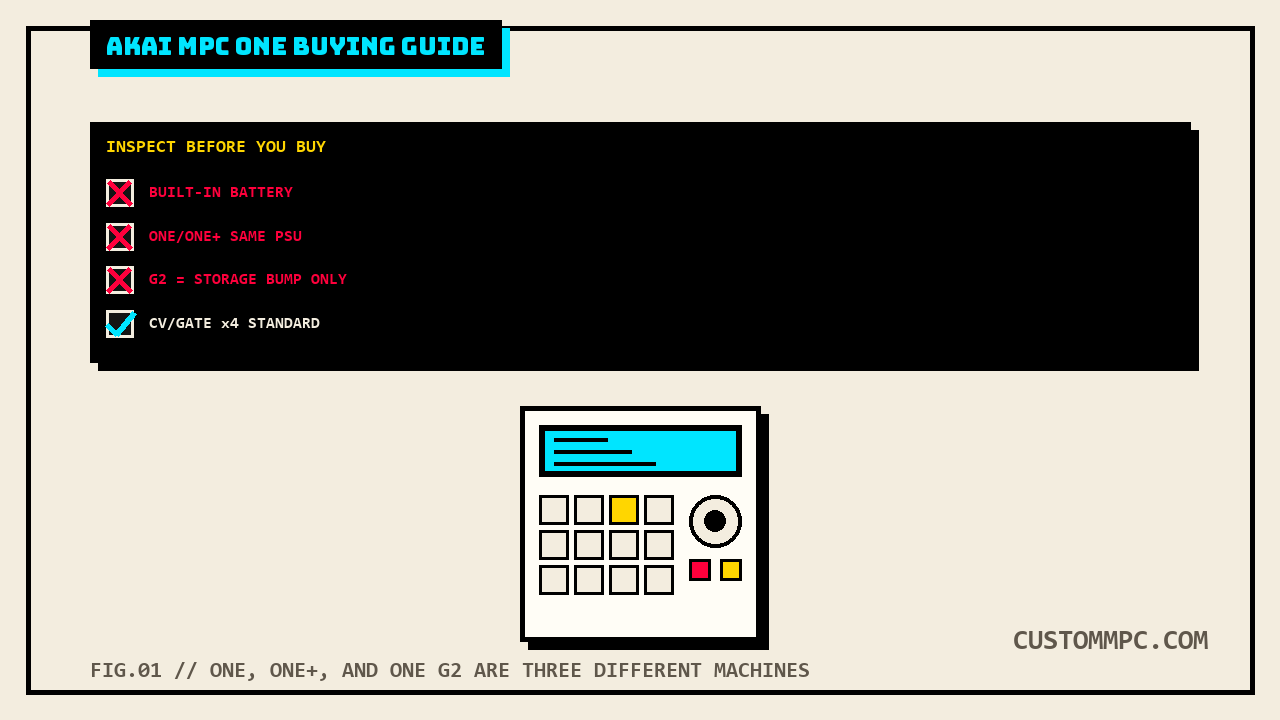
The Akai MPC One launched in February 2020 as the budget entry point into standalone MPC production, a 16-pad, 7-inch-touchscreen unit that needs no computer to sample, sequence, or mix. Since then Akai has shipped two more machines under the same "One" name: the MPC One+ (2023), which Akai's own current documentation confirms as a storage-capacity variant of the original One, and the MPC One G2 (announced June 18, 2026), a from-scratch redesign with a different processor, RAM, storage, and wireless hardware entirely. Akai's own current Standalone OS User Guide (v3.9) backs up the "One and One+ are close cousins, G2 is not" framing directly: its own Technical Specifications appendix documents the original One and the One+ together in a single combined spec table, differing only in storage capacity and power-adapter rating, while the One G2 gets its own separate table two pages later with a different processor, RAM figure, storage figure, and the only Wi-Fi/Bluetooth radio of the three. None of the three has a built-in battery, a real, easy-to-assume-wrong point confirmed in the same manual's own "Battery Usage" section: only the MPC Live and MPC Live II can run off internal power, every other model in the current lineup, One family included, needs a wall outlet.
SAM'S NOTE: I get asked "should I get a One or wait for something better" more than any other question on this beat. The real answer is that "One" isn't one thing anymore. Figure out which of the three you're actually looking at before you compare price, because the G2 isn't a bigger hard drive strapped to the same guts, it's a different machine.
Three machines share one name
The original MPC One announced at NAMM 2020 shipped with 4GB of total onboard storage, split 2GB of preloaded sounds and 2GB free for the user, a spec Akai's own current manual still documents unchanged. Sweetwater's own listing for the original MPC One now shows the product as no longer available for new purchase, with a last-seen sale price of $899, consistent with major retailers moving to the newer variants. The MPC One+ followed in 2023 as a storage-capacity refresh: Akai's own combined spec table lists it right alongside the original One, differing in exactly two rows, storage (16GB internal, 7.8GB usable, versus the original's 4GB total) and the power adapter's voltage and current rating, with every other row in the table, from the pad count to the display size to the Q-Link knob layout, identical between the two. A confirmed color option shipped alongside the storage bump too: Akai's own support documentation describes the One+ in "a new, red color edition making it stand out from previous MPCs," while continuing to sell the standard black finish as well. The MPC One G2, announced June 18, 2026 at $799 US, is a different animal: Akai's own separate spec table for it documents a new 8-core processor against the One/One+ table's unnamed (but far less powerful) quad-core chip, 4GB of RAM against 2GB, 64GB of storage against 4GB or 16GB, and Wi-Fi plus Bluetooth radios that appear nowhere in the One/One+ table at all.
Real specs, straight from the manuals
Every figure below is quoted or paraphrased directly from Akai's own MPC_Standalone_OS_User_Guide_v3.9.pdf Technical Specifications appendix. The original One/One+ table sits at PDF pages 475-476 (printed page footers 475-476); the separate One G2 table sits at PDF pages 477-478 (printed page footers 477-478), a flat continuation with no page-number offset at this point in the document, confirmed by direct pdftotext -f 475 -l 478 extraction against the isolated pages, independently cross-checked against a second, position-sorted pymupdf pass on the same pages.
| Spec | MPC One | MPC One+ | MPC One G2 |
|---|---|---|---|
| Processor | Quad-core ARM processor | G2 eight-core processor | |
| RAM | 2 GB | 4 GB | |
| Storage | 2 GB user + 2 GB pre-installed (4 GB total) | 16 GB internal, 7.8 GB user | 64 GB internal |
| Display | 7.0" full-color LED-backlit touch display, 151 x 94mm | Same 7.0" touch display | |
| Pads / knobs | 16 velocity- and pressure-sensitive RGB pads (8 banks), 4 Q-Link knobs, 1 push encoder | ||
| Wi-Fi / Bluetooth | None documented in this table | 2.4/5 GHz Wi-Fi; Bluetooth (HID profile) | |
| Connections | 2x 1/4" TRS in, 2x 1/4" TRS out, 1/8" headphone, 1x 5-pin MIDI in/out, 4x CV/Gate out, USB-A, USB-B, SD slot | Same layout, USB-C in place of USB-B, 4x CV/Gate jacks rated 8 outputs total | |
| Power adapter | 19 V, 3.42 A, center-positive | 12 V, 3 A, center-positive | 12 V, 3 A, center-positive |
| Built-in battery | None on any of the three; wall power required | ||
| Dimensions / weight | 272 x 272 x 53mm, 4.7 lbs / 2.1 kg, identical across all three | ||
Why the naming confusion matters
Three real reasons this isn't just pedantry. First, the power supplies genuinely don't interchange: the original MPC One's included adapter is rated 19V at 3.42A, while both the One+ and the One G2 ship with a 12V, 3A adapter, a real voltage mismatch, not a rounding difference, so a used-market bundle advertised as "MPC One with spare charger" is worth confirming against the unit's own rear-panel rating before assuming the spare works. Second, storage capacity swings by 16x across the range, from the original One's 4GB total to the One G2's 64GB, a real constraint for anyone planning to keep large sample libraries or full projects resident on the machine rather than swapping SD cards constantly. Third, the wireless gap is total, not partial: Akai's own current combined spec table for the One and One+ has no Wi-Fi or Bluetooth row anywhere in it, while the separate One G2 table two pages later documents both explicitly, meaning any workflow built around wireless file transfer, MIDI-over-Bluetooth, or a companion mobile app depends entirely on which of the three you actually own.
Worth flagging directly rather than resolving quietly: at least one contemporary press report on the One+ launch describes it as "adding Wi-Fi, Bluetooth and increased internal storage over its predecessor," which conflicts with Akai's own current manual, whose combined One/One+ spec table documents no wireless hardware for either machine and reserves those two spec rows for the One G2 alone. Both are real documents, one just isn't Akai's own current technical reference; if wireless connectivity is the deciding feature for your purchase, verify it on the specific unit in front of you rather than trusting either source alone.
The checklist: power, storage, and which one
Run these in order before you commit to a specific listing.
1. Confirm which of the three you're actually looking at
A seller's title reading "MPC One" without a "+" or "G2" suffix is most likely the original 2020 unit, now discontinued at major retail, but plenty of listings drop the suffix by accident or habit. Ask directly, and cross-check against the rear-panel power adapter rating (19V/3.42A means original One; 12V/3A means either One+ or One G2, distinguishable from there by the front-panel color and the presence of a USB-C port on the G2 where the One+ has USB-B).
2. Don't assume a spare charger from one model works on another
The original One's 19V, 3.42A adapter and the One+/One G2's shared 12V, 3A adapter are not interchangeable ratings; using the wrong one is a real risk to the unit, not just an inconvenience. If a used listing includes "an extra power supply," confirm its printed voltage and amperage against the specific unit before relying on it.
3. Budget for a power bank or dedicated battery pack if you want portability
None of the three One-family machines has a built-in battery; Akai's own manual states plainly that only the MPC Live and MPC Live II can run off internal power. A genuinely portable MPC One rig means a third-party USB-C power delivery bank or a dedicated battery pack sold for exactly this purpose, not a feature the hardware includes out of the box.
4. Don't skip the CV/Gate outputs when comparing to modular-friendly competitors
All three machines document 4 CV/Gate outputs as standard equipment, on the One G2 rated as 8 total outputs across those same 4 physical jacks, a real, easy-to-overlook feature for anyone weighing the One family against a modular-focused competitor that markets CV/Gate as a headline spec.
What they actually cost right now
The original MPC One is effectively discontinued at major retail: Sweetwater's own listing shows it no longer available for new purchase, with a last sale price of $899, so buying one today means the used market. The MPC One+ remains in stock new at Sweetwater at $699. The MPC One G2 launched June 18, 2026 at $799 US ($729 UK, $849 EU per the announcement's own listed regional pricing), the newest and most expensive of the three, positioned above the One+ rather than replacing it at the same price point. Weigh that against what each price actually buys: the One+'s extra $0 over its 2020 launch price for 4x the storage of the original, or the G2's $100 premium over the One+ for an 8-core processor, double the RAM, 4x the storage again, and wireless connectivity neither predecessor has.
Common mistakes
Mistake: assuming "MPC One" always means the same machine. It's covered three genuinely different products since 2020; confirm which one a listing or review is actually describing before comparing specs or price.
Mistake: assuming a spare power adapter from a different One-family model is safe to use. The original One's 19V/3.42A rating and the One+/G2's shared 12V/3A rating are not interchangeable; check the printed rating on the specific adapter and unit.
Mistake: expecting built-in battery power because a sibling model has it. Only the MPC Live and MPC Live II can run off internal battery per Akai's own manual; every MPC One variant needs a wall outlet or a third-party power bank.
Mistake: trusting a single press report over Akai's own current spec table on wireless connectivity. At least one contemporary report describes the One+ as gaining Wi-Fi and Bluetooth; Akai's own combined One/One+ table in the current manual lists neither, reserving both for the separate One G2 table. Verify on the unit itself if this matters to your purchase.
A note on sources
Rule two on this site is that conflicts get stated, not quietly resolved, and this article surfaced a real one: at least one press report on the MPC One+ launch describes it as adding Wi-Fi and Bluetooth alongside its storage bump, while Akai's own current Standalone OS User Guide documents the One and One+ together in a single combined spec table with no wireless hardware listed for either, reserving Wi-Fi and Bluetooth for the separate MPC One G2 table two pages later. Both extraction passes against the primary manual (a direct linear pdftotext pull and an independent position-sorted pymupdf pass) agree with each other on this point, so the primary-source reading itself isn't in doubt; the press claim is presented as a genuine, unresolved conflict against that reading rather than assumed wrong.
Pricing and retail stock-status figures for the original MPC One and the MPC One+ both came from WebSearch-indexed summaries of Sweetwater's own product listings; direct fetches of the specific Sweetwater product pages returned HTTP 403 in both cases, consistent with this site's prior experience fetching individual retailer item pages directly (Reverb, MPC-Forums). Where that's the case, it's stated plainly in the citation rather than upgraded to a direct-fetch claim. The MPC One G2 announcement, release date, and price came from WebSearch-indexed coverage of Akai's own June 18, 2026 announcement, cross-checked against the hardware's own spec table inside the already-verified local copy of MPC_Standalone_OS_User_Guide_v3.9.pdf, which independently confirms the processor, RAM, storage, and wireless claims from that press coverage.
Verdict
VERDICT
The specs: the original MPC One and MPC One+ share one Akai spec table differing only in storage (4GB versus 16GB total) and power adapter rating, both running a quad-core chip with 2GB RAM and no wireless hardware; the MPC One G2 is a separate table entirely, an 8-core chip, 4GB RAM, 64GB storage, and the only Wi-Fi/Bluetooth radio of the three, all confirmed straight from Akai's own current manual. The purchase: confirm which of the three a listing actually is before comparing price, never assume a spare power adapter is safe across models given the real 19V/3.42A versus 12V/3A split, budget separately for a power bank if portability matters since none of the three has a built-in battery, and don't overlook the standard 4x CV/Gate outputs when weighing this lineup against a modular-marketed competitor. The money: the original One is effectively used-market-only after Sweetwater discontinued new stock at a $899 last sale price, the One+ remains available new at $699, and the One G2 launched June 18, 2026 at $799, a real step up in specs for a real step up in price, not a rebrand. Get the model right first and the rest of this checklist is quick to run.
Bought one recently, or found something this checklist should have caught? Tell us what happened.