VS Comparison
MPC2000XL vs MPC4000: what actually changed
Three years separate the MPC2000XL (1999) from the MPC4000 (2002), the shortest gap of any pairing on this site so far, and on paper the 4000 reads like a clean generational upgrade rather than the mixed bag the MPC3000-vs-MPC4000 comparison turned up: double the polyphony, 16 times the max sample memory, a sequencer running ten times the resolution, and Akai's first-ever USB port. Unlike that 3000 pairing, digital I/O and the 8 individual outputs were already optional extras on the 2000XL, so nothing moved backward here, both machines gate the same functionality behind the same kind of add-in board. Every figure below is checked directly against Akai's own MPC2000XL Operator's Manual and MPC4000 Service Manual, including the one place their own documentation doesn't fully agree with itself.
The short version
The MPC2000XL was Akai's best-selling machine going into the 2000s, and the MPC4000 followed it three years later as the genuine studio flagship above it. On the sound engine, the 4000 wins almost every number outright: 64 simultaneous voices to the 2000XL's 32, sample memory expandable to 512MB against a 32MB ceiling, sampling up to 96kHz/24-bit against a fixed 44.1kHz/16-bit, and a sequencer running 960 parts per quarter-note where the 2000XL runs 96. It also adds a phono input with built-in RIAA equalization and Akai's first-ever USB port, host and slave both. None of that comes with the "features quietly moved from standard to optional" surprise this site's MPC3000-vs-MPC4000 comparison found, because on the 2000XL, digital I/O and the 8 individual outputs were already optional extras via add-in boards. The 4000 keeps that same arrangement rather than taking anything away.
DEX'S NOTE: People treat "2000XL to 4000" like a straight trade up because the 4000 costs more used today and has the bigger footprint, and on the spec sheet that's basically true. But check the Effects row before you assume the 4000 does more out of the box in every category, Akai's own spec table for the 4000 doesn't list an effects processor at all, while the 2000XL's manual is explicit that multi-effects need the optional EB16 board. It's the one place I'd tell you to actually go read both machines' documentation yourself before buying, because Akai's own paperwork leaves a real gap here.
Three years, entry workhorse to flagship
Akai released the MPC2000XL in 1999 as a refresh of the MPC2000, and it went on to become one of the best-selling machines in the whole MPC line, the unit most associated with the sample-heavy production era of the late 90s and early 2000s. The MPC4000 followed in September 2002 at a £2,299 launch price including VAT, explicitly positioned above the MPC2000XL as Akai's genuine studio flagship at a moment when the 2000XL was already the company's best-selling machine. That's the shortest gap between any two machines compared on this site so far, three years against the MPC3000-vs-MPC4000 pairing's eight and the MPC2000XL-vs-MPC3000 pairing's five (in the other direction, the 2000XL arriving after the 3000). It also means this is the first comparison here where the earlier machine, not the later one, was the reigning best-seller at the moment the newer flagship shipped.
Spec sheet, side by side
Every figure below comes straight from Akai's own documentation: the MPC2000XL Operator's Manual's Technical Specifications appendix (printed page 193) and the MPC4000 Service Manual's own SPECIFICATIONS section. Where the two machines are identical, the row says so rather than manufacturing a difference that isn't there.
| Spec | MPC2000XL | MPC4000 |
|---|---|---|
| Released | 1999 | 2002 |
| Sampling rate | 44.1kHz only | 44.1, 48, 96kHz |
| Sample format | 16-bit linear | 24 or 16-bit linear, selectable |
| Sound memory, stock | 2MB (21.9s mono / 10.9s stereo) | 16MB |
| Sound memory, max expanded | 32MB, via 2x 72-pin SIMM (70ns) | 512MB, via 2x 168-pin DIMM (PC133/PC100, CL2) |
| Simultaneous voices | 32 | 64 |
| Filter | 12dB/octave dynamic resonant lowpass per voice | 2-pole x3 with resonance, different architecture |
| Envelope generators | Not documented in this manual | 3 (2 multi-stage) |
| LFO | Not documented in this manual | 2, multi-wave |
| Max sounds in memory | 256 | Not documented as a flat cap in this manual |
| Sequencer capacity | 300,000 notes equivalent (50,000 max per sequence) | 300,000 notes equivalent, no per-sequence sub-cap listed in this section |
| Resolution | 96 parts per 1/4-note (ppq) | 960 parts per 1/4-note (ppq), exactly 10x |
| Sequences | 99 | 128 |
| Tracks per sequence | 64 | 128, exactly double |
| MIDI output channels | 32 (16 x 2 ports) | 64 (16 x 4 ports), exactly double |
| Song mode | 20 songs, 250 steps per song | 128 songs, 250 steps per song |
| Drum pad banks | 4 | 6 |
| Effects processor | Optional, EB16 multi-effects board | Not listed in the SPECIFICATIONS table; forum reports describe a shared effects processor board across all units |
| Digital I/O (S/PDIF) | Optional, requires unspecified board | Optional, requires IB-4D board |
| 8 individual/assignable outputs | Optional, IB-M208P board | Optional, IB-48P board |
| Phono input (turntable, RIAA EQ) | None | Standard, 2x RCA with RIAA EQ |
| SCSI | Built in, 50-pin high-pitch connector | Built in, 50-pin high-pitch connector, same type |
| USB | None, predates USB | Host x1, Slave x1 (v1.1) |
| Display | 248 x 60 dot graphic LCD | 320 x 240 dot grey-scale graphic LCD, backlit |
| Storage | 3.5" 2HD/2DD floppy, built in | Not listed as standard in this section; owner's manual documents a user-serviceable ATA hard disk/CD-ROM install appendix |
| CPU | Not documented (this site holds the Operator's Manual, not a Service Manual, for this machine) | Not named in this section (service manual instead documents the CPU board's Z4/Z8 cross-compatibility, covered below) |
| Power supply | 100-240V AC, 50/60Hz, 23W (13W without option) | 100-240V AC, 50/60Hz, 70W (27W without options) |
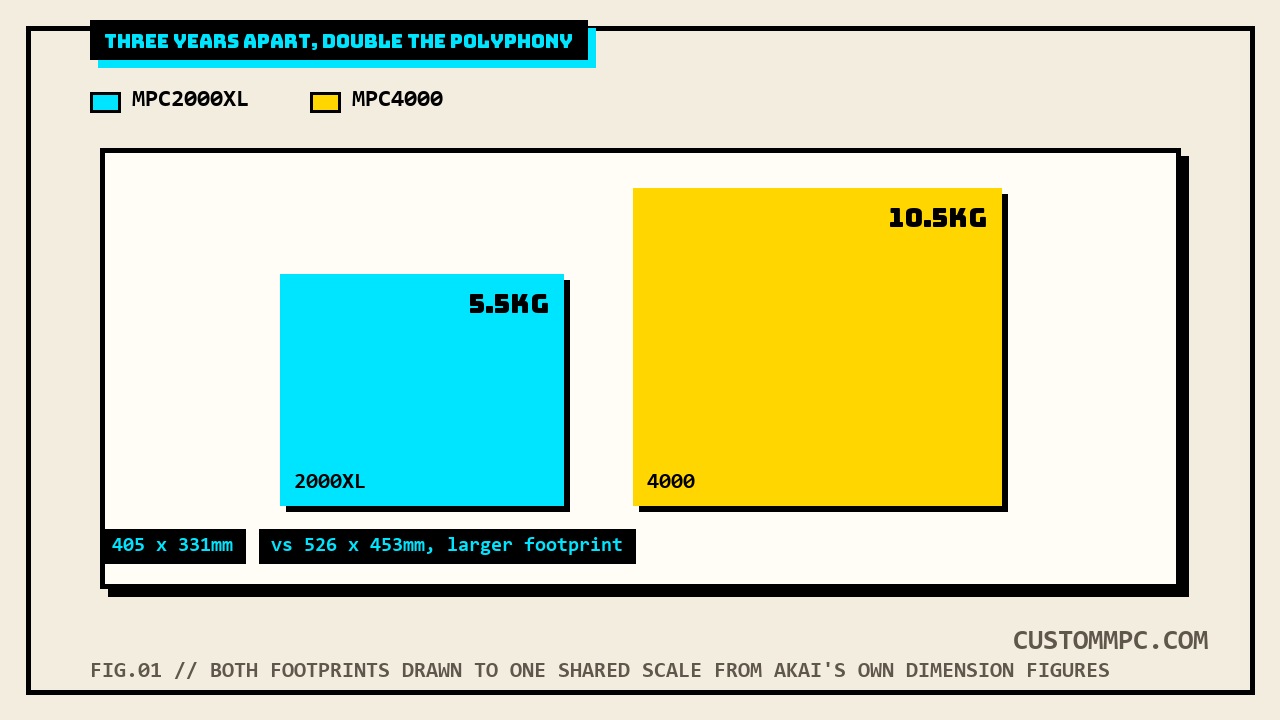
| Dimensions | 405(W) x 106(H) x 331(D) mm | 526(W) x 170(H) x 453(D) mm, LCD tilted down |
| Weight | 5.5kg | 10.5kg, without options |
Two rows deserve the same disclosure this site applies to every spec table rather than forcing certainty that isn't there. Effects is the sharpest gap: the 2000XL's own Options list names the EB16 board explicitly as the way to get multi-effects, but the 4000's SPECIFICATIONS table has no effects line at all, no board name, no "optional" tag, nothing. This site's own MPC4000 buying guide cites a long-running MPC-Forums thread reporting that the base unit and the so-called "Plus" variant "share the same effects processor board," which reads as standard-equipment, but that's a forum report, not a line in Akai's own spec sheet, and the two documents simply don't agree on how to even describe this feature. And "max sounds in memory," a flat 256 on the 2000XL, doesn't appear as an equivalent single figure anywhere in the 4000's own SPECIFICATIONS section, disclosed here rather than estimated from the memory-capacity numbers above it, exactly the same gap this site's MPC3000-vs-MPC4000 article found for the 3000's own 128 figure.
Sound engine and sequencer: the clean upgrade
This is the section where "flagship successor" holds up without much qualification needed. The 2000XL samples at a fixed 44.1kHz, 16-bit only. The 4000 adds 48kHz and 96kHz sampling rates and a selectable 24-bit depth:
"Sampling rate.... 44.1kHz, 48kHz, 96kHz" / "Data format.... 24/16 bit linear" (MPC4000). "Sampling rate 44.1kHz (frequency response: 20Hz-20kHz)" / "Data format 16-bit linear" (MPC2000XL).
Memory expansion is where the generational gap reads clearest, and it isn't just a bigger number, it's a different RAM technology entirely. The 2000XL expands via 72-pin SIMM modules to a 32MB ceiling. The 4000 moves to 168-pin DIMM slots, the same PC133/PC100 desktop-PC memory standard of its era, expandable to 512MB, 16 times the 2000XL's own maximum. Polyphony doubles, 32 simultaneous voices on the 2000XL to 64 on the 4000, and the sequencer's timing resolution jumps by exactly a factor of ten again, 96 parts per quarter-note to 960, the same 10x jump this site found comparing the MPC3000 to the MPC4000. Unlike that 3000 comparison, where MIDI output channels held flat across both machines, here the number actually doubles: 32 channels on the 2000XL to 64 on the 4000.
"MIDI output channels 32 (16 channels x 2 output ports)" (MPC2000XL). "MIDI output channels 64 (16 channels x 4 output ports)" (MPC4000).
Every core sound-engine and sequencer number on this list moves in the 4000's favor, and the 4000-vs-3000 comparison's one flat line, MIDI channels, isn't flat here. If MIDI-driven outboard gear is central to your setup, the jump from the 2000XL specifically doubles what you can address off the unit's own outputs.
I/O: what stayed optional on both
This is where this comparison genuinely differs from this site's MPC3000-vs-MPC4000 article. That comparison's sharpest finding was that S/PDIF digital I/O and 8 individual outputs shipped standard on the 3000 and moved behind optional boards on the 4000, a real regression on paper. Nothing like that happens here, because the 2000XL never shipped those features standard to begin with. Its own rear-panel spec lines mark both the digital sampling input and digital master output "(optional)" directly, and the 8 individual outputs line carries the same qualifier:
"Digital sampling input.... RCA-pin x 1, S/PDIF (optional)" / "8 individual outputs.... 1/4-inch phone x 8, unbalanced +11dBu, output Imp. 100Ω (optional)" (MPC2000XL).
The MPC4000 gates the equivalent functionality behind its own separate boards, IB-4D for digital I/O and IB-48P for the assignable outs, the exact same shape of limitation, just with different board part numbers:
"Digital Input (IB-4D required)... Digital Main Output (IB-4D required)" / "Assignable Outs (IB-48P required) 1/4-inch stereo phone x 8, balanced" (MPC4000).
Buyers shopping either machine used need to budget for the same category of add-in board either way, this isn't a case where the newer flagship took something away. The 4000 does add one input category the 2000XL has nothing for at all: a standard phono input with RIAA equalization built in, letting a turntable sample directly into the machine without an external phono preamp.
"Rec In PHONO L/R: RCA phono x 2 with RIAA EQ, -24dBu max. (1kHz)" (MPC4000).
SCSI is where this pairing genuinely differs from the 3000-vs-4000 comparison: both the 2000XL and the 4000 document the same 50-pin high-pitch SCSI connector, unlike the 3000's 25-pin D-sub connector that needed a different adapter than the 4000's. Anyone budgeting a SCSI2SD or ZuluSCSI storage mod for either of these two specific machines is shopping for the same connector type, a real, practical continuity this site's other classic-era comparisons don't all share. The clearest win for the 4000 in this section is still USB: the 2000XL's spec sheet has no USB category anywhere, it predates the standard entirely, while the 4000 documents both a USB Host and a USB Slave port at v1.1.
Size, weight, and the RAM generation jump
The 4000 is bigger in every dimension and roughly double the weight of the 2000XL, the same direction of change this site's MPC3000-vs-MPC4000 comparison found, just a bigger percentage jump this time:
"Dimensions 526 (W) x 170 (H) x 453 (D) mm (with LCD tilted down) / Weight 10.5kg (without options)" (MPC4000). "Dimensions... 405(W) x 106(H) x 331(D) mm / Weight... 5.5 kg" (MPC2000XL).
Power draw scales with it: the 2000XL is rated at 23W (13W without its optional board installed), the 4000 at 70W (27W without options), roughly three times the draw at idle-with-options. Both power specs list a plain "100-240V AC, 50/60Hz" figure with no per-region caveat, meaning both machines appear to be auto-switching rather than fixed to a single mains voltage, a genuine point of continuity that wasn't true for the MPC3000, whose own spec sheet fixes voltage per region (100V Japan, 120V US and Canada, 220-240V Europe). The CPU row is a documentation gap rather than a real spec difference, and it's a gap of a different kind than the 3000-vs-4000 comparison found. This site holds the MPC2000XL's Operator's Manual, not its Service Manual, and the Operator's Manual never names a CPU model anywhere in its Technical Specifications appendix. The 4000's own Service Manual also omits a CPU name from its SPECIFICATIONS table, but documents a CPU Board Test Mode elsewhere that confirms its board shares a design lineage with Akai's Z4/Z8 rack samplers. Neither machine's CPU is confirmed here, for two different reasons, disclosed rather than guessed at.
What never changed
As much signal here as in the differences, and a genuinely different list from the MPC3000-vs-MPC4000 comparison's own "what never changed" section.
- SCSI connector type is identical. Both machines document a 50-pin high-pitch SCSI connector, unlike the 3000-to-4000 jump, which changed connector types entirely.
- 16 velocity- and pressure-sensitive pads, unchanged. Both machines document exactly 16 drum pads, the core physical interaction hasn't moved across any generation on this site.
- Song mode's steps-per-song ceiling holds at 250. The 2000XL allows 20 songs at 250 steps each, the 4000 allows 128 songs, more than six times as many, but the per-song step ceiling itself didn't change, matching the same flat figure this site found comparing the MPC3000 to the MPC4000.
- Both power supplies read as auto-switching, a plain 100-240V AC rating with no fixed per-region voltage, unlike the MPC3000's fixed-per-region supply.
Used market reality
Pricing on both machines is a small, honestly scattered sample rather than a clean market average, the same caveat this site's own buying guides for each machine carry individually. MPC2000XL listings run in the low-to-mid hundreds for a working unit up to roughly $700-900 for a clean, well-kept example with extras, reflecting its status as the best-selling, most widely available classic MPC. MPC4000 listings run from roughly $500 for a bare working unit up past $2,100 for an excellent-condition example with extras, against a £2,299 launch price in 2002. Unlike the MPC3000, whose collector-driven cultural weight keeps its used prices unusually high for a 1994 machine, the 2000XL's own market sits closer to what its raw specs alone would predict, a genuinely accessible entry point into classic Akai sampling next to the 4000's steeper flagship pricing at the top of the range.
Verdict
VERDICT
Buy the MPC4000 if the sound-engine numbers matter most to how you work: double the polyphony, higher sampling rates and bit depth, a sequencer with ten times the resolution, 16 times the memory headroom, and a built-in phono input, and you're comfortable budgeting separately for the IB-4D and IB-48P boards if you need digital I/O or more than a stereo output, the same board-shopping the 2000XL already requires. Buy the MPC2000XL if budget and footprint matter more than raw headroom, you want the machine most identified with the sample-heavy sound of its era, or you're not going to touch 96kHz sampling or 512MB of RAM anyway. Either way, this is the cleanest generational upgrade this site has compared so far, nothing moved backward the way it did between the MPC3000 and MPC4000, just know the effects-processor question is a real Akai documentation gap on the 4000's side before you assume it's fully standard equipment.
Buying either one used? The MPC2000XL buying guide and the MPC4000 buying guide cover the full physical-condition checklist this article doesn't repeat. And if the MPC3000 versus MPC4000 comparison is more your speed, we've covered that pairing too.