VS Comparison
MPC2000XL vs MPC3000: what actually changed
The MPC2000XL arrived five years after the MPC3000, and the spec sheet doesn't play out the way "five years newer" usually suggests. It's smaller, lighter, and doubles the 3000's sound-memory slot count, but it also loses tracks per sequence and half its MIDI outputs to the machine it was supposed to succeed in spirit. Every figure below is checked directly against Akai's own MPC2000XL Operator's Manual and MPC3000 Service Manual, including the two real documentation gaps neither manual quietly resolves for you.
The short version
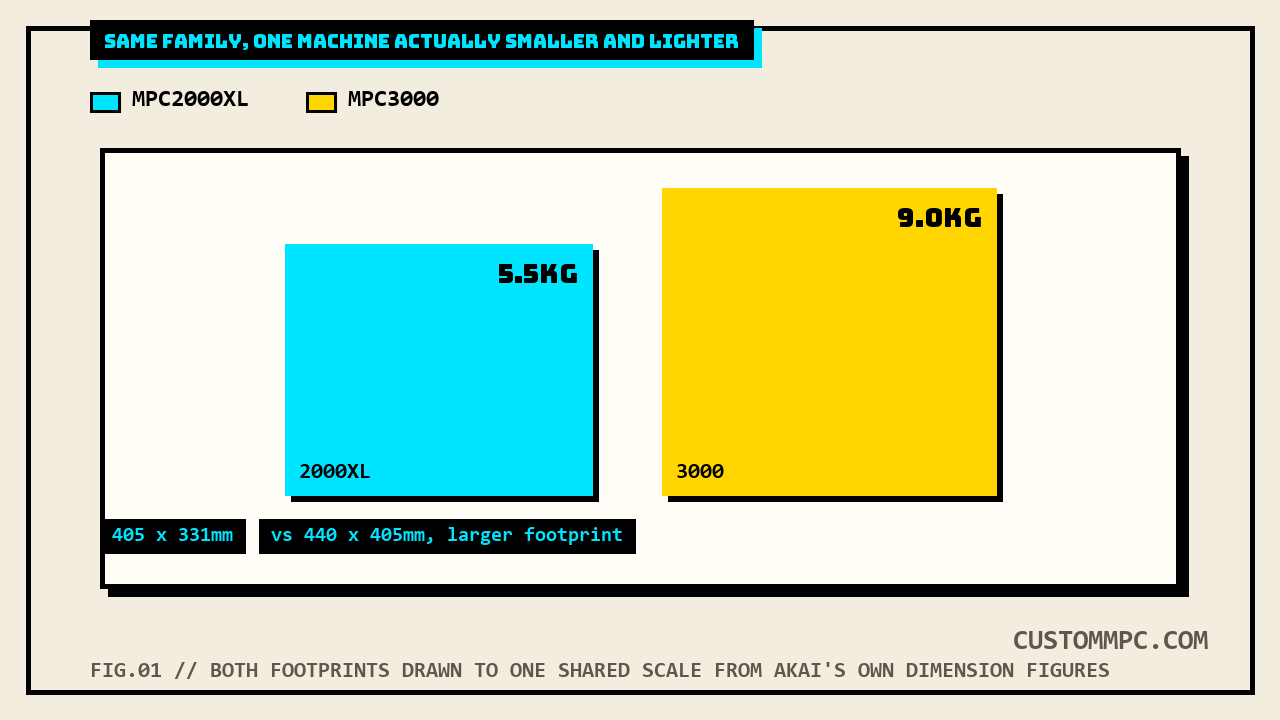
Read the release dates alone and you'd expect the MPC2000XL to cleanly beat the MPC3000: it shipped in 1999, five years after the 3000's 1994 debut. It does win some real ground, a smaller and lighter chassis, double the sound-memory slots, and double the maximum expandable sample memory, but it also loses tracks per sequence (64 versus the 3000's 99) and half its MIDI output channels (32 versus 64), and its 8 individual outputs are an optional board where the 3000 ships with them standard. Akai wasn't simply iterating one machine into a better version of itself between 1994 and 1999, it was building a smaller, cheaper, more accessible sampler that made real tradeoffs to get there.
DEX'S NOTE: I still see people list a 2000XL as "basically a 3000 replacement" and it isn't, not spec for spec. If your workflow leans on a lot of simultaneous MIDI-driven gear or you regularly run sequences with more than 64 tracks, that's not a 2000XL problem you can upgrade your way out of, that's a hardware ceiling the 3000 doesn't have. Know which numbers in this article actually matter to how you work before you let the smaller, cheaper price tag make the decision for you.
Five years, opposite direction
Akai released the MPC3000 in 1994 as its flagship, the second and last MPC to carry Roger Linn's original design lineage, and the machine most tied to a specific run of records, J Dilla's own unit is on permanent display at the Smithsonian's National Museum of African American History and Culture. The MPC2000XL followed in 1999, positioned as a mid-tier, higher-volume machine rather than a direct flagship successor, and it became the most common vintage MPC on the used market specifically because it shipped in the biggest numbers of any model on this site. That positioning explains most of what follows: the 2000XL isn't a worse 3000, it's a differently-scoped machine built five years later with a different budget and a different buyer in mind, and the spec table below reads a lot more sensibly once you stop expecting a straight generational upgrade.
Spec sheet, side by side
Every figure below comes straight from Akai's own documentation: the MPC2000XL Operator's Manual's Technical Specifications appendix for the 2000XL, and the MPC3000 Service Manual's SPECIFICATIONS section for the 3000. Where the two machines are identical, the row says so rather than manufacturing a difference that isn't there.
| Spec | MPC2000XL | MPC3000 |
|---|---|---|
| Released | 1999 | 1994 |
| Sampling rate | 44.1kHz | 44.1kHz, same |
| Sample format | 16-bit linear | 16-bit linear, same |
| Sound memory, stock | 2MB (21.9s mono / 10.9s stereo) | 2MB (21.9s mono / 10.9s stereo), same |
| Sound memory, max expanded | 32MB, via 2 SIMM slots directly | 16MB, via EXM3008 board + SIMMs |
| Simultaneous voices | 32 | 32, same |
| Max sounds in memory | 256 | 128 |
| Sound programs | 24 | 24, same |
| Sound assignments per program | 64 | 64, same |
| Sequencer capacity | 300,000 notes total, 50,000 per sequence | 75,000 notes total |
| Sequences | 99 | 99, same |
| Tracks per sequence | 64 | 99 |
| MIDI output channels | 32 (16 x 2 ports) | 64 (16 x 4 ports) |
| Drum pad banks | 4 | 4, same |
| 8 individual outputs | Optional (IB-M208P board) | Standard |
| SCSI | Built in, 50-pin connector | Built in, 25-pin D-sub connector |
| Foot switch inputs | None found (MIDI-implemented instead) | 2, independently assignable, dedicated jacks |
| Display | 248 x 60 dot graphic LCD | 240 x 64 dot graphic LCD |
| Storage | 1.44MB 3.5" 2HD/2DD floppy | 1.44MB 3.5" HD floppy, same capacity |
| Power supply | 100-240 VAC auto-switching, 23W | Fixed per region, 100V/120V/220-240V |
| CPU | Not documented in this manual | V53 @ 16MHz |
| Dimensions | 405(W) x 106(H) x 331(D) mm | 440(W) x 121(H) x 405(D) mm |
| Weight | 5.5kg | 9kg |
Two rows carry a caveat worth stating plainly rather than burying in the table. The sequencer-capacity row compares numbers Akai itself defines differently: the 2000XL's manual states "300,000 notes (maximum 50,000 notes per sequence)" as a total-events figure, while the MPC3000's manual states a flat "75,000" maximum notes with no total-versus-per-sequence split documented. Both figures are quoted directly from each machine's own appendix, not converted to a common unit, because the source text doesn't support that conversion cleanly. And the foot switch row reflects an absence, not a confirmed spec: the MPC2000XL manual's own Rear Panel Inputs/Outputs list, which itemizes nine distinct connectors, never lists a foot switch jack among them, while a later chapter documents a "MIDI Footswitch Assignment" feature instead, meaning the 2000XL's foot switch support runs through an external MIDI foot controller rather than a dedicated 1/4-inch jack the way the MPC3000 (and the MPC60 before it) implement it in hardware.
Tracks and MIDI outs: where the 3000 still wins
This is the pair of numbers that gets lost under the 2000XL's bigger sound-memory headline, and it's the one Dex's note above is pointing at directly. The MPC3000 allows 99 tracks per sequence, the same number as its sequence count, while the MPC2000XL caps out at 64:
"Tracks per sequence ..... 99" (MPC3000). "Tracks per sequence 64" (MPC2000XL).
For a dense multitrack arrangement, drum layers, multiple melodic parts, live-recorded MIDI from external gear all landing on separate tracks, hitting 64 tracks on a 2000XL is a real ceiling a 3000 user won't run into until well past that same point. MIDI output tells a similar story: the 2000XL's two independent MIDI output ports give 32 usable channels, while the 3000's four independent ports give 64. If your setup routes a lot of external synths and drum machines off the MPC's own MIDI outs rather than through a separate interface, that's twice the addressable channel count sitting on the older, more expensive machine, not the newer, cheaper one.
SCSI and outputs: connector and optional-board differences
Both machines shipped with built-in SCSI, a real advance over the MPC60 before them, which needed a third-party Marion Systems board bolted on to get any SCSI capability at all. But "both have SCSI" hides a real compatibility detail: the connectors aren't the same. The 2000XL uses a 50-pin high-pitch SCSI connector, while the 3000 uses a 25-pin D-sub connector.
"SCSI port ..... 50-pin high-pitch SCSI connector x 1" (MPC2000XL). "SCSI port ..... 1 (25-pin D-sub connector)" (MPC3000).
Anyone budgeting a SCSI2SD or ZuluSCSI storage mod needs the right adapter or cable for the specific connector on their specific machine, the two aren't interchangeable, and this site's own SCSI to SD card mod guide covers the practical side of that swap. The 8-individual-outputs question runs the opposite direction from what the "newer machine, more standard" instinct suggests. The MPC3000 ships with 8 individual outputs as a standard rear-panel feature, no qualifier anywhere in its own manual's spec line. The 2000XL's own manual tags the identical-looking line "(optional)," and the Chapter 13 Appendix names the specific board that adds it:
"IB-M208P 8 individual output and digital In/Out board."
A stock, un-upgraded 2000XL only has the main stereo output and headphone jack for audio out, no per-pad routing to a mixer or interface, unless the previous owner already installed that board. Ask directly about it before assuming a listed 2000XL matches the 3000's out-of-the-box output count.
Power: universal vs regional
This is the row least likely to show up in a spec comparison anyone actually reads before buying, and it matters the moment either machine crosses a border. The MPC2000XL's power spec is a single auto-switching line:
"Power requirements ..... 100-240 VAC, 50/60Hz, 23W (13W without option)."
One number range covers Japan, the US, and Europe. The MPC3000's manual, five years earlier, spells out three separate fixed voltages by region instead:
"AC 100V, 50/60Hz for Japan. AC 120V, 60Hz for U.S.A. and Canada. AC 220-240V, 50Hz for Europe."
A 3000 built for the Japanese or US market genuinely cannot be plugged into European mains without a step-up/step-down transformer or an internal voltage-selector service, and buyers importing a unit across regions need to confirm which regional build they're actually getting, that detail doesn't show up in a listing photo. The 2000XL's auto-switching PSU sidesteps the entire question, one of the quieter, less-discussed upgrades Akai made in the five years between the two machines.
What never changed
As much signal here as in the differences.
- Sampling rate, format, and dynamic filtering are identical. 44.1kHz, 16-bit linear, 12dB/Octave dynamic resonant lowpass filter per voice, worded near-identically in both manuals.
- Simultaneous voices didn't move. 32 on both machines, despite the five-year gap and the 2000XL's doubled sound-slot count. More sounds loaded doesn't mean more of them can ring out at once.
- Sound programs and per-program assignments are identical numbers. 24 programs max, 64 sound assignments per program, on both machines, even though the 2000XL's underlying sound-memory pool is twice as large.
- Stock sound memory and sequence count match exactly. 2MB standard (21.9s mono / 10.9s stereo) and 99 sequences, on both machines.
- Drum pad banks are the same, 4 banks of 16 pads. Neither machine grew this number over the other.
- Both got built-in SCSI, a real shared advance over the MPC60. The connector differs (covered above), but neither machine needs a third-party board just to see a SCSI drive at all, the way the MPC60 did.
Used market reality
Pricing on both machines is a small, honestly scattered sample rather than a clean market average, the same caveat this site's own buying guides for each machine carry individually. MPC2000XL listings run roughly $900 to $1,300 depending on condition, with a straightforward Excellent-condition unit landing around $1,029. MPC3000 listings run noticeably higher, roughly $1,800 to $2,300 for a standard unit, with MPC3000LE units tracking a much wider, collector-driven range on top of that. That price gap doesn't track cleanly with the spec table above, the 2000XL beats the 3000 on sound-memory slots, max expansion, size, and weight, and still sells for roughly half the price. The premium on the 3000 is buying legacy and reputation, the specific records made on it and the Smithsonian-grade cultural weight, as much as it's buying tracks per sequence and MIDI output count. Know which one you're actually paying for before you decide the spec table alone justifies the price gap either way.
Verdict
VERDICT
Buy the MPC3000 if your sequences genuinely need more than 64 tracks, your rig routes more than 32 channels of MIDI off the unit's own outputs, or the 8 individual outputs need to be standard on day one rather than a board you have to source and confirm separately, and you're willing to pay roughly double the 2000XL's used-market price for it. Buy the MPC2000XL if size, weight, a universal power supply that doesn't care what country you're in, and double the sound-memory headroom matter more to how you actually work, and confirm before you buy whether the specific unit already has the optional 8-output board installed. Either way, "five years newer" doesn't mean "strictly better" here, Akai built the 2000XL to a different budget and a different buyer, and the spec table has real wins on both sides once you stop assuming the later release date settles the comparison.
Buying either one used? The MPC2000XL buying guide and the MPC3000 buying guide cover the full physical-condition checklist this article doesn't repeat. And if the MPC60 versus MPC3000 comparison is more your speed, we've covered that pairing too.