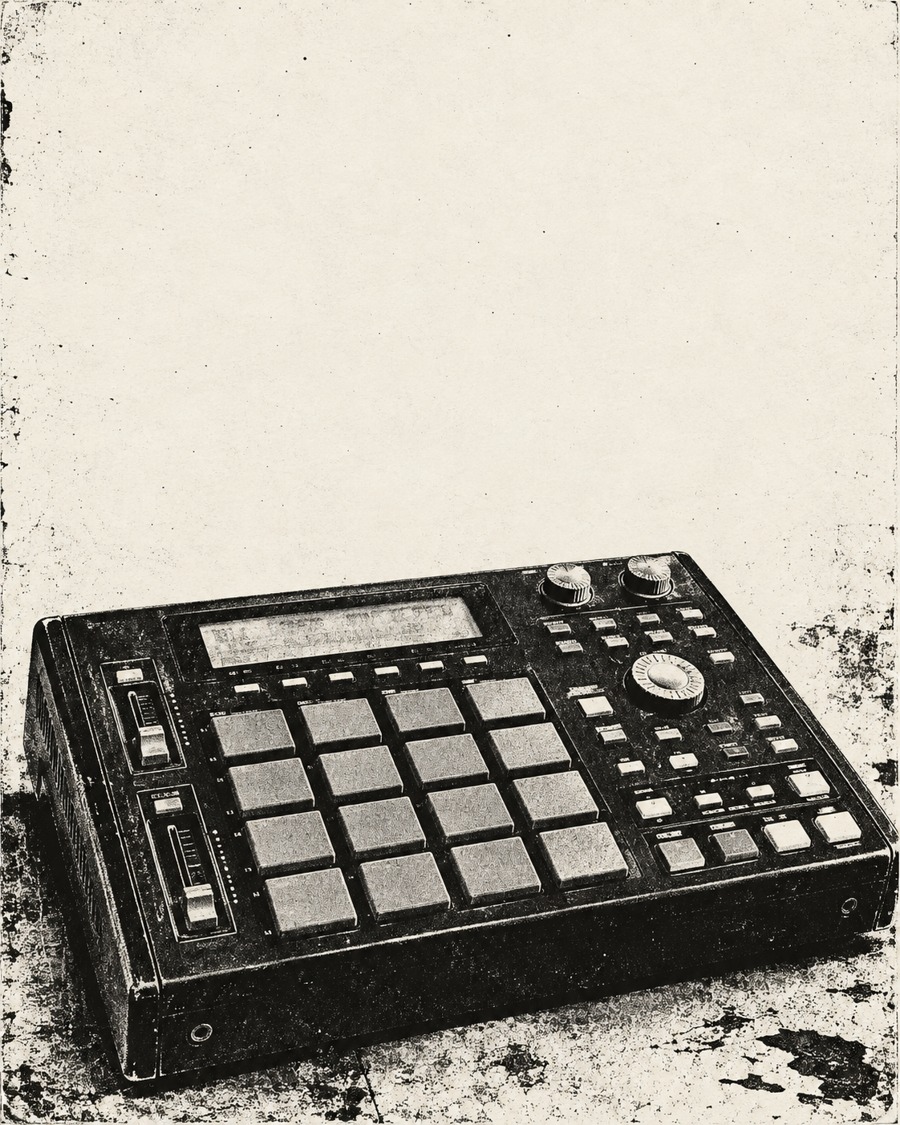
On May 12, 2026, a JJOS update corrected a beat line that was one pixel out of place in the MPC's MIDI Grid display. Almost twenty years after the earliest public beta discussion we could verify, someone was still refining the details. The entry is there in the developer's release log.
That small correction is a good place to begin a story usually told through a much bigger mystery: who is JJ?
Ask around MPC circles and versions of an origin story appear. A former Akai programmer. An insider with unfinished business. Someone who knew what these machines could do and kept going. The details shift, while the reputation of the software keeps the story alive.
We went back through old forums, contemporary reviews, community manuals and surviving release notes. What emerges is an extraordinary development history, with a biography that remains much harder to establish. For fans of the MPC1000 and MPC2500, both deserve a closer look.
What JJOS changed about owning an MPC
JJOS is a family of alternative operating systems for the Akai MPC1000 and MPC2500. It changes how supported machines handle editing, sequencing and performance. Installing the software does not replace their physical pads, converters or connections, although some OS branches are designed for a separately upgraded display. The official site and MPC-Tutor's introduction document that scope.
The attraction is easy to understand if you have ever learned an instrument deeply enough to encounter the same small frustration every session. You know where the control should be. You know which repeated operation interrupts the idea. A software change can alter that experience while your hands stay on familiar hardware.
Akai's own software was also evolving. A January 2006 forum post preserves official release notes that include time stretching, pitch shifting, reverse and slicing in the earlier 2.0 update. Those functions should not all be credited to JJOS. The interesting history lies in the differences between particular versions. Read the preserved Akai notes.
JJOS history was already happening in July 2006
On July 24, 2006, MPC-Forums member bigman opened a thread titled Beta 17 bugs. Users were discussing folder-name crashes, recording alignment and audio-track behavior. The opening post asked others to check the reports before they were submitted. Another participant described extensive use without crashes, while noting they did not use direct recording. The thread survives.
This is public testing in progress: specific operations, different experiences and people trying to work out what could be reproduced. It gives us a firm boundary. JJOS was circulating publicly by July 24, 2006. It does not give us an exact first-release date.
By November 22 that year, Chris Pfeil was reviewing JJOS v4.02 for AMAZONA. The review describes a paid release following free betas, with a password unlocking saving and user feedback contributing to development. Read the contemporary review.
A later MPC-Tutor review dates the beginning to 2007. The earlier records rule out treating that as the start of all public availability. We can leave the exact launch day open while still putting the beginning of this documented public history in 2006.
The name came from the community
Stan Steez's revision 3.5 manual credits MPC-Forums member Nym with the nickname Japanese Jenius. The same document describes the developer's identity as unknown. It is a revealing pairing: a memorable public name, supplied by a user, attached to someone without an established public biography. See the manual's preface.
You did not need a founder interview to discuss a new grid view or explain a shortcut to another owner. Over time, the name could stand for the software, the correspondence around it and the person or people doing the work. Those meanings are easy to collapse into a single character when retelling the history.
Did JJ actually work at Akai?
The surviving account is more complicated than a simple yes.
In January 2013, a user on MPC-Forum.eu reposted a statement attributed to HAYASHI. It describes HAYASHI as the manager of a software company contracted to Akai Japan, and JJ as an assistant called Hasegawa who wrote part of the MPC code. It also alleges a payment dispute. We could not authenticate the original statement or independently verify its personnel claims. Read the repost.
The wording matters. A claimed relationship through a software contractor is different from a verified record of direct employment at Akai. It gives the theory a specific reported form; it does not settle it.
Another detail complicates the idea of one public identity. In March 2015, a forum user reproduced a reply signed Murai saying the question had been passed to the programmer. As reported, the exchange distinguishes the responder from the person making the programming decision. A support signature alone cannot identify who wrote every release. See the reported exchange.
The most defensible description is an incomplete public authorship history. Names appear, but the record reviewed here does not establish a complete biography or an unchanged, one-person team across two decades.
How the revenge story grew around the gaps
The darker versions of the story involve stolen code, dismissal and retaliation. A March 2008 MPC5000 Q&A thread preserves accusations and arguments about ownership. Its title names an Akai product specialist, but the relevant accusations are user posts. The title does not turn them into official company statements. Read the discussion.
The attributed HAYASHI account disputes the theft narrative. The reviewed sources do not resolve code ownership or establish revenge as a motive. The competing account is here.
That distinction leaves plenty of room for a compelling history. An insider returning to finish what a company abandoned is an appealing plot. The surviving evidence gives us fewer certainties about the protagonist, and far more detail about the actual work.
The forum helped people learn the instrument
By August 2006, users were already requesting changes and comparing JJ's responsiveness with Akai's. The requests concern ordinary operations: the controls and settings people repeatedly touched while making music. The feature-request thread captures that conversation while it was happening.
The development and documentation happened in connected places. JJ’s Biglobe page served the software, release notes and developer documentation. The discussion took place on MPC-Forums. The developer’s download page and the community forum had different jobs.
- JJ published the changes. Download links and brief release notes appeared on the personal webpage. The plain HTML page remains live, with dated OS files and links to manuals.
- The community tested the software. Users installed builds on their MPCs, compared behavior and reported bugs. The July 2006 Beta 17 thread records this process already underway.
- Stan Steez mapped the workflows. His manual combined forum knowledge, material from JJ’s site and practical testing into instructions people could follow. Its credits name Stan for text and layout, Defect for covers and Don for proofreading. Read the credits and preface.
A concrete example survives from March 20, 2007: Stan posted a synchronization tutorial that joeybells had sent him for inclusion in the manual. Here is the community contributing a workflow and the manual’s author collecting it. Read their exchange.
Stan’s contribution is best understood as cartography: making an evolving instrument understandable. We have not established that he first discovered JJOS, or identified the first person who circulated the Biglobe link. Our earliest verified public testing remains July 24, 2006.
The manual had its own home at jjmanual.wordpress.com, which WordPress now marks as deleted. The PDF survives through MPC-Tutor. Our manual archive record preserves the credits, source and access history.
The FAQ shows how that knowledge accumulated. Its first post is dated July 29, 2007, but the displayed record lists 72 edits and a final edit in January 2012. Reading it historically requires care: the current contents cannot all be assigned to the first post's date. It was a reference being maintained as the software changed. Explore the FAQ.
Yes, there was Pong
On March 30, 2007, the OS 4.53 is here... thread reproduced a developer notice about a severe space constraint. Only 896 Kbytes could be written into the OS area, against an earlier assumption of 960. The notice announced that GAME had been deleted; users identified the game as Pong. It also reported the loss of a MIDI-IN-to-Q-Link capability. Read the notice and replies.
This was operating-system space, not the amount of RAM available for samples.
Some participants thought the room for major new features was effectively gone. Others suggested restructuring existing functions to free space. Reading the exchange now, with the benefit of nineteen more years, gives it an unexpected tension. The future of JJOS was not obvious to the people living through it.
The game makes a memorable anecdote. The discussion around its removal says more: users were invested enough to argue about how the remaining space should be spent.
OS2XL arrived with additions and tradeoffs
On December 23, 2008, Sequencer.de reported that OS2XL had become available the previous day. Its article preserves a detailed change list including CHORD, an arpeggiator, timing-correction strength and editing improvements. It also preserves removals and restrictions, including changes affecting mixer automation and Q-Link behavior. Read the contemporary OS2XL report.
That second part is essential to understanding the platform. A new branch could offer a better fit for one producer's routine and a less comfortable fit for another's.
The later developer logs keep recording those decisions. Entries dated April 3, 2017 document changes in OS3 and OS128XL 2.00, including non-destructive chopping and simultaneous sequences, alongside removed features. That dates their arrival in those branches; it does not date their first appearance anywhere in JJOS. Read the 2017 log.
Free, OS1, OS2, OS2XL, OS3 and the enlarged-display versions belong to a family with different requirements and histories. The version name matters when someone says a feature changed their life.
What those changes meant on the pads
Two OS2XL features help explain why the software inspired such loyalty.
The developer's non-destructive-chop documentation describes up to 32 start/end regions in one sample, with adjustable boundaries. That gives a producer room to revisit the shape of a chop while continuing to work with the source. See the chop documentation.
The INST documentation describes mapping samples across pitched note ranges and setting their original keys. Multiple samples can cover different parts of a keyboard. A sound can become material for an instrument as well as a hit on a pad. See the INST documentation.
Changes like these affect the route from an idea to a finished phrase. That is a more useful explanation of attachment than a feature count alone.
There were bugs and compromises along the way. June 2008 forum reports describe chopping and file-handling problems in named OS1 and OS2 releases. They belong in the record alongside the enthusiastic recommendations. Read the contemporary reports.
The evidence includes music
In September 2009, one MPC2500 owner explained why they intended to keep their JJOS-equipped machine. It is one person's account, but a useful glimpse of software contributing to the decision to stay with existing hardware. Read the owner's post.
In February 2011, Matrixsynth published Nym's account of making Warm Blooded Lizard on an MPC1000 with JJOS and beta testing since mid-2006. The person credited with the nickname also appears in the record as a musician putting the software to work. Read Nym's account.
These examples do not measure how many machines JJOS kept in use. They show something more specific: people incorporating it into their musical practice and explaining why they continued.
Twenty years later, the details still mattered
That brings us back to the displaced pixel.
OS2XL 3.87, dated May 12, 2026, records the MIDI Grid correction and a change to duration adjustment. Version 3.88 follows on May 21 with changes to minimum duration values. These are dated refinements, recorded in the same plain language as the rest of the official bug log.
The entries do not prove that development was uninterrupted, that the team never changed, or that updates will continue indefinitely. They do establish that the documented story reaches from public testing in 2006 to specific maintenance in 2026.
Our reading of that history is simple: an instrument can keep developing after it leaves the factory. Software changes what it can do. Users discover what those changes mean. Documentation lets the next person begin further along.
The identity behind JJOS remains an absorbing question. The work surrounding it is already a substantial part of MPC history.
Keep digging
Explore more MPC stories and guides at CUSTOM MPC, and follow @musicproductioncenter for the next trip through the archives.
Were you testing those early betas? Which JJOS feature made you keep your MPC? Share your recollection with us, especially if you have a dated thread or original document to help fill a gap.
Research checked September 9, 2026. Source links appear beside the claims they support. Surviving developer logs and contemporary reposts were read directly or through the web index. Internet Archive availability metadata identified a homepage capture from September 3, 2006 and a bug-directory capture from December 19, 2007; requests for their saved contents were rate-limited. We have not treated those unread snapshots as evidence of specific release features. The identity accounts remain attributed rather than independently authenticated.
Updated 9 September 2026: expanded the Biglobe / MPC-Forums / Stan Steez account and added the manual archive record.